


This story was originally reported by Nadra Nittle of The 19th. Meet Nadra and read more of their reporting on gender, politics and policy.
The viral photograph of federal authorities apprehending little Liam Conejo Ramos in his bunny ear beanie and Spider-Man backpack stunned viewers across the country, filling them with horror and rage. For the students and staff at Valley View Elementary in Columbia Heights, Minnesota, Liam’s detention in January particularly stung: That’s where the 5-year-old attends school.
“When Liam was taken, we had this devastating loss,” Valley View teacher Peg Nelson said. Although Liam has since been released, “We’ve had other students in our building also taken in. We realized a fifth grader was also at the detention center; they had just kind of disappeared.”
Under the guidance of teachers like Nelson, a 33-year education veteran, Valley View students expressed their emotions about their classmates’ detentions in letters to Immigration and Customs Enforcement (ICE) officials.
“We wrote letters to process our feelings, to give advice about how they should treat people differently because we felt like they aren’t treating people the way we talk about how we should treat others — the Golden Rule,” Nelson said.
Nelson is among the many teachers who have found themselves on the front lines of an immigration enforcement surge that has turned the simple routine of going to school into a source of extreme anxiety for students. With the number of people held in detention up by as much as 75 percent since President Donald Trump returned to office, educators are not only teaching but also tending to students’ emotional needs and offering vital support — groceries, car rides, rent money — to their immigrant families.
They are contending with the daily impact of a decision by the Trump administration to lift longstanding protections for schools and other so-called “sensitive locations” against federal law enforcement, which has left them vulnerable to ICE operations.
Teachers nationwide shared stories with The 19th about the toll that immigration enforcement is having on students, from chronic absenteeism to emotional distress that makes learning nearly impossible. All the while, they are going beyond the classroom to protect their pupils, experiencing exhaustion and fearing reprisals — for themselves and the students’ families.
At Valley View, where about two-thirds of students are Hispanic, some teachers have taken to escorting students to and from school by foot, while others have obtained special licenses to drive the children to class in district vans to help them avoid bumping into federal agents.
“My day is Monday. I’m a walker on certain days,” Nelson said. “It’s a whole system above and beyond what we normally do, which is to teach children. Now we’re doing this as well.”

ICE agents have followed school personnel delivering groceries and laptops for virtual learning, waving at them as if saying, “Hey, I see where you’re delivering groceries to,’” Nelson said. “Kind of like, ‘I now know where this family lives.’”
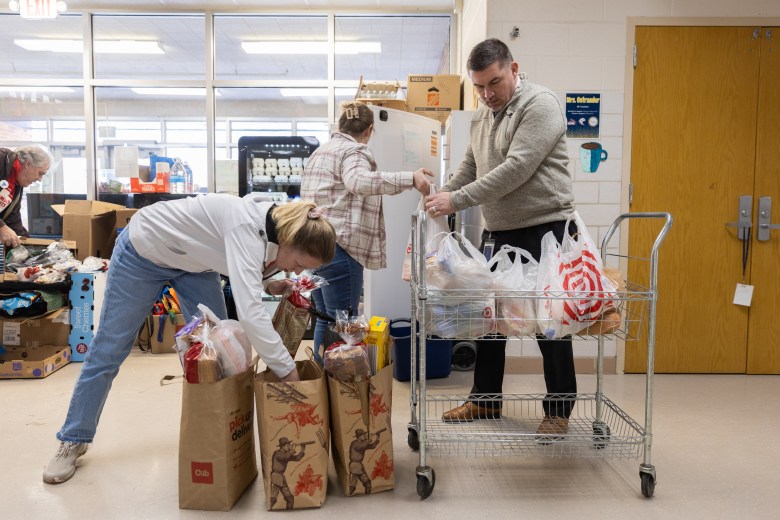
Staff have been bringing food to 140 vulnerable families. Recently, school officials reached out to the Columbia Heights Police Department to ask if their deliveries may be putting families at risk. The response, as Nelson recalled it, was sobering: “Them leaving the house to get groceries is more dangerous, so you keep doing what you’re doing because, ultimately, this is something that’s helping get their family fed.”
On Monday, Minnesota school districts and educators sought an emergency order in federal court to stop immigration operations near public schools because of their potential to traumatize children. The nation’s largest teachers unions, the National Education Association and the American Federation of Teachers, filed a similar motion earlier this month to stop ICE from operating in and around sensitive places, which also include hospitals and churches.
“All students, regardless of race, place of birth, or language they speak, deserve schools that are safe, welcoming and free from fear — no exceptions,” National Education Association President Becky Pringle said in a statement.
Nelson wonders if her district can provide enough social workers and counselors to support students who feel targeted. A pair of therapy dogs recently visited Valley View classrooms, a “wonderful” respite from the tensions the school community has faced, she said.
Her gifted and talented students in grades 3 through 5 know that federal agents shot dead Renée Nicole Good and Alex Pretti in January. When she appeared on television recently to condemn the rise of immigration enforcement in the region, students expressed concern for her. “They’re shooting white people, too,” they told Nelson. “You’ve got to be careful.”
One child told her that he was proud of her but wanted her to be OK. “That’s a fourth grader processing that,” Nelson said. “I told him, ‘Don’t worry about me. You just have fun and learn.’ But that’s how much they know what’s going on.”
In St. Paul, 15 miles southeast of Columbia Heights, Mandi Jung teaches seventh-grade science as part of a local school’s Spanish immersion program. “My students are being directly impacted by ICE. It would be absolutely ridiculous to not talk to them about it,” Jung said.
Attendance has dropped by 50 percent “on a good day,” she said, “and it’s just the white kids and African American students who are coming to school right now.” ICE agents have confronted some of her students on the streets, asking them for identification. They’ve had to explain, “We’re 12. We don’t have identification,” Jung said.

Even students with United States citizenship fear deportation, she said. One girl worried her Spanish surname would make her a target. While Jung told her that citizens should not be deported, she couldn’t guarantee it wouldn’t happen. People with legal status, including citizens, have been detained and deported.
As fear of immigration enforcement keeps undocumented people away from their jobs, the decade-long educator has paid rent for two families — one in December, one in January — after they reached out for help. “I don’t have children of my own, and I’m a social media influencer, so I have extra income. I’m happy to do it,” Jung explained.
She understands the sacrifices families made to get to the United States, she said, asserting that she owes those families “that same level of energy and grit and determination.”
The current political climate, however, has significantly lowered morale at her school. She’s witnessed students have emotional outbursts, break into tears, hide under their hoodies and push cafeteria food around on their plates because they’ve lost their appetites, unable to stomach the chaos in their communities.
“What we’re seeing in middle school is really just sad because they really don’t want anyone to know that their dad is in hiding,” Jung said. “I have one little girl — both her parents were taken.”
When asked where she finds the strength to comfort these children, Jung didn’t hesitate: “From them. There’s no teacher who gets into teaching after Columbine who isn’t ready to die for their kids,” she said. “I will put my body in between any member of the federal government and my students. Maybe it’s that feminine rage, but I have that deep down inside of me.”
The public school district in the Boston suburb of Chelsea, Massachusetts, has lost more than 400 students — or 7 percent of its 6,100-student population — over the past year, according to Kathryn Anderson, a middle-school special education teacher and president of the local teachers union.
“We’ve had a huge loss in enrollment from kids and families leaving the district because they’re trying to avoid enforcement,” Anderson said. “That includes families who are U.S. citizens who are just nervous about how indiscriminate immigration enforcement is now.”
Dozens of students have had family members detained or deported, and district social workers are developing grief groups to support children grappling with loss, Anderson said.

Immigration enforcement, she added, has been more disruptive to learning than the COVID-19 pandemic.
“COVID was relatively straightforward,” she said. “If you were at home, you knew you were pretty safe from the virus itself. Now there’s so much uncertainty. There’s so much fear and anxiety that’s really well-founded. We’ve had kids see people being detained by ICE on their way to school. We’ve had people pulled from their cars in front of their children. It’s really been devastating.”
Some of her middle school students are unafraid to initiate conversations about immigration enforcement, she said, while others keep their feelings to themselves or act out. She keeps her eye on the more withdrawn children, finding it overwhelming at times to ensure that no student in pain goes unnoticed.
Anderson considers this school year to be her most difficult since she began teaching in 2012. She doesn’t know what to expect next from the federal government, but she’s concerned about revocations of Temporary Protected Status and other existing protections against deportation for immigrants. Moreover, Chelsea Public Schools is facing budget shortfalls due to declining enrollment; school districts are funded on a per-pupil basis. This could result in cuts of up to 100 staff positions, or one-eighth of the district’s workforce.
“We need to keep giving kids hope and consistency while facing fear and uncertainty ourselves,” Anderson said. “It’s really hard.”
The National Guard troops and Marines that Trump deployed to the Los Angeles metropolitan area last summer are gone, but ethnic studies teacher Guadalupe Carrasco Cardona said the immigration raids have not let up. Her students and their parents still fear they could be detained or deported at any moment. Many have refrained from going to school.
Cardona’s high school, near Downtown Los Angeles, usually has a long waitlist, but when the current school year started, the waitlist evaporated. In fact, the school has lost over 200 students, causing a budget shortfall that resulted in three teacher positions being cut from the faculty.

(Courtesy Guadalupe Cardona)
When staff visited the homes of students to inquire about chronic absences, they discovered a troubling trend: parents staying home from work to avoid federal agents and their children working to support their families instead.
“We tried to get resources to keep as many students in school as possible, but it’s a daily challenge,” Cardona said.
She shared story after story of students whose lives have ruptured under the weight of immigration enforcement. One senior is considering leaving school to work because her mother has been detained since last year — and she has younger siblings to support. “We have been trying our very best to get her resources so that she doesn’t have to leave school because she’s got excellent grades,” Cardona said. “She contributes. She’s an athlete.”
A family, where only the younger siblings have legal status, is struggling because they can’t make their usual outings together to the park or library. The daughter, she said, is an exceptional student who has already won admission to several film schools, though she almost decided against completing her senior year. “She was afraid to walk to the bus stop from her apartment,” Cardona said. After school personnel arranged for a bus to pick her up directly in front of her home, she continued coming to class.
Dozens of other students have simply stopped coming to school. Some who continue to show up keep quiet about the detentions or deportations of family members because they feel ashamed, Cardona said. “Then you have friend groups where one friend’s dad may have been deported, and now the rest of the friends are worried that could happen to their dad or their mom or their brother.”
Cardona herself fears that ICE might target her son because of his brown skin.
Across her campus, anxiety has spread — but students and teachers have organized. Youths have staged walkouts to protest immigration enforcement, while educators like herself patrol neighborhoods to spot federal agents, informing the community if they do.
“There’s a group of about 15 teachers, before school and definitely after school until all the bus stops are clear, we wait and we monitor to make sure kids get on the bus,” she said. “We are communicating with a cluster of schools, so all the other high schools, middle schools and elementary schools in the area, they’re doing the same thing.”
Taking part in patrols and teaching — Cardona is also an adjunct professor at California State University, Northridge — makes self-care a struggle. She feels exhausted. The effort, she said, is “taking a toll on us and our families.”
For Kat Zamarrón, a music teacher at an elementary school on Chicago’s North Side, the uncertainty of not knowing when ICE might target students or staff has been trying. She serves as her school’s sanctuary team lead, a volunteer role that entails preparing the building for potential immigration enforcement.
Like the other teachers who spoke to The 19th, she’s seen students or their parents disappear at the hands of federal agents. Recently, ICE detained the parent of a student, leaving the child understandably too shaken to attend classes.
“The family doesn’t know where the father is,” Zamarrón said. “He’s not coming up in the detention locator yet.”
Zamarrón is always vigilant. “My phone is always close to me now because I need to know if somebody is reaching out to let me know that ICE is close by. My attention is divided. I’m on alert after school, while at home, and then on alert at school. I was burning the wick at both ends,” she said. She even wrote an emergency plan in case agents detain her as she commutes or defends her students. “It doesn’t matter that I’m a citizen and that I speak English.”
She notices the enforcement’s impact on students in even mundane moments. During recess one day, a student inquired about a helicopter flying overhead — “Is that ICE?” the child asked. (The local police department owned the chopper.) She especially worries about the children who might be keeping their anxieties to themselves, which gets her thinking about the people without legal status who once hid in the shadows to protect themselves.
“There was a period in this country when undocumented people never talked about status,” she said. “It wasn’t just that it didn’t come up — it was, ‘You 100 percent can’t talk about this with anybody. Make sure nobody’s asking questions.’ I think we’re getting closer to that.”