



Hartford is a city that feeds its stray cats. In my neighborhood, schoolchildren practice saxophone on their front porches. A homeless couple helped my family lift our stroller over a snowbank on the walk to our child’s first doctor’s appointment. It is a city of people who show up for one another.
But a city cannot run on neighborliness alone.
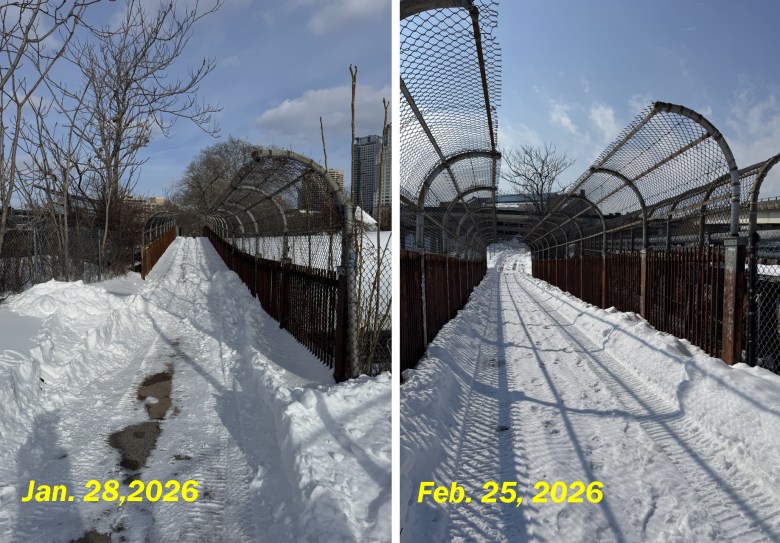
Since this winter’s record-breaking snowstorms, key pedestrian routes –- including the stretch of the East Coast Greenway connecting Frog Hollow to downtown -– have remained unshoveled for weeks. What should be a vital, heavily used route connecting neighborhoods became an icy obstacle course in a neighborhood where 36% of residents do not own a car – one of the highest rates in the state. For weeks, it has cut off safe access to work, services and transit.
The problem is not snow. The problem is accountability.
If the state expects Hartford to function as its civic front door, it must fund that responsibility accordingly. The state owns much of the infrastructure surrounding these gaps. It should own the responsibility for maintaining them.
In the 33-response email chain that I initiated –- with some officials still silent – I tried to determine who was responsible for clearing this stretch of sidewalk. The result was a bureaucratic loop of finger pointing. The city’s Parks and Public Works departments did not respond. Amtrak said it was the state’s responsibility. State offices denied involvement. The Connecticut Department of Transportation pointed back to the city. Hartford 311 advised contacting Amtrak about a maintenance agreement with CTDOT — while reiterating that the city does not maintain the property.
>Who was responsible? The answer is no one.
This is not an isolated issue. Sidewalks near highway ramps and under bridges currently remain unshoveled and sheathed in ice weeks after the storm. In the summer, some underpass sidewalks become impassable as weeds grow unchecked. These gaps determine whether a person can safely reach Union Station, a bus stop, a job or a medical appointment.
When no agency can clearly explain who is responsible for maintaining a public walkway, governance itself becomes the obstacle.
The solution does not require inventing a new policy. It requires clarity and leadership. If the state bears legal responsibility, it should say so and act. If responsibility is shared or disputed, then one elected official should step forward and ensure this corridor is cleared while the paperwork catches up.
Hartford deserves leadership – at both the city and state level – that treats public space as a basic obligation, not an afterthought. If we expect residents to raise families here, build businesses here, and invest in its future, then the institutions that govern it must be accountable in return.
A sidewalk cannot belong to everyone in theory and no one in practice. The governor and the mayor both know this stretch exists. It is time for one of them to own it – publicly, clearly, and before the next storm hits.
Leah Beckett is a Hartford resident and city planner at IMEG, the founder of Herd Supply Co., and co-owner of Beckett Farms.