


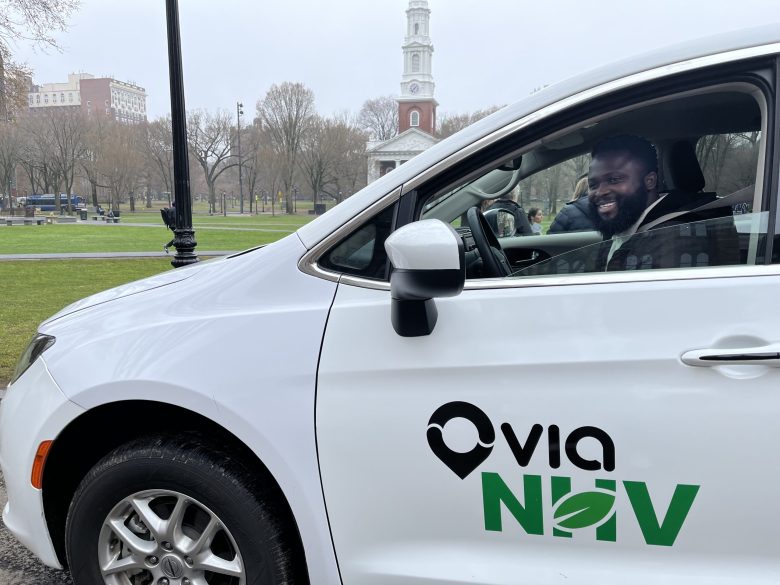
Transportation leaders and town officials expressed broad support Monday for a bill that would continue to provide state funding for microtransit ride-hailing services across Connecticut.
Legislators on the Transportation Committee heard testimony on Senate Bill 9 Monday at a public hearing in the Legislative Office Building in Hartford. As the two-year pilot program is set to expire at the end of June, the Transportation Committee proposed extending the program for another year and providing state funding totaling $9 million from the Special Transportation Fund for the effort.
More than 370 people submitted written testimony on the bill. None opposed it.
The services in Connecticut began in spring 2024 when Gov. Ned Lamont and the Connecticut Department of Transportation awarded $19.5 million to support ride-hailing services in nine transit districts and municipalities.
The program operates similarly to Uber or Lyft, but the prices, $0.85 to $4, are similar to that of public transportation because of the state subsidies. The rides often connect people to other forms of public transit or fixed route transportation.
Haley Simpson, director of Transportation, Traffic and Parking in New Haven, said microtransit has become essential for New Haven residents, particularly youth and senior populations and those who are most vulnerable, lack a car or have a disability.
“Seventy-three percent of riders in New Haven don’t have access to a personal car, and 41% have a household income of less than $50,000, so microtransit fills a critical transportation gap for those residents with a fare of 85 cents for low income or senior riders,” Simpson said.
Out of the $19.5 million funding, New Haven received $3.1 million to fund Via NHV. The New Haven program began in March 2025, and since then, it has completed some 45,000 rides, Simpson said.
Another transit program called XtraMile services microtransit in Middletown, East Hampton, Madison and Guilford. It costs $1.75 for one way and began in May 2024 at the start of the pilot program funding.
Peggy Lyon, the first selectwoman in the town of Madison, said her town does not have any fixed route transportation and residents of all ages have come to rely on the services, especially to access regional transportation links including Shoreline East.
“Most Madison residents would need to walk many miles each day to reach public transportation,” Lyon said, noting that the landscape of the town, 12 miles from the shoreline to the north, does not make public transportation easily accessible compared to other districts in the state.
Between Guilford and Madison, Lyon said, the senior centers regularly book trips for their seniors to get to medical appointments, and middle- and high school students use the services to get to after-school activities and jobs.
“Without the passage of S.B. 9, we risk abandoning a proven investment that serves our most vulnerable residents and discourages a new generation of public transit riders,” Lyon said. “I think this is the future of public transportation in many ways.”
Guilford and Madison are a part of the River Valley Transit, which runs three of the pilot programs. Joe Comerford, executive director of the River Valley Transit, said that nearly half of the trips are for individuals getting to work, largely retail employees, nursing assistants, home health aides and hospitality workers.
“It’s the people who keep our economy running,” Comerford said.
Both XtraMile and Via New Haven are supported by Via Transportation, one of three companies in the state that are contracted to provide the software and transportation service support.
Jeremy Tillunger, director of public policy at Via, said when you stop services completely, it fractures trust in the thousands of riders who use the service.
“It is something they grow to rely on, and this is why it is so critical that this funding is maintained,” Tillunger said.
Microtransit is not a replacement of other fixed route services or other forms of more sustainable public transportation. If there is a bus or train that is coming close to the location that someone is requesting a microtransit ride, the algorithm prompts them to use public transport instead, Tillunger said.
Advocates said microtransit fills the gap for other forms of public transportation, especially at non-peak times when buses are running less frequently.
Garrett Eucalitto, the commissioner of the Department of Transportation, spoke in support of the bill but said that the $9 million in the bill’s language would be insufficient to continue all current programs and would require at least $10.5 million, according to CT DOT’s estimates.
He said CT DOT cannot support the language of the proposal because Lamont’s proposed FY27 budget adjustments do not include funding for this extension.
While Sen. Tony Hwang, R-Fairfield, said he supports the idea of microtransit, he said the added funding is a point of concern as they have not calculated the budget bonding implications and special transportation fund shortfall.
“We need to maintain and move on a steady predictable funding mechanism for these projects to continue toward completion,” noting that if the Department reallocates money from other ongoing transportation infrastructure projects, it could also have downside effects.
Eucallito agreed there “is a whole bunch of different red tape around transportation funding” and said Connecticut is unique in that the entire microtransit service is funded by the state.
“However, I do agree there are benefits that come from microtransit, especially for unserved and underrepresented areas that have historically not had fixed route public transportation,” Eucalitto said.