



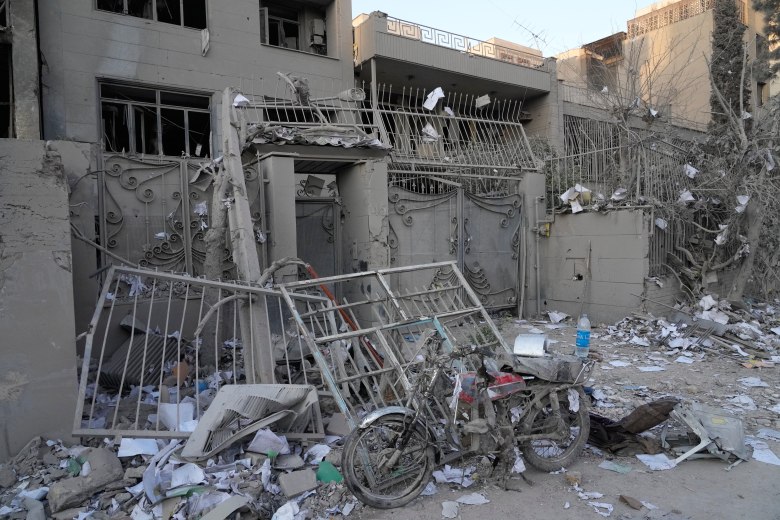
As conflict escalates in Iran with reports of American casualties, Connecticut’s federal lawmakers are warning of a prolonged war that could spread throughout the Middle East “without clear objectives” and economic consequences that could exacerbate cost-of-living issues in the U.S. in the long term.
President Donald Trump’s latest unilateral military action has once again put a spotlight on the debate over war powers. Back in June, his administration struck Iran’s nuclear facilities. Now, eight months later, the U.S. and Israel launched a coordinated military action that killed Iran’s Supreme Leader Ayatollah Ali Khamenei. And nearly two months ago, the U.S. captured Venezuelan leader Nicolás Maduro.
While presidential administrations in both parties have chipped away at Congress’ war powers over time, Democrats and some Republicans want to reassert their authority on military action and compel Trump to come to Congress to get approval for such strikes. Members of Connecticut’s delegation have received varying amounts of information as they’ve sought more answers on Trump’s goals with Iran.
Unlike the previous strike against Iran last summer, U.S. Rep. Jim Himes, D-4th District, has been kept more in the loop this time by Trump administration officials. He’s a member of the “Gang of Eight” because of his role as ranking member on the House Intelligence Committee and gets some of the earliest intelligence information in Congress.
When the U.S. bombed Iran’s nuclear facilities last June, Himes found out about it on social media. This time, Secretary of State Marco Rubio and CIA Director John Ratcliffe gave the Gang of Eight a closed-door briefing last week. Ahead of the strike early Saturday, Rubio called them to say that the administration was proceeding with military action.
“I’ll give the administration points for reaching out to Congress a little bit more aggressively prior to the [previous] Iran and Venezuela strikes,” Himes said after his initial briefing on Iran, which he received hours before Trump’s State of the Union address.
Still, Himes — along with many of his Democratic colleagues — argues the administration should have come to Congress for a vote to authorize an attack on Iran.
Himes said leaders in both parties haven’t learned the lesson that conflict in the Middle East “just ends presidencies” and puts Americans at risk.
“There’s something about the Middle East, from Benghazi to Afghanistan … Very few presidents can resist making the same mistake over and over and over again, which is to get involved in military action,” Himes said in an interview last week. “The fact of the matter is there’s immense risk to our men and women.”
While criticizing the Iranian regime that has been in place since 1979, the congressman said the public will need to determine if America should “be in the business of being the world’s policeman” and pursuing regime change in the Middle East, especially after Trump promised no “forever wars” as part of his foreign policy doctrine during his reelection campaign.
“Now, in the coming weeks, as we see whether there is, in fact, regime change — something you might be doubtful about — Americans will begin to decide whether this enormously expensive and risky operation was, in fact, worth it, if it doesn’t actually change the regime, in the same way that the regime has actually not been changed in Venezuela,” Himes told NPR on Sunday.
The cost of a prolonged conflict in the Middle East has also been the subject of criticism among Connecticut Democrats at a time when energy prices are rising.
U.S. Sen. Chris Murphy, who sits on the Senate Foreign Relations Committee, has framed a mushrooming regional conflict as an economic issue that would have a disproportionate effect on working families.
In a social media post, he linked it back to a domestic issue that Congress has yet to resolve. He argued that the cost of a war with Iran would likely be more than the cost of renewing the enhanced Affordable Care Act subsidies that expired at the end of last year.
“We’re not getting regime change to a democracy. We’re not going to eliminate their nuclear program. We are going to have regional war breaking out. It won’t be the billionaire kids of Donald Trump and his buddies that die. It’s going to be the children of middle class and poor families all across this country who are going to die for a war of choice, a war of vanity, an illegal war,” Murphy said Sunday on CBS’ “Face the Nation.”
With ongoing bombardment from the U.S. and Israel and the retaliatory strikes from Iran, oil prices have shot up. Affordability has become one of the driving issues ahead of the November midterm elections where control of Congress is at stake.
“Americans are demanding help with the cost-of-living crisis, but President Trump would rather start another war, potentially driving up energy prices, than listen to them,” U.S. Rep. Rosa DeLauro, ranking member on the House Appropriations Committee, said in a statement.
In the short-term, the U.S. would see minimal impacts in this arena. Purba Mukerji, a professor of economics at Connecticut College, said that oil and LNG shipped out of the Middle East around Iran affects parts of Asia and Europe in particular. She noted that the U.S. has been bringing in larger oil shipments and has oil reserves in anticipation of hostilities with Iran.
But if the conflict dragged on beyond a month, the U.S. would feel more of the effects. Beyond fuel, Mukerji said, the U.S. gets a lot of fertilizer from the Middle East, which can impact the upcoming planting season.
“In about a month or so, things will start to get difficult, and we’ll start to see the rising prices, and that’s why I think it’ll be wrapped up before that,” Mukerji said. “We would see the increase in oil prices that would then seep into inflation.”
Trump said operations in Iran could last up to four weeks, “and they will continue until all of our objectives are achieved.” Both the president and his top officials said they’ll work to minimize more deaths of U.S. troops, but there will “likely” be more before the operation ends.
“This is not a single overnight operation. The military objectives that (U.S. Central Command) and the Joint Force have been tasked with will take some time to achieve, and in some cases will be difficult and gritty work. We expect to take additional losses, and as always, we will work to minimize U.S. losses,” Chair of the Joint Chiefs of Staff Gen. Dan Caine said at Monday’s press conference alongside Defense Secretary Pete Hegseth.
Speaking to reporters from Connecticut, U.S. Sen. Richard Blumenthal, D-Conn., called it a “war of choice” that rejected diplomacy. From the information currently provided to him, the senator said he saw no imminent threat to the U.S. or its regional allies. He called for both a briefing and a vote on a war powers resolution to rein in the president on further military action.
“We are in the midst of a spreading, apparently prolonged war in the Middle East, it’s spreading to the entire region with unknown costs and unspecified objectives,” Blumenthal said Monday morning. “The consequences to the global economy may be disastrous, but foremost in my mind is the safety of our men and women in uniform in the region.”
The Constitution grants the legislative branch the ability to “declare war.” The War Powers Act of 1973 requires a president to notify Congress within 48 hours of military action if there is no declaration of war and limits military deployment to 60 days unless Congress authorizes force. A war powers resolution would make Trump seek approval from Congress on further military action in the region.
Last summer, the U.S. Senate blocked a war powers resolution on Iran following a previous strike in the country. But with support from a few Republicans, the GOP-led Senate approved a war powers resolution to limit Trump in Venezuela.
The U.S. House plans to take up a bipartisan version of a war powers resolution regarding Iran as soon as this week after lawmakers return to Washington on Wednesday.
Himes described a measure that would “require the withdrawal or the cessation of hostilities against Iran until there is a authorization given by the Congress.”
“Whatever you think of the Iranian regime or the action taken so far, this is what the Constitution demands,” Himes told NPR. “And so, yes, there will be such a vote, and I will vote in favor of stopping hostilities or pausing them until the Congress authorizes this military activity.”
But war powers resolutions still face hurdles in a Republican-controlled Congress.
House Republicans could vote to table, or block, the measure. And even if if got through the House and Senate, Trump can veto the resolution. And it would be a tall order for Congress to override that veto, requiring a two-thirds majority.
Blumenthal described the war powers resolution as essentially an enforcement mechanism that “would force the president to come to Congress if you’re going to continue this war.” He’s pushing for a vote on it and would support it.
War powers resolutions, however, have not been particularly effective since one was used in the 1970s during the Vietnam War era and Congress was “uniquely united” to prevent Richard Nixon from using force in southeast Asia. At the time, Congress successfully overrode Nixon’s veto.
“Since the war powers resolution was passed in 1973, it’s never been successfully implemented. Using those mechanisms, Congress has never been able to prevent a president from using military force,” said Eric Fleury, an associate professor of government and international relations at Connecticut College.
Fleury said one of the most recent examples of a president seeking congressional approval was Barack Obama in 2013 for a strike against Syria over its use of chemical weapons, but it didn’t go anywhere.
“In this day in age, the exercise of presidential power is very much bound up with the use of military force,” Fleury said. “As much as I find bad-faith and cynicism in what the Trump administration is doing, they are certainly part of a tradition of using the power of the executive willy-nilly, and more often than not, getting away with it, at least from an institutional standpoint.”
While much of the focus has been on a war powers resolution, Murphy said Democrats should also demand a vote on an Authorization for Use of Military Force, or an AUMF, in Iran.
“If a War Powers Resolution becomes the way we debate war, then the burden is forever shifted. Instead of the president seeking approval before starting war, the opponents need to muster the votes to stop it. That’s not how our founders designed it,” Murphy posted on X.
When it comes to American boots on the ground in Iran, Blumenthal, who has been critical of the regime and a strong supporter of Israel, said he’s opposed.
The delegation has taken umbrage with all of Trump’s military actions over the past year, but many see the latest strikes in Iran differently.
Blumenthal said the strike in Venezuela that led to the capture of Maduro and his wife was ultimately limited in nature. And he pointed out that after initial strikes in Iran last year, the administration touted the military obliterated Iran’s three nuclear facilities, an assessment at the time that drew contrasting reactions from Democrats and Republicans.
“I will oppose American troops involved in Iran risking another forever war. American boots on the ground is clearly contrary to what Americans want. This potential risk of another forever war is exactly what Donald Trump said he would not do, against the clear wishes of the American people,” Blumenthal said.
“A nuclear-armed Iran is unacceptable. Building missiles that can reach the U.S. should be stopped,” he continued. “But the president has offered no explanation for how those objectives are going to be achieved.”
The Connecticut Mirror/Connecticut Public Radio federal policy reporter position is made possible, in part, by funding from the Robert and Margaret Patricelli Family Foundation.
