



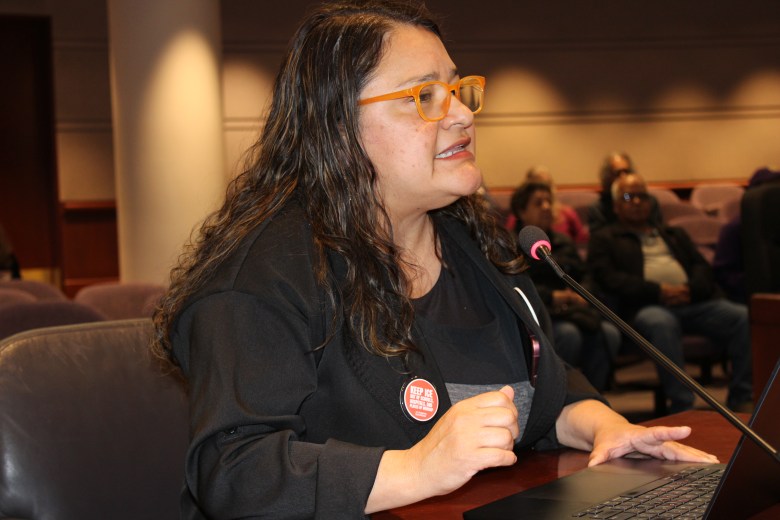
Hundreds of people testified in support of a series of bills before the Connecticut legislature that seek to limit immigration enforcement operations in the state and create methods for people injured by those agents to seek compensation.
Senate Bill 91, proposed by Gov. Ned Lamont, gives the Inspector General authority to investigate use-of-force incidents involving federal law enforcement agents, including immigration officials. It also creates “protected areas” — including schools, medical facilities and places of worship — where law enforcement cannot take someone into custody based on a civil offense, including immigration detainers.
Members of immigrant advocacy groups — including CT Students for a Dream, Husky 4 Immigrants and Comunidades Sin Fronteras — along with teachers and faith leaders testified in support of the bill at a hearing that stretched for hours Monday at the Legislative Office Building in Hartford.
“Families should be able to pray at church services, attend community meals or mosques or synagogues, and gather for holiday celebrations without worrying that law enforcement actions are outside the door,” said Norma Martinez HoSang, director of the Connecticut for All Coalition. “Patients should feel safe going to hospitals for emergency treatment, taking their children to pediatric checkups, or visiting community health clinics for vaccinations and prenatal care.”
In January 2025, the Trump administration reversed guidance preventing immigration enforcement agents from arresting people in schools or churches. At the time, a spokesperson for the U.S. Department of Homeland Security said in a statement that the change would make it so that “criminals will no longer be able to hide in America’s schools and churches to avoid arrest.”
People who testified to Connecticut lawmakers Monday told stories of immigrants and their children living in fear. A number of teachers from the New Haven Public Schools submitted testimony recounting students not coming to school or having to deal with their parents being detained while they were at school.
“In New Haven and other Connecticut municipalities, we have been concerned by a drop in enrollment by multilingual learners this year,” wrote New Haven Superintendent Madeline Negron. “Fear is a barrier to entry. When students are afraid that their parents might be detained during a morning drop-off, they cannot learn.”
Camila Bortolleto, a steering committee member for Husky 4 Immigrants, which advocates for expanding healthcare to unauthorized migrants, said many immigrants are afraid to get medical care. Doctors who submitted testimony warned this could worsen medical conditions or result in more people seeking care at hospital emergency departments.
[RELATED: Immigration enforcement drives health concerns in CT]
“We cannot allow people to not feel safe seeking health care because then they are less likely to come, and one day will end up in the Emergency Department due to neglected care. Illnesses don’t go away just because people don’t show up,” Andrew Nunno, a doctor in New Haven, said in written testimony.
Rep. Craig Fishbein, R-Wallingford, questioned where the lines should be drawn when it comes to immigration enforcement in the state. He said some people seemed to be asking that there be no enforcement at all, and he asked how then should the U.S. address immigrants who entered the country illegally.
Fishbein said he understands immigration enforcement can tear families apart, particularly in a family where parents entered the U.S. illegally and had a child in the U.S. But he pointed out that some immigrants who come to the U.S. commit crimes. “The individual who comes here to terrorize our communities … I’ve got to look at families that are ripped apart by those crimes,” he said.
Rep. Patrick Callahan, R-New Fairfield, said immigration agents were doing their jobs, exercising laws that had been passed in Congress.
“If change is needed, maybe Washington is the place you should go,” Callahan said.
Sen. Gary Winfield, D-New Haven, said he didn’t dispute that there should be systems in place for immigration enforcement. But he said that following the creation of the Department of Homeland Security — in response to the 9/11 terrorist attacks on the Twin Towers — the agency had “gone too far.”
Winfield also criticized the failure of Congress to enact functional immigration policies, and he pushed back against the assertion that the majority of people arrested by ICE are dangerous criminals.
“We need to have a system that works better, a system that respects rights and a system that more hews to who and what we say we are,” said Winfield.
Accountability for ICE
Connecticut Inspector General Eliott Prescott told lawmakers at Monday’s hearing that he supports the governor’s proposal. He said it made sense for his office to take on the role of investigating use-of-force incidents involving federal agents and that his staff is already equipped to do so.
“ The state has the sovereign right to enforce the criminal laws against federal agents regardless of what agency they work for,” Prescott said.
Rep. Greg Howard, R-Stonington, said he was concerned about how initial findings by the inspector general regarding the use of deadly force might affect the public’s perception of whether an officer was justified before more conclusive findings were determined.
He also questioned a recent memo the inspector general sent to local law enforcement agencies asking that his office be alerted to ICE activities, even in cases where no deadly force was employed.
But Rep. Steve Stafstrom, D-Bridgeport, said the purpose of the Office of the Inspector General is to provide assurance to the public that investigations into the use of deadly force by law enforcement aren’t biased. He noted that the office rarely finds that use of force by a police officer was unjustified.
Rep. Renee LaMark Muir, D-Deep River, inquired how the inspector general would go about holding federal agents accountable for violating Connecticut laws if their agency wasn’t cooperative.
Prescott said his office was concerned about that — particularly which agencies would have access to any crime scene.
He said that in Minnesota, local and state officials were denied access to the scene where Renee Good was killed, and they petitioned the federal court for an order forcing the federal agency to cooperate. He said the proposed legislation specified that his office and the state Division of Criminal Justice would have access to evidence.
“Look, we want cooperation between the federal government and state law enforcement officers,” Prescott said. “It should be a partnership and that’s what we hope it will be.”
People in support of the governor’s bill also spoke in favor of a second bill, S.B. 397, which opens a way for citizens to sue federal law enforcement agents for violations of their constitutional rights through the state Office of the Attorney General. The bill was proposed following to the January shooting of Alex Pretti in Minneapolis by a U.S. Customs and Border Patrol officer.
The bill would also remove qualified immunity for officers who assault or falsely arrest someone who is recording them as they work.
The 1971 U.S. Supreme Court case Bivens v. Six Unknown Named Agents of the Federal Bureau of Narcotics found that individuals have the right to sue federal officials for damages relating to violations of their constitutional rights. But the court has not allowed a lawsuit under Bivens to proceed in more than 30 years, and a 2017 U.S. Supreme Court decision applied further restrictions.
Saifullah Khan, an immigrant from Afghanistan and former Yale University student who was expelled after being accused of rape, told lawmakers that he allowed his visa to lapse for a few months and then applied for asylum. Khan, who was acquitted of the rape charge in federal court, said he was attending a recent immigration hearing in Hartford when he saw unmasked federal agents in the hallways. He said they “lunged” toward him and he ran away. The agents then tased him, he said.
Khan has filed a $70 million claim against U.S. Immigration and Customs Enforcement. But he said in testimony before the Judiciary Committee Monday that the U.S. Supreme Court had made it all but impossible for a citizen to succeed in a claim against the federal government.
Khan said the bill didn’t create any new obligations, it simply reiterated the limitations that ICE agents were already subject to regarding the use of excessive force.
“It is a necessary and constitutionally appropriate exercise of state legislative authority,” Khan said.
If adopted, Connecticut would join several other states that have enacted similar laws, including California, Massachusetts, Maine and, most recently, Illinois.
