



In classrooms across Bridgeport, the effects of years of budget strain are visible in ways that go far beyond numbers. They show up in crowded classes, stretched staff and the daily adjustments educators and families say they are forced to make in a district that has spent decades fighting to maintain resources.
Leaders from Bridgeport Public Schools say the city’s schools are once again confronting a difficult budget season, shaped by what district officials, lawmakers and advocates describe as chronic underfunding compared with wealthier neighboring communities.
Earlier this month, the Bridgeport Board of Education voted 6–2, with one abstention, to request an additional $106 million for next year’s budget. While the figure may sound startling, those closest to the issue say it reflects the scale of need after years of cuts that have hollowed out staffing and programs.
In November 2024, Bridgeport Public Schools announced it was facing a roughly $38 million deficit for the 2024–25 school year, driven by the expiration of federal COVID-19 relief funds, flat city funding and rising special education costs. District officials said they would work to close the gap by “downsizing and reevaluating all positions, programs and services,” using $14 million in reserve funds, charging $6.5 million in expenses to grants and reducing costs by more than $10 million.
In April 2025, the school board voted for more cuts, including the loss of 20 teaching positions, kindergarten paraprofessionals, busing for over 2,000 students, a performing arts program and all the district’s librarians.
The financial strain has continued beyond those budget cycles.
Bridgeport Public Schools serves roughly 20,000 students and operates with an annual budget of about $294 million. District leaders warn that without additional state funding, the system could face a projected $45 million shortfall this year too, raising concerns about potential staffing reductions, program cuts and continued reliance on one-time funding sources.
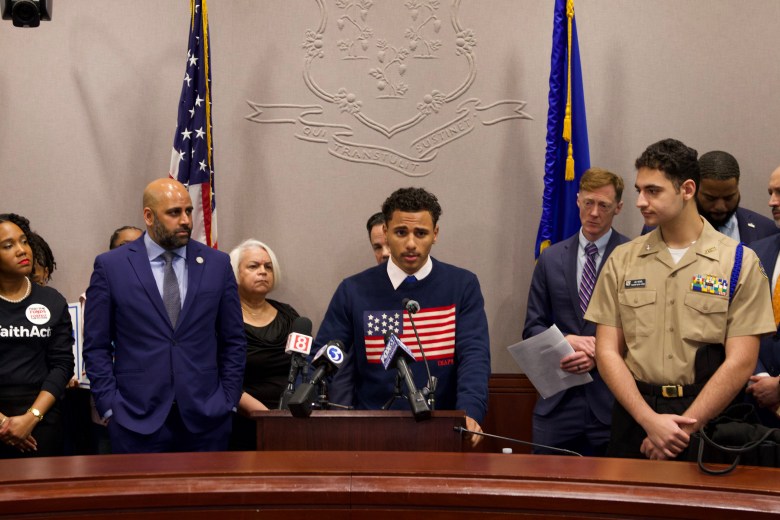
Bridgeport Public Schools Interim Superintendent Royce Avery said the funding push is not happening in isolation. At the state Capitol, superintendents, administrators, students and community leaders from across the state recently gathered to advocate for changes to Connecticut’s Education Cost Sharing formula.
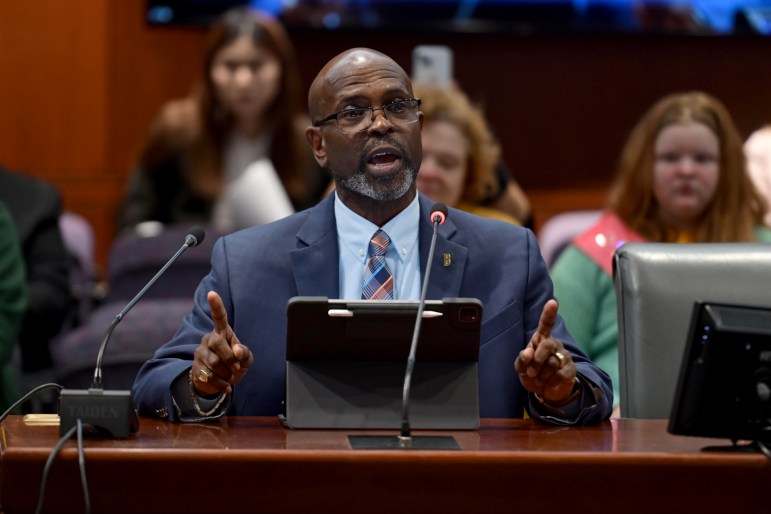
“This morning’s event is an opportunity for collaboration across Connecticut,” Avery said. “You have superintendents, their administrative staff, students, community members and the faith community all here in Hartford advocating for ECS funding increases… to make sure that we can push our legislators and the governor to provide additional dollars to school districts across Connecticut, and especially for Bridgeport.”
For Bridgeport students, he said, the stakes are high.
“It will give our kids additional advantages that they don’t have currently due to the fact that we don’t have enough dollars to stretch across all the aspects of the needs that we have in Bridgeport,” Avery said. “It will give our kids a fighting chance to be part of a productive community that I know Connecticut is trying to strive for.”
The superintendent pointed to the fact that the state’s ECS formula has gone largely unchanged for more than a decade.
“That ECS formula has not been touched in about 13 years, and the time is now,” he said. “We can’t wait any longer.”
The urgency is heightened by what district leaders say is already at risk. Avery said the district cut nearly $40 million from its budget last year and could face another $45 million in reductions if state funding is not increased.
“We have nothing else to cut,” he said. “That means cutting teachers, cutting programs, cutting curriculum and after-school programming. Those types of things are detrimental to students.”
Rep. Antonio Felipe, who represents Bridgeport’s 130th District, said closing the gap in education funding is the single most important measure of success for his district this legislative session.
“Right now, we’re going to have a massive budget hole going into the next year, and that’s just to maintain the services we have,” Felipe said. “That’s not to get our paraprofessionals back. That’s not to figure out how to lower classroom sizes. That’s just continuing with the status quo.”
Felipe said Bridgeport is not asking for luxury, but parity.
“We need to bridge that gap at least, and hopefully put a little bit of money in the coffers so that Bridgeport kids can learn like kids even in neighboring districts like Fairfield and Trumbull,” he said.
For Joseph Sokolovic, vice chair of the Bridgeport Board of Education, the state budget conversation is inseparable from what students carry with them into school each day.
He pointed to a proposal from Gov. Ned Lamont to fund universal free breakfast for students across Connecticut, but said the plan does little to address the challenges districts like Bridgeport already face. Because many urban districts already qualify for federally funded free meal programs, Sokolovic said the proposal would have limited impact locally while broader funding issues remain unresolved.
“In places like Bridgeport, hunger isn’t just a word. It’s a daily reality,” Sokolovic said. “Every morning, kids walk into school carrying more than just backpacks. They carry stress. They carry uncertainty. And far too often, they carry hunger.”
Sokolovic stressed that feeding children should never be controversial but warned that policy proposals can sometimes obscure how programs are funded and who ultimately absorbs the costs.
“Long before this promise, low-income children in every district were already eligible for free breakfast through federal programs,” he said. “In urban districts like Bridgeport, that access was already universal.”
What concerned him, he said, was how new initiatives are funded.
“No new investment is made,” Sokolovic said. “It’s just a trade hidden in the fine print.”
Students say the impact of the budget strain is visible throughout their schools.
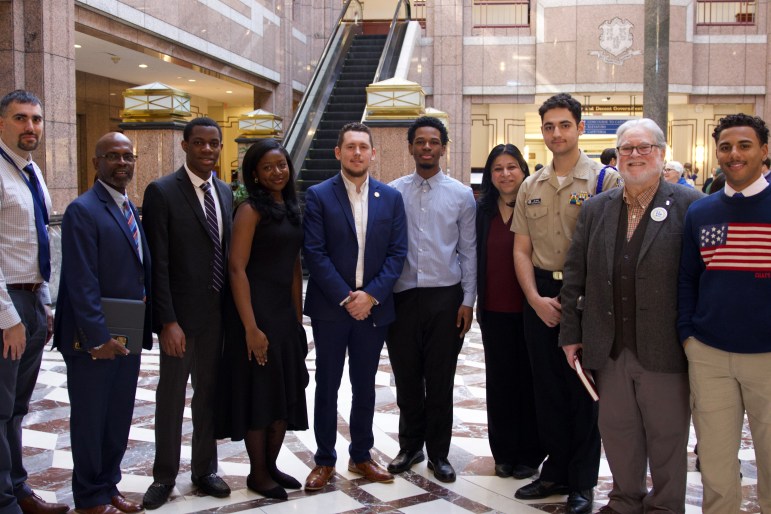
Anika Fazal, a 16-year-old junior at Fairchild Wheeler Interdistrict Multi-Magnet High School, said the effects are felt in staffing shortages and limited student support.
“I feel like there’s so many issues with technology and things of that nature,” Fazal said. “I think there’s a lack of support staff. Our school used to have like eight counselors, and now we’re down to like three. So obviously students are really feeling those cuts.”
She said the size of the school population compared with the number of staff members can make it difficult for students to find help.
“There’s more than 1,000 students and only three administrators,” she said. “When you have issues and you want to advocate for yourself, there’s not always someone there to hear you.”
Fazal also pointed to outdated learning materials and missing teachers.
“Our textbooks are kind of outdated, especially history textbooks,” she said. “Right now there’s no chemistry teacher at my school, and people are learning through an online platform. If you’re learning something as intensive as chemistry online, you might not walk away with as much information as you want.”
For her, the changes have been noticeable over time.
“As a freshman I came in and saw a fully stocked school,” Fazal said. “We had our counselors, social workers and support staff. Now as I’ve gotten older, a lot of those things aren’t available anymore.”
Other students say the loss of staff can shape the entire school experience.
Israel Prevail, an 18-year-old senior at Fairchild Wheeler, said the district’s cuts included paraprofessionals and librarians who played key roles in students’ lives.
“I was close to my librarian,” Prevail said. “She shaped who I am as a person from the books that she gave me. Without her, I don’t know who I’d be, so I can only imagine a child that lacks that librarian.”
Over time, he said, students have learned to adapt to fewer resources.
“We don’t rely on the state anymore,” he said. “We rely on ourselves.”
Jad Abou Hayka, a 17-year-old senior at Bridgeport Military Academy, said funding challenges also affect school facilities and infrastructure.
“The main issue that we have is we don’t have a school,” he said, referring to the academy’s smaller, aging building with ongoing maintenance issues.
Next year, the academy is expected to share space with Fairchild Wheeler while awaiting a permanent facility. Even in its current location, Abou Hayka said students deal with basic problems like heating and air conditioning.
“We have a bunch of issues with heating and AC,” he said.
Still, he said investing in Bridgeport schools is about more than buildings or programs.
“They’re not only investing in Bridgeport education,” Hayka said. “They’re investing in the future of this city and this state, because we’re going to be the leaders of tomorrow.”
City leaders say they are trying to contribute where possible, though they argue the core responsibility lies with the state.
Mayor Joe Ganim said the city is committing what he described as the largest local education funding increase in Bridgeport’s history — $10 million over two years, or $5 million annually. The city’s contribution to the Bridgeport Public Schools operating budget for the 2025-26 fiscal year was roughly $81.7 million, including a $3 million increase that year and about $15 million in total increases over the past six years.
“I’ve never seen this type of unity around this being a top priority, defining moment type of thing,” Ganim said. “The city is going to make its largest contribution annually… a two-year commitment totaling $10 million, $5 million a year.”
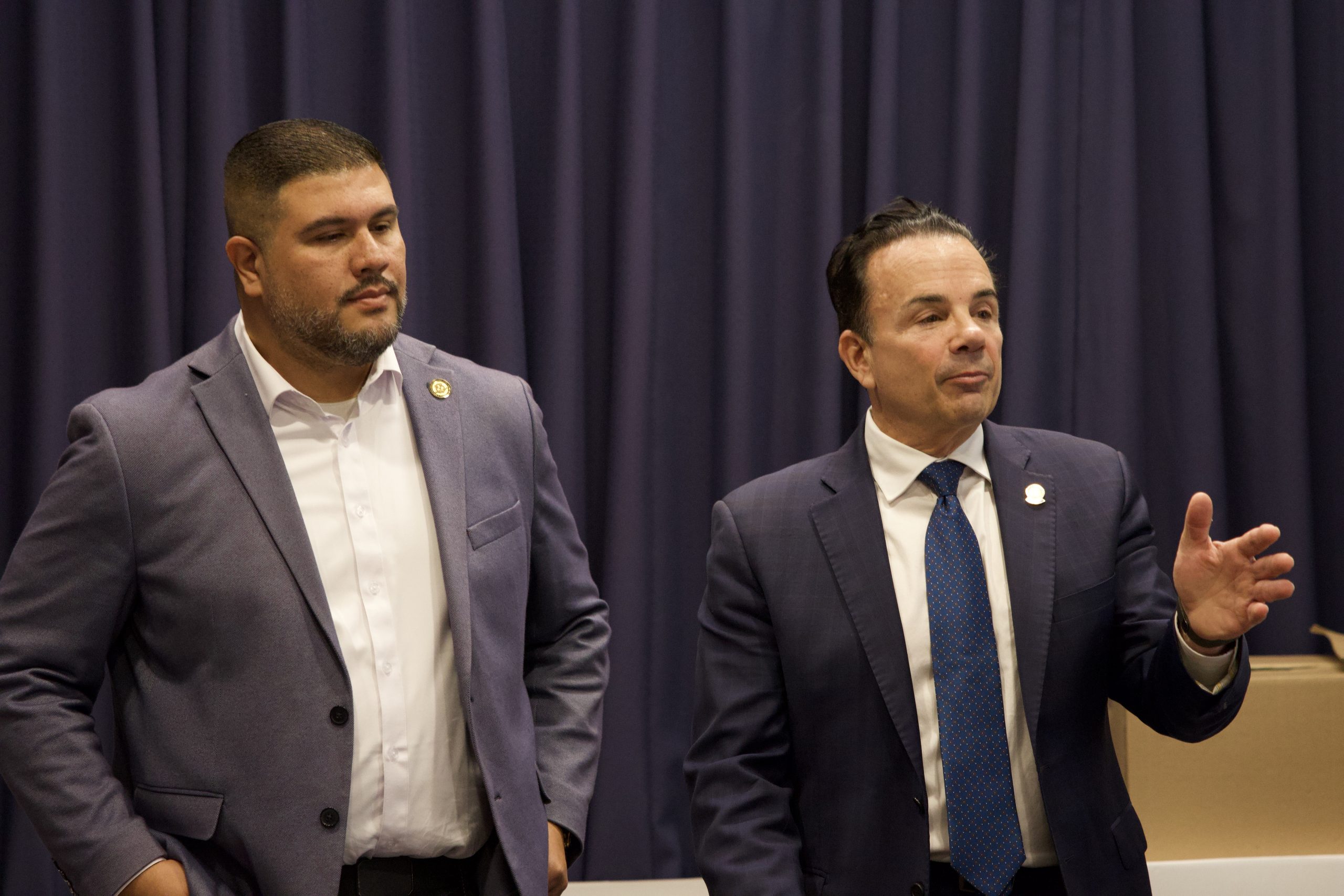
But Ganim said municipal funding alone cannot solve the broader issue of education finance in Connecticut.
“This underfunding issue historically for Bridgeport has been something we’ve been shouting about for decades,” he said. “The legislature needs to put this in place.”
He also pushed back on the idea that cities like Bridgeport can simply raise local taxes to make up the difference.
“The reliance on the property tax is a regressive form of tax,” he said. “You can say ‘just raise property taxes,’ but in the real world that’s not a good idea.”
Special education costs, he said, place additional pressure on the district budget.
“The cost is enormous,” Ganim said. “Sometimes it’s over $100,000 per student when you factor in services and transportation.”
Advocates say those pressures exist within a larger structural problem in Connecticut’s school funding system.
Bobbi Brown, president of the Greater Bridgeport branch of the NAACP, said the state’s Education Cost Sharing “foundation” amount has remained frozen at $11,525 per student since 2013.
“That number has not been meaningfully updated,” Brown said. “Transportation costs have increased. Health insurance has increased. Utility, staffing, technology demands and special education expenses have all increased, yet the foundation amount has remained the same.”
If the foundation level had kept pace with inflation alone, she said, it would be closer to $16,000 per student today.
“When we freeze the foundation, we freeze opportunity,” Brown said. “And in districts like Bridgeport, where the majority of students are students of color, that freeze sends a clear and troubling signal. This is not a simple budget issue. It is a racial equity issue.”
For parents, the consequences are deeply personal.
“In our communities, parents are asked to fill gaps that should never exist,” said Chaila Robinson, whose children attend Bridgeport public schools. “We pull what little we have, holding fundraisers and writing letters to businesses just to afford basic supplies like paper, pencils and classroom materials.”
She described the emotional toll when students cannot participate in opportunities that peers elsewhere may take for granted.
“It is painful to explain to my child why they can’t go on a field trip when it’s simply a lack of money,” Robinson said.
She said the frustration is compounded by accountability systems that hold all students to the same academic benchmarks regardless of resources.
“Our children are held to the same standards as students in wealthier districts, yet the resources provided are not equal,” she said. “We can’t expect the same outcomes while offering unequal funding, staffing, materials and learning environments.”
Her message, she said, is not about lowering expectations but meeting them fairly.
“Equity does not mean lowering expectations,” Robinson said. “It means providing equal access to opportunity.”
District leaders, advocates and students say Bridgeport’s latest funding push is about ensuring that opportunity.
“Students are our future,” Fazal said. “If we’re not educated, how are we going to vote? How are we going to go into life?”
For Robinson, the principle is simple.
“Education is a state responsibility,” she said. “If we truly believe in equal education under the law, then our funding must reflect that belief — because our children’s future should never depend on the color of their skin or the zip code they call home.”
