


About 1,900 pieces of written testimony were submitted in opposition to a bill that would ban the sale of certain handguns and pistols that have the potential for conversion into automatic firearms.
The bill, which was proposed by Gov. Ned Lamont, bans the sale of pistols that “can be readily converted by hand or with a common household tool into a machine gun solely by the installation or attachment of a pistol converter.”
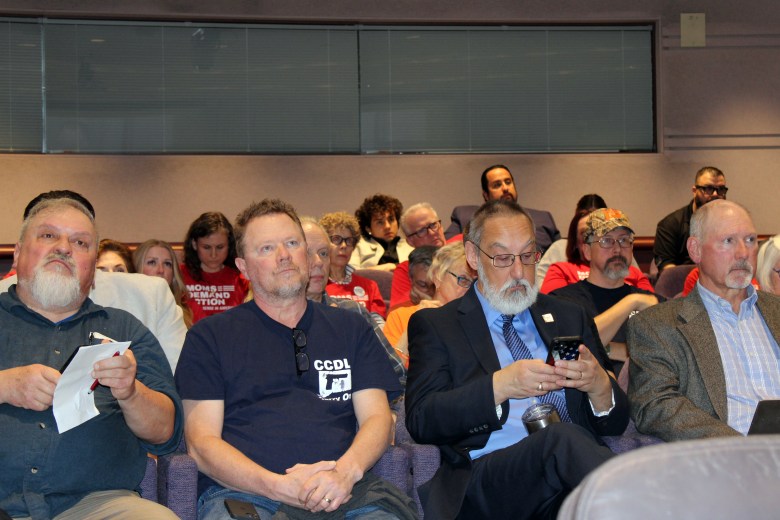
At Wednesday’s public hearing on the bill, residents in support of the measure, many of whom were wearing T-shirts with logos from Moms Demand Action and CT Against Gun Violence, were outnumbered by those opposed.
While the bill drew written testimony from about 1,900 people in opposition — many of whom were anonymous — only 50 people wrote in support of the ban.
Lamont’s bill is similar to one signed into law by Gov. Gavin Newsom of California last year, which placed a ban on the sale or transfer of Glock handguns and pistols that have a “cruciform trigger bar,” which allows them to be converted to fire automatically. The NRA has filed a lawsuit against the ban. In the lawsuit, the organization argues that the ban should be considered unconstitutional because Glock handguns are “in common use” and therefore protected by the Second Amendment.
Lamont said in a press conference on Monday that the goal of the ban was to pressure gun manufacturers into redesigning their firearms so that it would be more difficult for people to modify them.
The Connecticut Police Chiefs Association also supported the bill, citing an increase in the number of firearms being seized by city police departments that had been modified with “switches.”
“Law enforcement is concerned that an increase in rounds fired by an individual increases the likelihood that a member of the public or an officer will be struck by one of those rounds,” the chiefs wrote.
But people who testified against the bill called the language vague and said it risked criminalizing responsible gun owners.

“Many semiautomatic pistols share common internal design features. Criminalizing an entire class of firearms because they could theoretically be modified — illegally — places responsibility on manufacturers and lawful owners instead of on those who actually commit crimes,” Matthew McBrien, the owner of Patriotware Holsters LLC wrote in testimony.
Gun supporters, many of whom were members of the Connecticut Civilians Defense League, told CT Mirror on Wednesday that “Glock switches,” a device that can be attached to a semiautomatic handgun that makes it able to fire automatically, are already illegal.
Walt Kupson, a physician and outreach coordinator for CCDL, said that he believed the state saw it easier to ban an object rather than change a culture or deal with mental health issues that drove people to commit crimes with guns.
Anthony Schnur, a 25-year-old resident of Wethersfield, told CT Mirror that guns are so simple mechanically that people can figure out new ways to modify them. He said that guns, like chainsaws, became dangerous based on how they were used and whether they were used responsibly.
Schur said he understood the point of view of people who had relatives killed through gun violence. But he said he felt that the bill had been crafted by people that had never shot a gun and had no understanding of how guns worked mechanically. He said people needed to separate personal emotions from policy decisions.
“I’m sure a lot of these people have lost a son or a daughter,” Schur said, referring to people in support of the gun legislation. “But none of us here are any of those people who took [away] any of their family members.”
Elizabeth Drysdale, the secretary of the Connecticut Citizens Defense League and a resident of Cheshire, said owning a gun for her was a matter of personal safety. She said she had two daughters and taught them both how to shoot.
“I feel like my personal safety is at risk,” she said of the bill. “If they take away my pistol, what am I left with? A baseball bat?”
Drysdale said she has not used her gun for self-defense. But she said that being able to shoot at the shooting range was, for her, a method of stress-relief.
“I can tell you how many times I’ve had to use my gun: zero,” she said. “Most of us go to the range.”
Beth Bonney, a member of Moms Demand Action, which supports the governor’s bill, told CT Mirror that she wasn’t against gun ownership or “anti-gun.” But she said that being a first-grade teacher at the time of the Sandy Hook mass shooting had deeply affected her.
“[It’s a] different attitude when looking at a classroom of first graders and thinking ‘my first job is to keep you alive,’” she said. “That is wrenching.”
Bonney said she was upset that people could “put gun rights over children’s rights.”
Joanna Whitney, an East Granby resident and member of Moms Demand Action, told CT Mirror that the bill would not affect responsible gun owners and people who already own guns. She said the target was manufacturers.
Whitney said she believed that gun rights supporters and her group could find common ground; she said they agreed on the importance of secure storage and keeping loaded guns out of the hands of children.
“We want safer communities, they want safer communities,” she said.
Convertible firearms
Much of the discussion on Wednesday on the governor’s bill revolved around the ease of converting Glock pistols to fire automatically, the prevalence of these weapons and whether a ban would stop people from modifying other firearms.
Gregory Lickenbrock, a senior firearms analyst with Everytown for Gun Safety, argued on Wednesday that although the switches were already illegal, their size and ease of being replicated using 3-D printers made it difficult for police officers to intercept them. According to Lickenbrock, modified Glocks have been involved in 20 mass shootings, including one in Alabama in 2024.
According to the governor’s office, the Hartford police seized 51 Glock switches between 2023 and 2024.
Rep. Greg Howard, R-Stonington, also said it was problematic to ban a gun based on its potential to be converted into an illegal firearm. He also countered that while today the focus was on Glocks and “Glock switches,” people would figure out other ways to modify legal firearms into illegal weapons.
“With modern technology, human ingenuity and AI and 3D printers … it is my belief that … while it may be the cruciform trigger bar today … going forward we are setting a framework to outlaw the sale of pistols in the state of Connecticut,” said Howard.
Howard said that a big problem was also the low rate at which the state prosecutes people who violate Connecticut’s gun laws.
But Lickenbock said the problem with Glocks was the ease at which they could become automatic. He argued that other models, like the Smith and Wesson M&P pistol and SIG Sauer P365, are not easy to convert.
“ We’re trying to say that guns should have certain standards, and that means they should not be readily convertible with switches in less than a minute,” said Lickenbrock.
According to Lickenbrock, the ban would cover nearly all Glock models, as well as the Ruger RXM and other “Glock clones.”
While Ryan said that the bill affected only a small subset of the handguns that are on the market, people who testified underscored the popularity and utility of Glocks.
CCDL member Elizabeth Miller said she has carried a Glock since age 21 and that she relies on it to protect herself and her three children. She said the models were affordable and reliable.
“I can’t stress the fact enough, as a woman, that some guns can be intimidating. A Glock is easy to use and, once you’re comfortable with it, you can get so many different models that all function the same,” she said.
Current Glock owners would be allowed to keep their guns under the bill, but it would prevent them from selling or transferring those guns to others, including family members. Lickenbrock and Ryan said they would not be opposed to adding a carve-out into the bill so that people could pass their guns on to relatives.
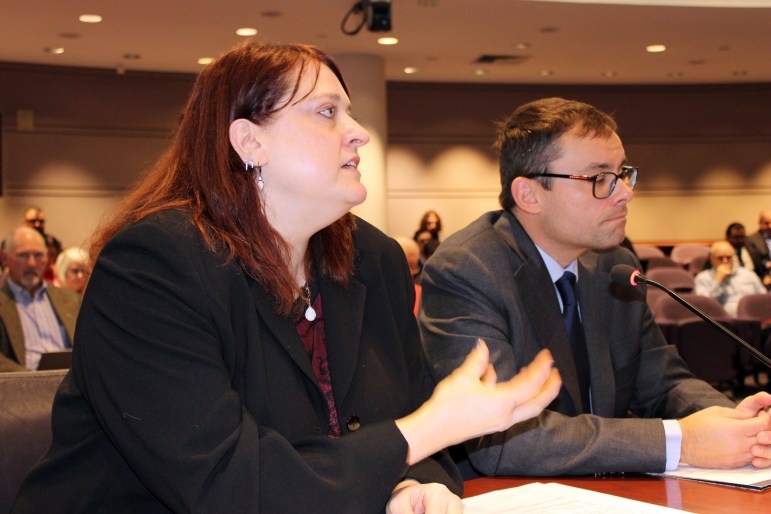
Elisabeth Ryan, policy counsel for Everytown for Gun Safety, echoed Lamont, saying that the goal was not to penalize individual gun owners but to change the gun industry.
“This is about the manufacturers who know that their pistols are convertible this way, that know there is a way to design, [a] need to make them resistant to this, and yet continue to sell them. There are plenty of models on the market that are not designed this way, that function exactly like regular handguns for the purpose that they are paid for,” Ryan said.
Don Wilson, a member of Moms Demand Action and founder of Bridgeport Youth Lacrosse, said the work he and others did to provide mentorship, sports and education for young people was undermined by the presence of “DIY machine guns” in the streets.
“When weapons like these appear in our communities, they don’t just affect those directly involved in the violence, they put children, families and innocent bystanders at risk … and they create trauma that impacts the entire community,” he said.
Many of the people in attendance on Wednesday also opposed a second bill, which changes the definition of a firearm to include components like the unfinished frame, barrel, slide and lower receiver. People opposed to the bill said that regulating gun components in the same way as guns would result in significant delays for people getting background checks. They argued it would overwhelm dealers that have federal firearms licenses and cost gun owners more money if dealers start charging fees for the transfer of basic firearm parts. Federal license fees run between $25 and $50 per firearm in Connecticut.
David Pucino, legal director and deputy chief counsel at GIFFORDS law center, said the purpose of the bill was to crack down on ghost guns by requiring that people who sell gun components to be licensed as if they are selling firearms. He said that some “enterprises” were selling people a kit that includes all the components to make a gun — barrels, slides, etc — and then directing people to download and 3-D print a frame and receiver from their website, thereby avoiding having to go through a background check and serialize the gun.
Pucino said they planned to submit substitute language for the bill so that it did not require components like barrels and cylinders to be serialized.
Krystofer DiBella, owner of Tobacco Valley Guns LLC, said he felt that people who were in favor of new laws regulating gun ownership had some of the same goals as those against those laws: to keep illegal weapons off the street. But he said it seemed like many people in favor of the gun legislation didn’t know a lot about the gun industry.
“One thing I always advocate for the anti-gun community is, why can’t we sit down and have a conversation instead of just having this constant battle back and forth? I don’t understand the disconnect between us. No one wants Glock switches on the street, and we just want to have our rights,” he said.