


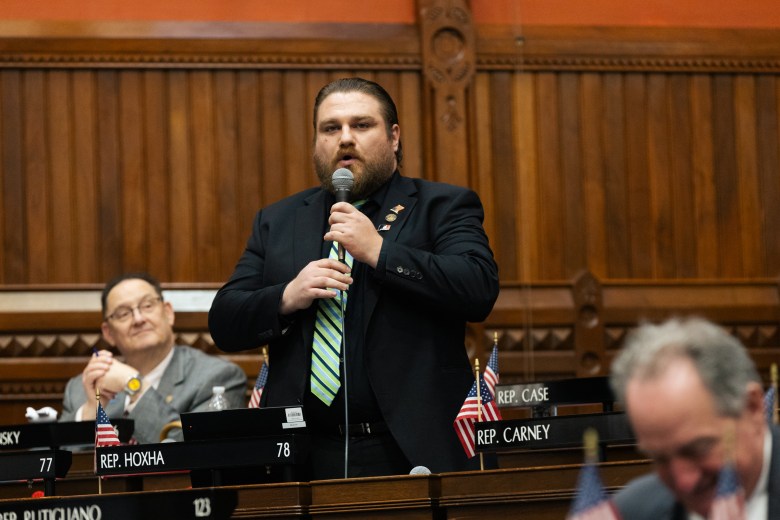
The truth is out there, and state Rep. Joe Hoxha, R-Bristol, wants to find it.
Hoxha authored a bill, H.B. 5422, that calls for the University of Connecticut to partner with various state agencies to study unidentified aerial phenomena, or UAPs — the technical term for UFOs — and explore the potential benefits of establishing a “state center” for further research. On Thursday, lawmakers on the Appropriations Committee heard testimony from residents on the topic.
Hoxha said the idea is for the state to “have a dedicated program that can at least record, study and collect data on UAPs that are seen in Connecticut skies.” He said that might help aggregate the decentralized information ecosystem that currently exists for UAPs.
“I’ve been a UFO enthusiast and researcher for many years,” Hoxha said in an interview with the Connecticut Mirror. “The topic is finally starting to be taken seriously, starting with the federal government.”
The bill already has a cosponsor across the aisle in Rep. Aundre Bumgardner, D-Groton. Bumgardner said that, as a representative of a town that makes submarines for the U.S. Navy, he’s keenly aware of the need to better understand UAPs.
“We should know if it’s coming from one of our adversaries,” Bumgardner said.
To some, the prospect of a state legislature formally calling for the study of UAPs may seem unserious. It has, however, already happened.
New Jersey passed a law last year to establish a center to study UAPs in collaboration with higher education institutions. That law went into effect in January.
Sri Tata, a PhD student at Yale, testified in support of the bill Thursday. He said the New Jersey drone wave in 2024 drove new attention to UAP activity.
“A lot of students and faculty are interested in this topic, and it’s also one that crosses state borders and international borders,” Tata said. “Establishing a scientific study for both public policy, for our scientific curiosity and for public reporting mechanisms would be important.”
In response, Rep. Martin Foncello, R-Brookfield, said he has a colleague who investigates UAPs for the U.S. Department of Defense.
“I know in fairly recent days, I have seen some things out there that need to be explained and haven’t [been],” Foncello said. He told Tata he’d like to work with him on developing the bill further.
Many individuals — including airplane pilots and military personnel — have reported UAP sightings, and the topic has received increased attention in recent years.
Congress held a hearing on UAPs for the first time in decades in May 2022. The All-domain Anomaly Resolution Office of the Department of Defense was established the following July to “serve as the authoritative office of the Unidentified Aerial Phenomena (UAP) and UAP-related activities for the DoD,” according to a Defense Department memo from that time.
Although talk of UAPs has prompted a wide range of discourse around the possibility of alien visitors to Earth, a 2024 report from the AARO found no evidence of alien technology involved in any UAP sightings.
That hasn’t stopped people — including Hoxha — from wondering what UAPs actually are.
Hoxha said he doesn’t want research and discussion of UAPs to devolve into “a club” for “crazy and wacky conspiracy theories.” Instead, he proposed the bill as a way to focus on objective scientific inquiry.
In his view, it’s a worthy expense for the state — far more than some earmarks in the most recent biennial budget, which he said went “essentially to throw parties.”
“This is light years, no pun intended, more important than giving $50,000 to Jeep enthusiasts or, you know, festivals and things like that,” Hoxha said.