


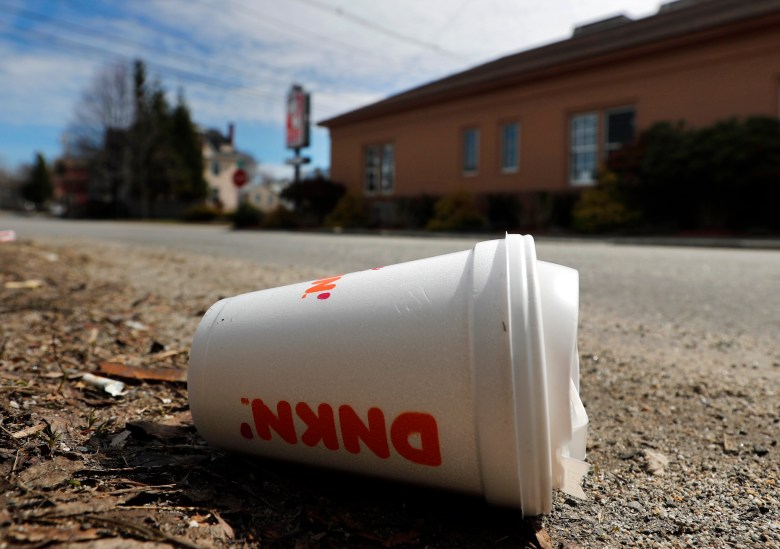
In their perennial battle to solve state’s mounting trash problems, Connecticut lawmakers are again considering a ban on polystyrene takeout containers and other limits on single-use plastics.
The latest effort to ban polystyrene containers — also known as Styrofoam — would take effect on July 1, 2028. In addition, restaurants and other food service providers would be prohibited from offering single-use items such as utensils, napkins, condiment packets or straws except upon request from customers.
The proposed restrictions are included in wider-ranging bill addressing the management of solid waste, House Bill 5524. The legislation also seeks to expand the number of establishments required to compost food scraps and other organics, and it would clarify how municipalities can spend waste-reduction grants from the state Department of Energy and Environmental Protection.
Large producers of food waste — such as supermarkets and wholesalers, which are already required by law to divert those items from the trash — would also have to prioritize donating any edible food before sending it off to be recycled or composted.
“This is some of the low-hanging fruit that has a big impact,” said state Rep. Aundre Bumgardner, D-Groton, one of the bill’s sponsors. “Food donation, compost, 30% of our waste stream is organic waste… it shouldn’t be landfilled, it shouldn’t be shipped out of our state.”
The bill was heard before the legislature’s Environment Committee on Friday, where dozens of people testified in support of its passage. It has yet to receive a vote from the committee.
Previous efforts to ban the use of polystyrene or single-use plastics in Connecticut have fallen short in the face of opposition from the food industry, as well as public grumbling over the quality of more environmentally-friendly alternatives, such as paper straws.
By narrowing the ban to just polystyrene and allowing customers to ask for plastic straws and utensils, Bumgardner said he’d been assured groups such as the Connecticut Business and Industry Association would not actively oppose the effort. The bill does not specify any fines or other enforcement measures against businesses found to be violating the law.
A spokesman for CBIA confirmed the group is not weighing in on the bill.
The legislation does face opposition from the Connecticut Restaurant Association as well as national trade groups representing the packaging and plastics industries.
Scott Dolch, the president of the restaurant association, said he was concerned the bill would apply the ban on polystyrene only to restaurants while allowing other large users, such as school districts, to enter into recycling programs. He also said it was unclear whether customers would have speak up to ask for plastic utensils, or whether they could be left out for customers to take.
Earlier this year, lawmakers in New Jersey passed a similar prohibition on single-use plastics known as the “Skip the Stuff” bill. Dolch said his organization has already been urging members to save money and reduce waste by not automatically handing out plastic utensils.
“The bill singles out restaurants and hotels with vague requirements and inconsistent standards that don’t apply to other sectors, or to pre-packaged goods,” Dolch said in a statement. “We are concerned that this level of complexity and unfair treatment will hinder operations for the very businesses that serve as the backbone of Connecticut’s economy.”
During a Friday morning press conference in the Legislative Office Building — just a short distance away from where napkins, plastic forks and ketchup packets were available to breakfast-goers at the building’s cafeteria — advocates said bill was necessary to address Connecticut’s aging waste infrastructure and the lack of space within the state to send trash.
“Landfills will charge more based on our increased demand and eventually reach capacity,” Madison Spremulli, an organizer with the Connecticut Zero-Waste Coalition. “It may not be felt by all right now, but if we do not address this, residents, businesses and municipalities will experience higher waste disposal costs.
Connecticut’s troubles with trash began in 2022, when the state closed the Materials Innovation and Recycling Authority’s waste-to-energy incinerator in Hartford, resulting in nearly 1 million tons of trash each year heading to landfills in Pennsylvania and Ohio.
Since then, lawmakers have tried repeatedly to come up with solutions that would reduce the amount of stuff being thrown away, divert more of it to compost and recycling facilities and manage whatever is left within the state’s borders. While officials have reported some successes through locally-run diversion programs, efforts to come up with a long-term plan to stop shipping waste out of state have repeatedly ended in failure.
H.B. 5524 does not include any funding for new facilities that could handle large quantities of trash, and lawmakers said there was little appetite in this year’s shorter session to wade back into that debate.
State Rep. Joe Gresko, D-Stratford, instead pointed to millions of dollars in grants handed out by DEEP to help cities and towns develop their own composting and recycling programs. The bill seeks to clarify how those grants could be spent in the future, including for items such as dish-washing equipment that would allow schools to stop using single-use trays and cold storage for donated food.
The growth of those local efforts, Gresko said, have succeeded in attracting private composting facilities and developing infrastructure needed for further expansion.
“These grants that we’ve been giving out are starting to work,” Gresko said. “Oftentimes it’s not a magic or silver bullet…It’s a series of steps and adjustments that people make.