


Waterbury Public Schools has been criticized for increasing school suspensions and expulsions many times before. That is not a novel argument, nor is there a lack of evidence for it. However, this is a multifaceted issue. Research over the last few decades revealed that students who are out-of-school suspended are more likely to be arrested, especially on the days and months they are out of school than when they are in school, they are also exponentially more likely to drop out and not graduate from high school and up to a decade after the out-of-school suspension occurred suspended youth were less likely graduate college, and were more likely to have been arrested and on probation than their non suspended peers (Hirschfield, 2009; Losen, 2016; & Rosenbaum, 2018). The long-term, negative impacts of out-of-school suspensions have to be addressed at every turn and this year the state legislature must act to narrow the ways and behaviors that out-of-school suspensions are used in our schools.
While the social repercussions for these children are vast and include the school-to-prison pipeline, there is another economic argument that serves just as well as fuel for change. Putting a child into the prison system ends up costing Waterbury and the state more money than it does graduating a child.
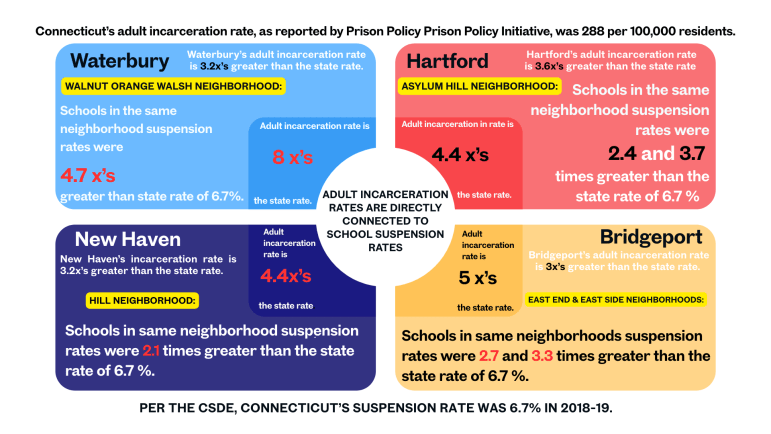
In Connecticut, it costs approximately $750 per day or $274,000.00 per year, to incarcerate a single student (Justice Policy Institute, 2020). In contrast, Waterbury spends about $18,654.00 annually to educate a single child and Connecticut’s average is $22,054.00 per pupil totaling over $12 billion every year (Connecticut State Department of Education, 2026). This means that for the cost of maintaining one prison bed for a year, the city and state could instead fund the high-quality education of more than 14 students.
When this math is applied to local statistics, the financial drain on the community becomes clear: In the 2022-23 school year, Waterbury recorded 172 school-based arrests. If just one-fourth of those students (43 individuals) were sentenced to juvenile centers, the cost to taxpayers would climb to $11,771,250 (Justice Policy Initiative, 2020 and Connecticut Department of Education Suspension Data 2018-19).
The economic case for change is even stronger when you think about the long-term effects of taxpayers investing in education and for at-risk youth. This multi-million dollar “incarceration tax” is being extracted from a community where the median household income has already declined by roughly $3,000 between 2010 and 2022, falling from $56,554 to $53,573 (Neilsberg Research, 2025). High school graduates are more likely to find jobs, help the economy, and need less public support (Boston Consulting Group, 2023). This eases the financial burden on the state and creates a positive economic cycle that benefits everyone.
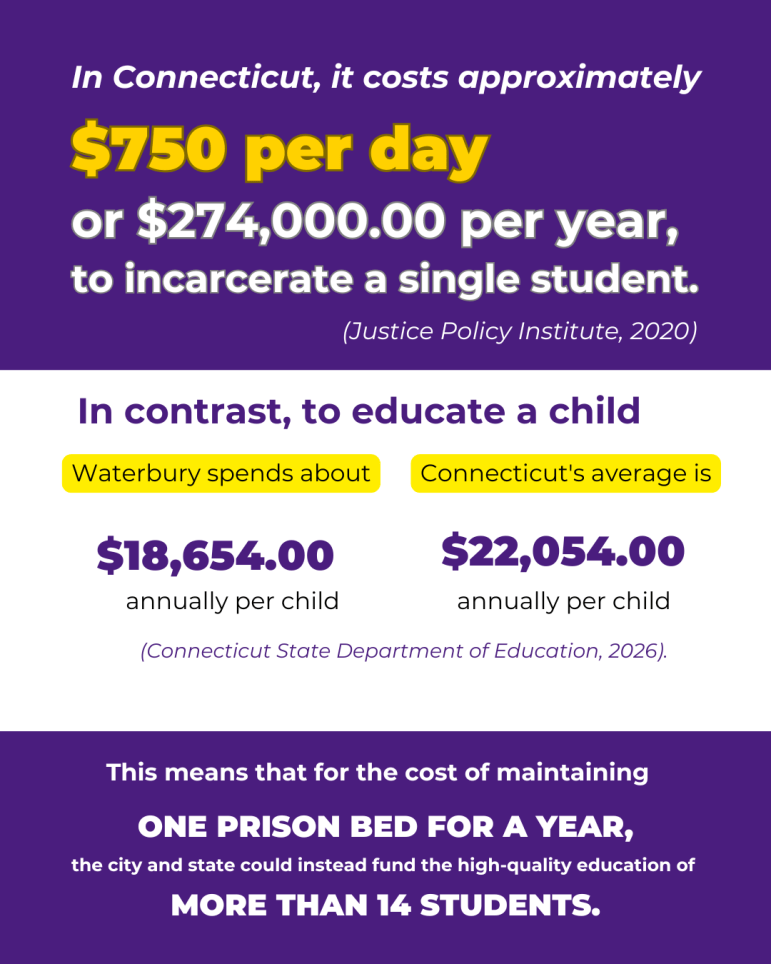
This is a statewide dilemma, but it has grown to be a hyper-local one of generational hardship and poverty. These outcomes are geographically and racially predictable. In Waterbury, the Walnut Orange Walsh (WOW) neighborhood, with an adult incarceration rate 8 times the state average, feeds into Wilby and Crosby High Schools, where suspension rates exceed 33% and 30%, respectively, 4.7 times the state average. (Prison Policy Initiative, 2020 and Connecticut Department of Education suspension data 2018-19) Similarly, in Hartford’s Asylum Hill neighborhood, the incarceration rate is 1,278 per 100,000: 4.4 times the state average. (Prison Policy Initiative, Hartford, 2020) This links to high suspension rates at Hartford Public High School, which reach 25% (3.7 times the state rate). (Id.) In New Haven’s Hill neighborhood, the incarceration rate is 1,272 per 100,000, with suspension rates at Hillhouse and Wilbur Cross High Schools around 14.5%, double the state average. (Prison Policy Initiative, New Haven, 2020) The disproportionate number of suspensions in high-incarceration neighborhoods creates a cycle of inequality throughout Connecticut where students are socialized into legal systems early. (Id.)
Investing in preventive measures and support systems within schools helps increase graduation rates, which directly contributes to building a skilled workforce. This, in turn, enhances tax revenue, reduces reliance on social services, and lowers costs associated with the criminal justice system (Sinkevich, 2025). By maintaining a disciplinary climate that prioritizes arrests and removals, Waterbury and the state are choosing the most expensive possible social intervention (Chedekel, 2013). Shifting these funds away from the carceral system and toward restorative justice, mental health support, teachers, and alternative forms of discipline is more than a matter of fairness; it is a financially smart strategy (Child Health and Development Institute, 2026). Investing in graduation rather than incarceration creates a positive economic cycle: high school graduates are more likely to find jobs, increase tax revenue, and require less public support, ultimately easing the financial burden on every Waterbury resident.
In summary, the economic case for changing Waterbury’s and the state’s discipline policies is strong. The cost of locking up students is much higher than educating them, and the long-term benefits of investing in education and support programs are robust.