


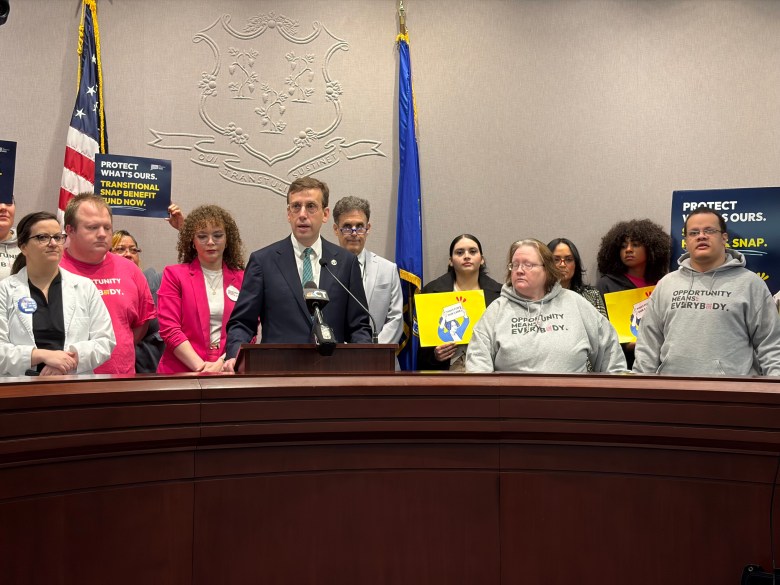
Democratic lawmakers and advocates gathered at the state Capitol on Tuesday to rally for the establishment of a statewide food assistance program to serve Connecticut residents who have lost SNAP benefits as a result of new federal eligibility requirements.
A bill proposed by the legislature’s Human Services Committee would create a “bridge” program that provides a year of food assistance for certain “vulnerable” populations who must now meet federal work requirements. This includes veterans, people experiencing homelessness and young adults aging out of the foster system.
Sen. Matt Lesser, D-Middletown, co-chair of the legislature’s Human Services Committee, said the state needs to step in and help.
“The concern that I have, and that advocates who are here have, is that tens of thousands of residents in the state — without further action — are going to go hungry this year,” he said during the Tuesday morning press conference.
The proposal would fund the program by tapping $40 million from the state’s $500 million Federal Cuts Response Fund, created in November to bolster social services programs threatened by a federal government shutdowns and cuts included as part of the One Big Beautiful Bill Act, or H.R. 1. (Advocates have separately asked the legislature to allocate $70 million from the emergency fund for Care4Kids, a state program that helps low to moderate income families access child care.)
Federal guidance passed as part of H.R. 1 introduced new work requirements for the Supplemental Nutrition Assistance Program, also known as SNAP or food stamps. The new requirements went into effect in December of last year, and the Department of Social Services estimated that 36,000 Connecticut residents could be kicked off the program as a result.
Sen. Paul Honig, D-Simsbury, who serves as co-chair of the Veterans and Military Affairs Committee, said the eligibility changes in H.R. 1 meant some veterans transitioning back to civilian life might not qualify for food assistance until they can prove their disabilities, which could take months.
“For the federal government to put obstacles in the way of veterans returning to civilian life who need food assistance is just absolutely shameful,” Honig said.
[RELATED: Should CT fund its own SNAP program? Lamont, Appropriations chair disagree]
Even with the demonstrated need, the bill could face headwinds.
Gov. Ned Lamont’s proposed budget doesn’t include the necessary funding. Budget director Joshua Wojcik said the administration wanted to focus on “making sure as few people as possible lose their federal SNAP.”
And only the governor can order specific expenditures from the emergency federal response fund. A panel of six legislative leaders could block any spending if they disagreed but couldn’t order any themselves.
In written testimony to the legislature Tuesday, Department of Social Services commissioner Andrea Barton Reeves raised several concerns regarding the proposal and highlighted the cost and complexity of setting up the program.
“DSS appreciates the intent of this committee to assist those at risk of losing assistance… but has serious concerns regarding the time and complexity that will be required to implement a new Supplemental Nutrition Assistance Transitional Benefit Program and eligibility system,” Barton Reeves wrote.