


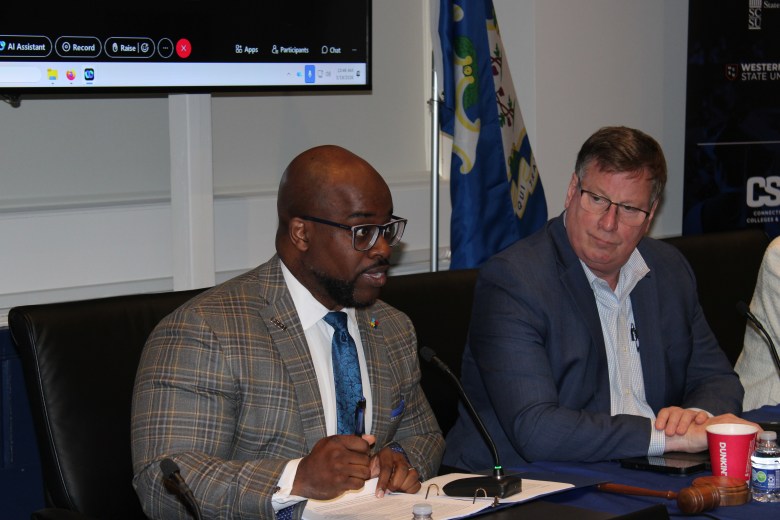
Connecticut State Colleges and Universities Chancellor John Maduko said Thursday that a state program created to provide debt-free bachelor’s degrees to Connecticut students will only serve a third of the students who will meet already reduced eligibility requirements this fall.
The Finish Line Scholarship Program, which was established last year, is designed to offer financial aid to students who received funding through the state’s debt-free community college program — also known as the Mary Ann Handley Award program — and are enrolling in a four-year bachelor’s degree at one of the state’s four public universities or Charter Oak State College.
To be eligible for the Finish Line Scholarship Program under state law, a student must have earned 60 credits through the Mary Ann Handley Award program at a state community college. While 60 credits is the number generally required for an associate’s degree, as the law is currently written a student does not have to have completed an associate’s degree to qualify for the program.
The Finish Line Scholarship Program, which is scheduled to begin this fall, is designed to fill in any gaps in funding that still remain after students have received funding from other sources, like federal Pell grants. The university system estimated that the average student would qualify for between $8,750 and $9,750.
According to estimates from CT state, about 5,500 students are expected to be eligible for the Finish Line Scholarship program under the law by the end of this academic year. But in February, the governor’s proposed budget decreased the funding for the new program from $7.7 million to $3.85 million. As a result, the governor’s budget would only make it possible for between 350 and 450 students to attend a four-year university debt-free.
If the original budget of $7.7 million were restored, the funds would support between 800 and 900 students.
“ We’re facing a situation where we would be turning away CT State students who received the PACT/Mary Ann Handley Award, who are interested in transferring to one of our four-year institutions,” Maduko told the Board of Regents on Thursday.
In response to the budget constraints, the CSCU administration decided to limit eligibility this coming fall to students who had completed their associate degrees within the 2025-26 year or later. Under this framework, about 1,300 students will be eligible — three times the number of students who would be able to receive funding if the governor’s budget proposal is approved.
Chris Collibee, spokesperson for the Office of Policy and Management, said CSCU did not provide any indication that the funding estimates and assumptions used to fund the program, including in a fiscal note, were “insufficient.”
The fiscal note states that it was “estimated that 550 students who enroll at the CSUs in FY 26 could be eligible to participate” in the Finish Line Scholarship Program.
“Governor Lamont remains committed to helping students achieve their academic goals and lowering the cost of higher education,” Collibee said. “The Governor’s budget sets the program’s first‑year appropriation at $3.85 million, reflecting that it will launch with its initial cohort of students in the 2026–2027 academic year and will therefore require only half of its full annualized funding.”
Maduko told lawmakers that the $7.7 million would only have covered students who enrolled in a bachelor’s degree program for one year, leaving them uncertain whether they would receive tuition assistance in the future.
“Students want guarantees to say, ‘This is my financial aid package. I know how to schedule my life around my education,” Maduko told lawmakers in February.
Sen. Derek Slap, D-West Hartford, told CT Mirror that lawmakers were considering a legislative change to the program that would restrict eligibility for the scholarship going forward to people who had gotten their associate’s degree, not just 60 credits. He said this would lower the program’s cost by reducing the number of eligible students.
“Not only is it fiscally prudent but it also would improve outcomes, I believe, for the students themselves,” Slap said.
Slap said the Board of Regents wouldn’t be able to market the program to students if they weren’t able to rely on the funding. He said he would support funding the program with the amount the CSCU system is requesting.
In a document submitted to the legislature’s Appropriations Committee, the CSCU system estimated that it would cost between $49 and $54 million to fund all 5,500 students who are currently eligible under the law. They are requesting, however, that lawmakers commit between $10 and $15 million for fiscal year 2027.
With the current funding, the scholarship will be granted to students on a first-come, first-serve basis.
The colleges and universities have been criticized in the past for retaining hundreds of millions of dollars in reserves while still requesting additional aid from the state. Data from CSCU that was provided to the Appropriations Committee shows that, as of June 2025, the CSCU system had just over $700 million in reserves, with $491 million of that already designated for capital projects, deficit mitigation and other things.
Samantha Norton, spokesperson for CSCU, said that although the system did have $216 million in reserves that hasn’t been designated for other things, the system is expecting an annual funding deficit of $150 million.
At the Thursday meeting, Maduko said that pulling money from the reserves was not an appropriate way to fund the program.
“ The reserves are one-time funding. We want this to be a continued resource,” Maduko explained.
He said that using institutional aid to fill the gaps was also not a viable option, because institutional aid, unlike the Finish Line Scholarship Program, is need-based.
Colina Sesanker, a professor of philosophy at CT State and chair of the Faculty Advisory Committee to the Board of Regents, criticized the legislature by what she viewed as a lack of follow-through in funding programs it sets up.
“ I think we continue to see a disconnect or an ambivalence perhaps on the part of the legislature in the sense of writing legislation that expresses a certain hope or aim or shape for our system that is then not supported by funding that can actually make that viable and sustainable,” Sesanker said.