


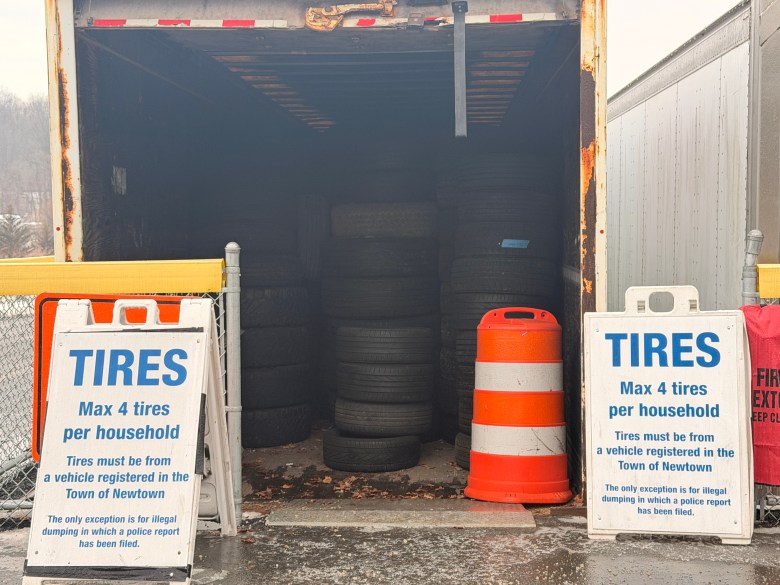
After years of toiling, officials in Connecticut are on the verge of launching a new program they hope will ease the disposal of old, unwanted and tough-to-trash tires.
But the initial launch will be limited. Most people looking to throw out one of the nearly 3.5 million tires state residents discard each year will have to wait.
Starting Saturday, residents in four towns — Redding, Weston, Newtown and Canton — will be able to drop off tires at their local transfer station without paying a disposal fee. From there, the tires will be collected and sent to one of five processors in Connecticut and Massachusetts, which will either resell them or find another way to keep them from being dumped in a landfill.
The program represents the nation’s first stewardship effort being led by tire manufacturers, a system also known as extended producer responsibility. Major brands that have already signed up to participate in the program include Bridgestone, Continental, Michelin and Goodyear, among others.
“There’s a lot of other tire EPR programs globally, and especially across Canada,” said said Jesse Schofield, the executive director of Connecticut Tire Stewardship, a nonprofit organization established by the tire industry to oversee the program.
“We’re trying to learn a lot of our best lessons from those, but unfortunately, they’ve sometimes started up in the 1990s and kind of built on that,” Schofield added. “We’re very much in the infancy of trying to set this up and figure out some of these aspects that work for Connecticut, and the differences that we have.”
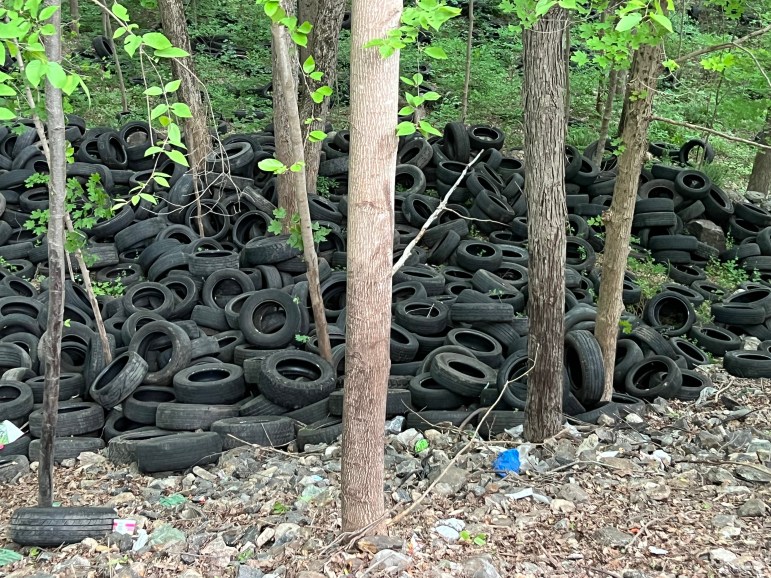
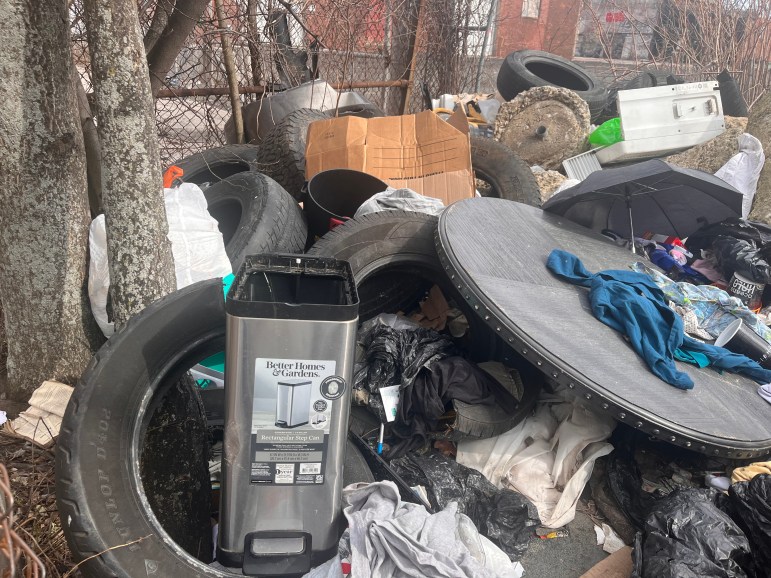
EPR programs are designed to solve a persistent problem with the disposal of tires and other tricky items such as mattresses and gas cylinders: If people have to pay a fee to properly dispose of those products, many will instead resort to illegally dumping them in vacant lots, the woods or along the side of the road.
That dumping, in addition to being an eyesore, creates significant cleanup costs for state and local governments.
By shifting more responsibility onto manufacturers, EPR programs can collect revenue from the sale of new products to be put toward funding their eventual disposal — eliminating the incentive for people to avoid having to pay to throw it away.
In 2023, Connecticut lawmakers passed legislation creating the nation’s first producer-led stewardship program for the disposal of tires. The law required tire manufacturers to establish their own organization, overseen by the Department of Energy and Environmental Protection, to manage a free disposal system for tires.
The law allowed manufacturers to pay for the program through fees included in the cost of new tires, though it prohibited participants from collecting additional disposal fees.
Controversially, the law did not require the participation of retail stores that serve as the collection point for the majority of the state’s discarded tires. Instead, stores were allowed to continue collecting their own disposal fees, which are not regulated by the state.
Critics of that system argue that it lacks transparency, resulting in some retailers pocketing the fee and reselling the tires, or even dumping them illegally.
In addition, without the participation of the retailers in the EPR program, many customers could end up paying twice for disposal: once when they purchase a set of new tires, and again when they leave their old tires behind at the store. Since DEEP approved the rollout of the program in September, no retailers have volunteered to join, according to a spokesman for Connecticut Tire Stewardship.
“When the retailers opt out, it does weaken the statewide collection network,” said Jennifer Heaton-Jones, the executive director the Housatonic Resources Recovery Authority, which includes all four towns participating in the program. “It does limit the public’s access to convenient drop off locations, and it does continue to heighten the risk of undermining the environmental and economic benefits that the law was designed to deliver.”
The sponsor of the original stewardship law, state Rep. Joe Gresko, D-Stratford, attempted to close the loophole last year through legislation that would have required tire retailers to participate in the launch of the EPR program.
The retail industry successfully lobbied against the bill, arguing it would have disrupted their existing recycling efforts and imposed additional costs on small businesses. After engaging in further talks with the industry over the last year, Gresko introduced a compromise measure, House Bill 5157, that would give retailers until July 1, 2027 to formally join the EPR program.
This time, the bill has received tepid support from the industry.
“It’s going to happen,” said Michael Barbaro, the president of Town Fair Tire, who testified in favor of the bill. “By delaying this, we would like to have a voice at the table on how the program works.”
Among the issues with the program that still need to be worked out, Barbaro said, is figuring out a better way to track the number of tires being sold in Connecticut so that enough money can be collected to cover their disposal costs. Currently, he said, manufacturers are using estimates based on the total number of tires sold in North America, which he said has underestimated the size of the Connecticut market.
Schofield, the director of the stewardship organization, said the program has collected about $1 million in fees from manufacturers since the fourth quarter of 2025.
Those fees, $2 for a typical car tire, are either absorbed by the manufacturer or, if they choose to, baked into the sticker price of new tires sold in Connecticut. As retailers enter the program, Barbaro said they will have to determine whether the system will continue in that manner, or whether a separate fee will be broken out at the point of sale.
In addition to the four towns that are helping to launch the program, Schofield said the stewardship nonprofit is finalizing agreements with 16 other towns to participate.
As the program seeks to ramp up over the next few months, Schofield said he working bring a few remaining manufacturers — representing between 15% and 20% of the industry — into the stewardship organization. He said he is also talking with municipal leaders to answer their questions and encourage participation.
One concern he said he’s heard is that without the participation of retailers, more residents will opt for free municipal disposal, overwhelming local transfer stations. In order to keep that from happening, towns are allowed to limit dropoffs to residents, and set caps on the number of tires they will accept.
“A lot of the municipal sites are obviously interested in joining,” Schofield said. “They deal with the headaches of tires, and they want the tires to be taken care of and not have to cover all those costs. But most of the market, most people disposing of tires, they’re going to a retailer.”
Once tires are collected by the stewardship organization, the law allows them to be resold, recycled into products such as crumb rubber or sent out of state for incineration. Currently, most of the tires that are legally discarded in Connecticut are shipped to Maine to be burned as fuel in pulp and paper mills, according to DEEP.
That market — which has been blamed for increases in toxic air pollution — is still going to be where many of the tires collected in Connecticut are sent, at least for the time being, Schofield said. Over time, he and other proponents of the program say their hope is that it will attract new businesses seeking to repurpose large quantities of tires in more environmentally friendly ways.
“One of the things that we look to product stewardship organizations to do — and they’ve been successful in other spaces like mattresses — is really identifying and helping to create the marketplace for these products at the end of their life,” said Emma Cimino, DEEP’s deputy commissioner of environmental quality.
One entrepreneur who has been watching the launch of Connecticut’s tire EPR program from afar is Tommy Alfredo, the president of New York-based K.B. Industries, which uses discarded tires to create to create its flagship product known as “Flexi-Pave.” The porous, pavement-like material is used in sidewalks, bike paths and driveways.
Alfredo has submitted testimony to lawmakers as far back as 2017, offering to open a manufacturing facility in Connecticut if the state launches a tire EPR program. In an interview this week, he said he is still exploring a $10 million to $12 million investment, which he said would require a steady stream of at least 800,000 tires.
“It all depends on the state, this program was supposed to be implemented for a while now, so we’re just waiting,” Alfredo said.