


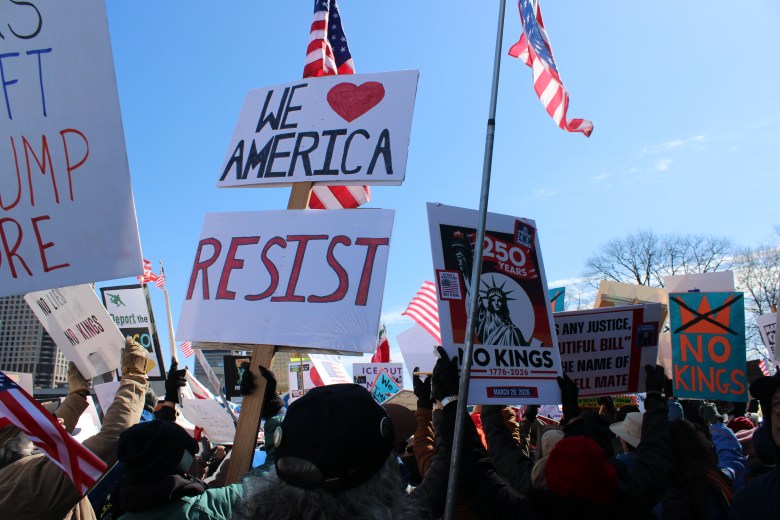
Protestors and activists packed the Connecticut state Capitol lawn in Hartford on Saturday for the third “No Kings” rally since the November 2024 election of President Donald Trump to a second term.
At the most recent “No Kings” rally, which took place in October, an estimated 10,000 people came to the state Capitol to protest the Trump administration’s actions on immigration, health care, environmental regulation rollbacks and voting redistricting.
Capitol Police on Saturday estimated that the crowd was not as large as the October protest, placing the number of people present at around 5,500.
Sen. Richard Blumenthal, D-Conn., Attorney General William Tong and Gov. Ned Lamont spoke at a protest organized by Indivisible CT on Saturday morning. In the afternoon, more protesters gathered on the opposite side of the Capitol, where Rep. Josh Elliott, D-Hamden, who is challenging Lamont for the Democratic nomination for governor, spoke alongside labor leaders and representatives for the Connecticut for All Coalition.
Lamont, Tong and Blumenthal focused on the actions taken in Connecticut to check some of the policies of the federal government. Tong said he had filed more than 50 lawsuits against the Trump administration, in response to the federal government’s attempts to cut health care and school funding, to block the Revolution Wind project and to institute broad tariffs.
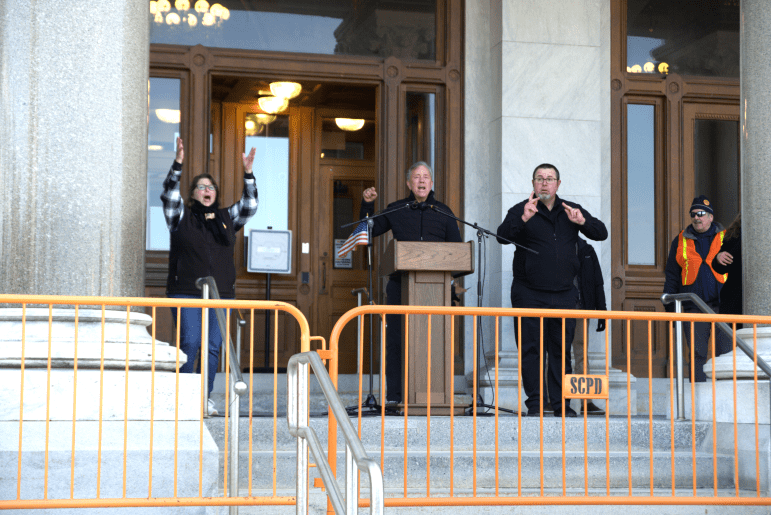
Lamont criticized the SAVE America Act, which, if passed by congress, would require people to present proof of citizenship and a photo identification in order to vote. He also criticized the administration’s request for funds to continue the war in Iran.
“ This is 250 years [after the U.S. was founded]. We’re not going backwards. We’re not going backwards in this country, and God, we’re not going backwards in the state of Connecticut. We’re going to stand up and fight,” Lamont said.
Elliott and the labor leaders and activists who spoke in the afternoon decried what they saw as the overarching problem of income inequality, in Connecticut and across the country. They called on the state to pass local legislation that would make it easier for residents to afford child care, housing and health care.
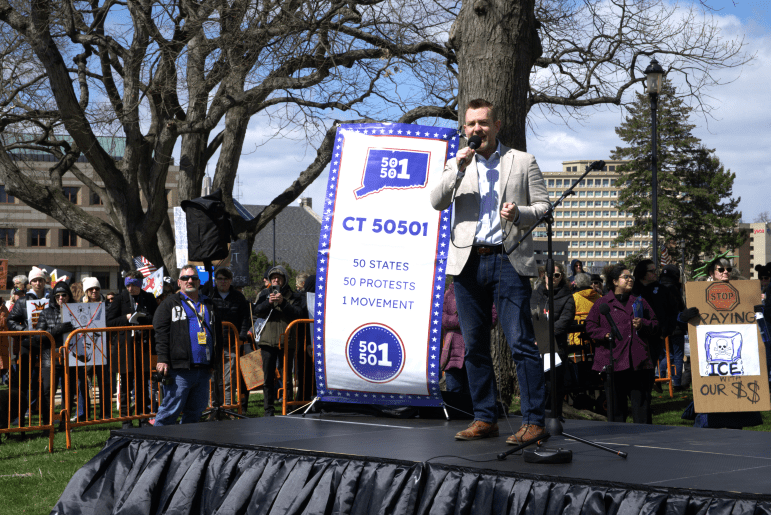
Constanza Segovia, director of the Connecticut for All Coalition, called for a tax on the “ultrawealthy” to fund Medicaid and SNAP. She voiced support for a series of bills that state lawmakers are currently considering — bills that would prevent federal immigration agents from detaining people at schools or hospitals and put parameters around the use of automated license plate readers.
Elliott also criticized what he described as the rising costs of health care, child care, energy, housing and other household necessities. He said that the tax system in the state of Connecticut “models monarchy,” with lower-income earners paying a larger percentage of their income in taxes than the top income bracket.
“ We have collectively built an economic model in this state that is broken,” said Elliott. “When we say no kings, we have built a system of kings — kings in business suits.”
Love and war, and fear
Protesters who spoke to CT Mirror on Saturday cited the January deaths of Renee Good and Alex Pretti by federal immigration agents during a sweeping operation in Minneapolis, along with the war in Iran, new restrictions on transgender athletes and the ability of children to receive transgender medical treatment, the Epstein files and women’s rights as reasons that the country needed a change.
Andrea Paquin, a Plainville resident who carried a sign reading “I refuse to hate my neighbor,” said she appreciated the diversity in her son’s school and said she personally knew some people who had been affected by ICE.
“I was raised to love everybody, and everybody is equal, and we are all together for a reason. I feel like we should all be supportive of each other and love one another. That’s just how I was raised and how it should be,” she said.
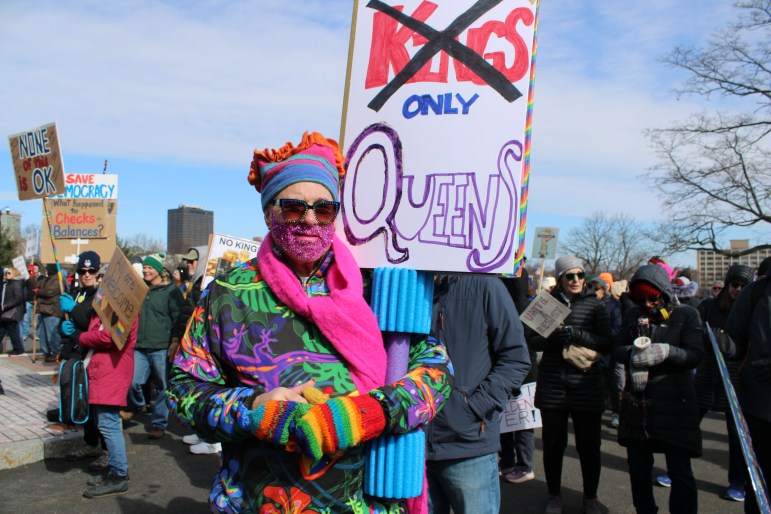
Richard Stillson, a psychologist who teaches human sexuality at Trinity College, said the queer community had suffered as a result of the Trump administration’s policies limiting transgender medical care for children, participation in athletics and preventing sex changes on passports.
“ People are petrified. Afraid to travel, afraid to come out of their cocoons, out of their places where they’re feeling the safest, just because they don’t know how they’ll be received and what repercussions they’ll be,” said Stillson.
Stillson also mentioned the large number of “elders” who were protesting in Hartford and said more young people need to get involved.
Ken MacDonald, a Navy veteran, said he came out to protest “every illegal action the president’s taken in the short period of time he’s been in.”
“It’s about getting rid of a dictator and the people who support a dictator,” MacDonald said.
MacDonald served in the submarine service in the 1970s and ’80s. During that time, he met presidents Jimmy Carter and Ronald Reagan — “Two opposing parties, nothing like the chaos it is now,” he said.
He expressed pride in being in the military in the waning years of the Cold War.
“I was in when the (Berlin) Wall was still up, and I always feel that me and millions of others helped get that wall knocked down,” MacDonald said.
By contrast, the fact that the U.S. is now at war with Iran has him worried.
“War is insane. … I can’t believe that many many more people are gonna have to live with their life, knowing that they killed many people without due cause,” MacDonald said.
MacDonald was sharply critical of the administration’s decision to launch the campaign.
“Anybody who did military intelligence gathering 101 knows what the Strait of Hormuz is and why you don’t attack Iran if you want that strait open, ever,” MacDonald said.
Nancy and Robbie — two younger women who declined to provide their last names — said Saturday’s event was their first No Kings protest. They said they’ve been hesitant to attend protests in the past, but another friend gave them the push this time to make it out.
“I don’t want to be scared. I have an extended family member who’s abroad right now in Nepal, and I don’t want to have to be scared about her having to come home through the airport and possibly getting detained,” Nancy said.
Nancy said the family member in question has a green card, but she’s heard of green card holders being detained under the Trump administration. She’s still worried.
The youth voice
While many of those in attendance were older, the rally did draw some high school and college students who said they, too, were concerned about the actions they saw the federal government taking.
“ I see every single day they’re taking back these actions that are working to save our environment, and it’s not something we can just brush under the rug and ignore. And it’s devastating, as a young person, to see them throw away our future and our children’s futures for money,” said Dannan Page, a 20-year-old sophomore at UConn.
“ For me, a big part of it is women’s rights and reproductive rights and just having a right to choose and not having ideals forced onto our bodies,” added 21-year-old Alyssa Teixeira, a junior at UConn.
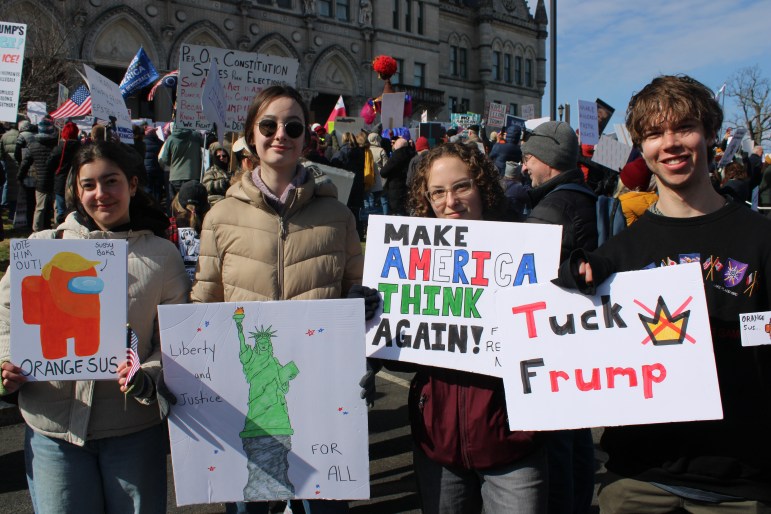
Asked about the shortage of youth at rallies like the “No Kings” protest, the students attributed it to a lack of education about current events, as well as doubts about the effectiveness of protests.
“I think the biggest thing I hear is that, ‘Oh, a protest isn’t going to do anything. It’s not going to make a difference.’ And that’s what I hear the most when I talk to my peers. And I feel like that’s just a misconception that young people should try to alter,” said 20-year-old Madelena Graves, a sophomore at UConn.
Sarah Berlinski, a high schooler from Winsted, said she thought many of her peers believed they didn’t have a lot of power to change what was happening around them, or they felt that what was going on in national politics didn’t personally affect them.
“ I think a lot of them think there’s nothing they can do. And that if they can’t do anything, why should they care? And I think that’s something that probably needs to be fixed,” said Berlinski, who said she also worked for congressional candidate and former Hartford Mayor Luke Bronin.
Katelyn Osoba, a 19-year-old who goes to Capital Community College, said she hopes to see more of her peers attend rallies like the “No Kings.” She says many people repost articles on social media but that it was important for people to show up in person and “put yourself out there.”
“ I’m hoping that more people who are in my generation and more of my age come out and speak out because it affects everyone,” she said.
Osoba said that women’s rights and immigration are particularly important to her. She said she was considering volunteering for organizations like Planned Parenthood or the New Haven-based Integrated Refugee and Immigration Services, a nonprofit that settles immigrants and refugees who come to the U.S.
“I know I’m young and I don’t have power as in being in the government, but I have my voice and I want to use it,” she said.
Some young people are using social media to mobilize fellow students in actions protesting the federal government. Dylan Labonte, a 16-year-old sophomore at Fitch High School in Groton who led 20-30 students in a walkout in early February to protest the actions of ICE, also spoke to the crowd at the protest.
Labonte said he used TikTok to mobilize his peers. He said his school has a large population of immigrants, and that many of his friends were passionate about eliminating ICE.
“ Me and my friends just couldn’t stand by and watch our neighbors get terrorized by ICE. We didn’t want what was happening in Minneapolis to happen in Connecticut,” Labonte said.
Attendees said they hoped the rally would spur more people to vote in the midterm elections this coming November. They also said they hoped it would show people that their voices matter.
“I hope that our leaders in Connecticut especially will really listen to us and see that we are mad, that we want change, and they will keep pushing harder and harder in our federal government for that change for us,” said Page.
Beyond the Capitol
Hartford was the setting for just one of dozens of protests that took place across Connecticut. In Westport, thousands of demonstrators gathered, filling Jesup Green and lining nearby bridges with signs and chants of “No Kings.”
Virginia Auster, a 102-year-old Westport resident, said she felt compelled to show up despite her age.
“I’m trying to keep our democracy alive,” she said. “It’s not happening.”
Others framed their participation as a response to what they see as a broader crisis in American political life.
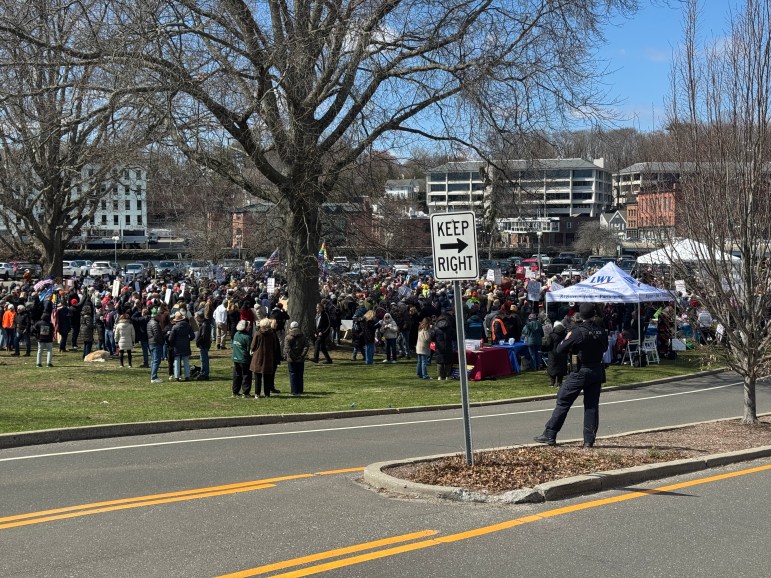
“People started believing their own truths,” said David Bue, 81, also of Westport. “When the president of the United States is a criminal, and everybody knows it, Trump seems to model himself off Putin. He likes dictators and he lets billionaires do all kinds of things.”
Lynne Cloutier, 87, pointed to voting rights and the environment as key concerns driving her to protest.
“I’m very worried about voting rights and the environment,” she said, adding that she hopes to see more young people become involved. “I see a lot of older people here, but young people need to be a part of this.”
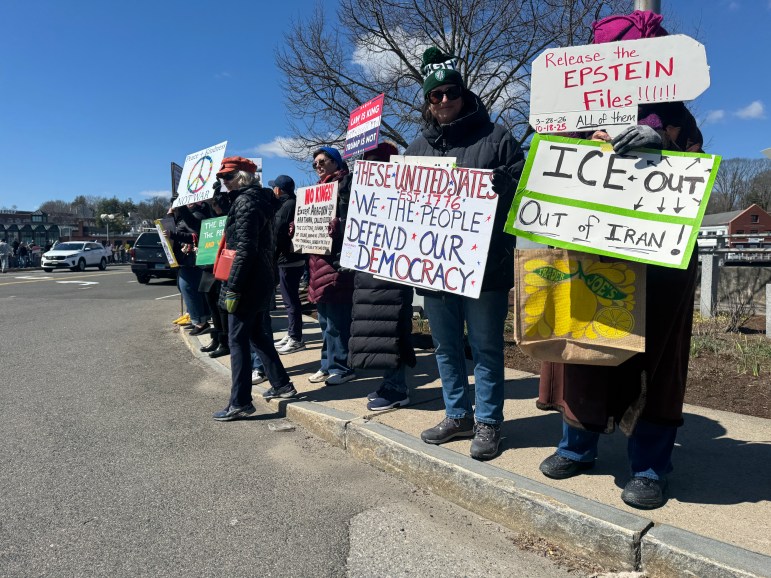
Organizer Pamela Clark, who helps lead weekly protests in the area, said the Westport rally is part of a sustained and growing movement.
“We run rallies every Saturday to protest what’s going on in Washington,” Clark said. “We’re here to stand up, be counted and show that we reject this.”
Clark emphasized that the movement is rooted in nonviolence and collective action.
“Nonviolent and peaceful, we’re in this together,” she said. “We support each other and we just want the madness to stop. We need guardrails.”
Many protesters echoed that sense of urgency, pointing to what they see as a breakdown in political accountability.
“I’m angry about everything that’s going on with our democracy,” said John Waski, 65, of Westport. “There are no checks and balances anymore. The Republican Party is not standing up.”
Sherrylee Dickinson of Norwalk criticized federal immigration enforcement, arguing that it reflects a broader abuse of authority. She also expressed concern about the influence of political and ideological groups shaping national policy, as well as threats to religious freedom and democratic institutions.
Kathleen Spellman of Norwalk described the moment as a turning point for the country.
“Our country is in a dire state of decline, and it’s purposeful,” she said. “We’re losing our democracy. We’re losing our humanity. We’re losing everything this country is supposed to stand for.”
Spellman said she hopes the protests send a message of unity while also pressuring those in power to act.
“I want people to know they are not alone. We are standing together,” she said. “I want Republicans to stand up and do the right thing.”