



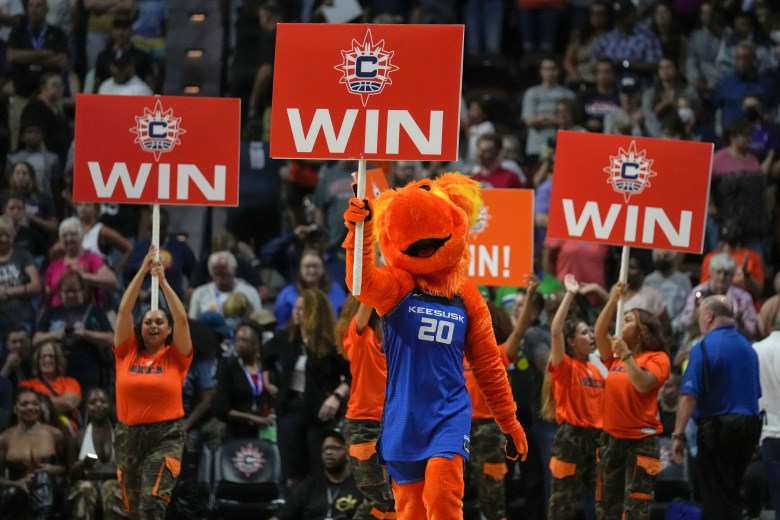
This story has been updated.
After more than two decades, the Sun is starting to set on major league sports in Connecticut.
On Friday, Texas-based PaperCity Magazine first reported that Connecticut’s last major league sports team, the WNBA’s Connecticut Sun, would be sold and relocated to Houston. The deal was later confirmed by the team’s current ownership, the Mohegan Tribe on Monday, ending months of speculation over the future of the team.
The deal will transfer ownership of the Sun to a group led by businessman Tilman Fertitta, the owner of the NBA’s Houston Rockets and current U.S. ambassador to Italy. The team will play one final season in Connecticut this year, including two games in Hartford and one in Boston, before moving south in 2027.
The new Houston-based team is expected to once again be known as the Houston Comets. The franchise, one of the WNBA’s original teams, was previously active in the city from 1997-2008 before it was disbanded.
Early reports say the deal, which has not been officially announced by the WNBA and awaits approval from the league’s Board of Governors, will see Fertitta purchase the team for $300 million, the largest sale in WNBA history.
As news of the sale spreads, Connecticut fans are beginning to process the impending loss of a franchise that has become a significant part of the state’s identity as a basketball haven.
“Mohegan owes an enormous amount of gratitude first and foremost to our extraordinary fans cheering on the team for 23 incredible seasons,” Joe Soper, the corresponding secretary for the Mohegan Tribe, said in a statement. “This team and what the talented women who have worn this uniform over the years have meant to Mohegan Sun, our region and the impact they’ve made both on and off the court, has been nothing short of remarkable.”
The historic offer is still short of a $325 million pitched by Boston Celtics minority owner Steve Pagliuca last August. The deal is also smaller than a counteroffer made last year by an investment group led by investor and former Milwaukee Bucks co-owner Marc Lasry, who hoped to move the team to Hartford.
The latter deal had been supported by Connecticut state officials, including Gov. Ned Lamont, who launched an effort to keep the team last fall. To sweeten the proposal, the governor had offered to use state pension funds to help Connecticut purchase a minority stake in the team — a politically controversial choice.
“I’m trying to keep the Sun in Connecticut,” Lamont said last year. “I think they belong in Connecticut, which is a birthplace of women’s basketball.”
But the WNBA, which is largely owned by the NBA and is influenced by NBA-affiliated team owners, brushed off the offers, arguing that the league, not the Mohegan Tribe, was the only party with the power to make a sale. The league’s preferred buyer had long been Houston, further aligning WNBA ownership with that of NBA teams.
That reasoning doesn’t lessen the impact of the sale for state officials, who argue that given Connecticut’s storied basketball history, the impending sale leaves a vacuum in the state’s sports ecosystem.
And as other local sports teams leave for different markets, there are concerns the Sun’s departure might highlight a deeper problem: Connecticut’s lack of appeal to major franchises.
Connecticut tried to fight for the Sun, but was dismissed by the WNBA
While it has now fizzled out, there was at one point a strong push to keep the Sun in state.
That push was led by Lamont, who argued that the team was a necessary presence in the state. The governor enlisted other officials in the effort, including state Treasurer Erick Russell and economic development Commissioner Dan O’Keefe, with both making appearances at press events. Hartford Mayor Arunan Arulampalam also pushed heavily for the team’s proposed move to Hartford.
One of the more vocal state officials was Attorney General William Tong, who argued that there could be potential action taken against the WNBA for interfering in a sale. In a letter sent to the league in September, he said such an action would be “anticompetitive and may violate state and federal law.”
Similar arguments were made by U.S. Sen. Richard Blumenthal, who raised concerns last year that the WNBA could be violating antitrust law. The senator repeated those concerns over the sale over the weekend as news of the Houston deal broke.
But while there had been vocal support for the team, and widespread belief that the Mohegan Tribe had a right to choose its preferred buyer, the state stayed away from more aggressive actions.
A public deal between the tribe and the state that could have forced the WNBA to make an official statement on why it was rejecting Hartford was never made. And while comments about legal action were tossed around, actual lawsuits did not materialize. The proposal to use state pension funds to buy a minority stake in the team quickly became fodder for Republican lawmakers and union leaders critical of the Lamont administration, prompting the state to move on from it.

Meanwhile, the WNBA maintained that Hartford needed to submit a formal bid for a team — despite just wanting the Sun to move a few miles — and it mostly remained silent as the state’s campaign unfolded. The state’s efforts eventually collapsed, with Lamont noting that the campaign to keep the team was an “uphill climb.”
With the Houston sale now happening, supporters of the Sun say they are doing their best to look ahead.
“The Connecticut Sun inspired fans, elevated women’s sports, and represented our state with pride. We’re deeply grateful for everything they’ve brought to our communities and we look forward to cheering them on here for one more season,” Lamont said in a statement on Friday. “Decisions around a team’s future are complex and driven by many factors, and it’s important not to oversimplify them.”
A bigger question
The sale also comes as Connecticut tries to figure out its lane when it comes to professional sports.
The Sun, which was purchased by the Mohegan Tribe in 2003, was the last major league team standing following the Hartford Whalers’ departure for North Carolina in 1997.
In recent years, local economic development officials and investors have worked to make the case for Connecticut as a strong sports market, often highlighting its proximity to large cities like New York and Boston. And with the success of college basketball programs at the University of Connecticut, which will see both teams play in the Final Four this week, there’s also an argument that a passionate sports fanbase is here, just waiting to be engaged with.
Members of the Connecticut Sun’s leadership team say that the state — and the fanbase — has been supportive. “This decision has always sat at the ownership level and we worked hard as a front office to make us New England’s WNBA team,” team president Jennifer Rizzotti said in a statement. “Playing and selling out two games in Boston shows this is a market that can support a team at a significant level.”
But the television market and passion of fans are only some of what factors into of the equation. Teams looking to succeed must also deal with the rising costs of facilities, equipment and the budgets needed to attract top players.
This is part of where the Sun’s current owners faced challenges. While the team spent a period as one of WNBA’s better franchises, making two finals appearances, eight consecutive playoff appearances from 2016 to 2024 and even ranking in top part of the league for attendance in 2022, the WNBA’s recent explosion in popularity has boosted team valuations and team expenses.
And with the league making more money, state-of-the-art practice facilities, higher salaries, and better quality of life are becoming baseline expectations among the its players. The Mohegan Tribe has struggled to keep up with some of those needs.
With the WNBA looking to consolidate its leadership in a way that puts more WNBA teams under NBA ownership, staying in Connecticut was an increasingly unlikely option.

Unfortunately, the Sun wasn’t the only team making that call.
Earlier in March the Bridgeport Islanders, the American Hockey League affiliate for the National Hockey League’s New York Islanders, announced it would be leaving the state for Ontario.
Still, there are some bright spots in the state’s sports landscape. Minor League Baseball has proven successful, with the Hartford Yard Goats in particular becoming a popular draw in the Greater Hartford region. The AHL’s Hartford Wolf Pack, which plays in downtown Hartford’s PeoplesBank Arena, has also reached attendance highs in recent years.
And elsewhere in the state, team owners are betting on soccer growing in popularity, with the United Soccer League’s Hartford Athletic winning its first ever major trophy, the 2025 Jägermeister Cup, last year. Major League Soccer’s MLS Next Pro developmental league has also moved into the state. The league’s new team, CT United FC, started play earlier this month, albeit without a home stadium.
Now, as the chapter closes on major league sports in the state for the foreseeable future, there’s a question of what, if anything, can be done to draw in another big team.
But that is a question for team owners and league commissioners. For the Connecticut Sun, the focus now shifts to a more pressing matter: saying goodbye to their home of the past two decades.
And as it gears up for its final season as the Sun, the team says big things are coming. “Connecticut has been the heartbeat of the Sun for over two decades. You — our fans, families, supporters, and community partners — turned this team into something bigger than sports,” the team said in a statement. “The Sun’s legacy exists because of you.”
Correction:
An earlier version of this story credited ESPN with breaking the news of the Sun’s sale at the same time as PaperCity Magazine. PaperCity broke the news first.
