



Gov. Ned Lamont criticized the loss of farmland and other open space for the construction of Connecticut’s largest solar array on Tuesday. But he stopped short of expressing support for a moratorium on further solar development in towns at the epicenter of the state’s solar industry.
Lamont’s visit to East Windsor — home to the 120-megawatt Gravel Pit Solar project and several smaller arrays — was arranged by local critics of the developments. They say their community has been inundated with solar panels, which have taken over farms, made noise and caused other quality-of-life problems that alter the town’s rural character.
Last month, the Connecticut Siting Council signed off on a 30-megawatt expansion that would add an additional 150 acres to Gravel Pit’s footprint in East Windsor. The town has already pledged to appeal the ruling.
“I love clean renewable power that’s also affordable, but I also love open space, protecting open space,” Lamont said after being driven on a tour around the sprawling facility. “I don’t think we have that balance right, right now.”
The tour highlighted a tricky political question facing Lamont and other Democrats who are supportive of the state’s long-term climate goals: how to build clean, renewable sources of electricity without angering the people living alongside those projects.

Residents in East Windsor and surrounding river valley towns, such as Enfield and Ellington, say they’ve already done their part playing host to large solar arrays. Together, the six-town region produces nearly a third of the state’s grid-scale solar output.
“Too much of a good thing can become very bad,” said state Sen. Saud Anwar, D-South Windsor. “We’re seeing that something that started with a good concept is overwhelming our community.”
Anwar and the principal organizer of the tour, state Rep. Jaime Foster, D-Ellington, have sponsored House Bill 5551, which would allow officials in any town that’s home to or abutting a solar facility larger than 100 megawatts to veto new projects within their borders. (Under those parameters, the bill would only apply to East Windsor and neighboring towns.)
Asked after his tour whether he would support such a policy, Lamont hedged.
“I’d like to do something broader than that, so we’re not just taking care of one or two towns. But what I can do statewide is to make sure that this doesn’t happen again, and make sure that any of these things that aren’t yet developed we can preserve,” Lamont said.
The governor also expressed dismay at the name the developers chose for Gravel Pit Solar, which came from an old quarry on which a portion of the array was built. “I saw a beautiful open space, beautiful fields, and this ought to be the last place you want to develop,” Lamont said.
A spokesperson for Gravel Pit’s owner, DESRI Holdings, declined to comment on Lamont’s visit.
Decisions on where to place large solar arrays and other power projects fall to the Connecticut Siting Council, which was formed in the 1970s take over a process that had previously been subject to the use of eminent domain by utility companies.
State law allows the Siting Council to consider a variety of factors in its decisions, including a project’s impact on agriculture, forests and scenic areas, as well as its potential impact on air and water quality. Other local concerns, such as the effect on property values or municipal tax tolls, are not part of the council’s evaluation criteria.
Melanie Bachman, executive director of the Siting Council, said in an email that none of the land used by Gravel Pit Solar had been set aside for protection under Connecticut’s open space and farmland preservation programs. In addition, she noted that the developers had pledged to allow sheep grazing and beekeeping on parts of the property, while also donating 70 acres of land to East Windsor for conservation.
Bachman declined to comment specifically on the governor’s remarks on the project.
In 2023, Lamont vetoed legislation that would have allowed municipalities to appoint a nonvoting member to weigh in on projects before the Siting Council. In his veto message, the governor explained that the bill could give opponents within a town access to sensitive information about applicants, while also eroding the council’s authority to approve “climate-positive projects,” such as transmission lines and solar facilities.
Still, lawmakers have put forward a similar bill this session to give towns a greater role in Siting Council decisions.
Lamont declined to say Tuesday whether he would veto that legislation, Senate Bill 144, if it reaches his desk. Supporters say they’ve added language requiring nonvoting members to abide by the council’s confidentiality rules, in order to ease some of the governor’s concerns.

Foster and her allies have proposed several ways to alter the structure of the Siting Council to give towns a greater voice, while still preserving its ability to preempt local control. Those ideas include having a permanent member with experience in municipal government, or seat for a representative of the regional council of governments in the area where a project is proposed.
“I have long held the assumption that the current membership of the Siting Council… have a sort of myopic view on what holds weight in their consideration, and I think that’s pretty clearly demonstrated in their approvals,” Foster said. “To diversify the membership and perspective on the board would be helpful.”
In testimony submitted to lawmakers last month, Bachman argued that the Siting Council has already undergone legislative changes in recent years to alter the makeup of its members and provide for greater input by local officials.
She warned that further changes, such as those proposed in H.B. 5551 and S.B. 144, would threaten the independence of the council to act on behalf of all Connecticut residents, as well as the environment.
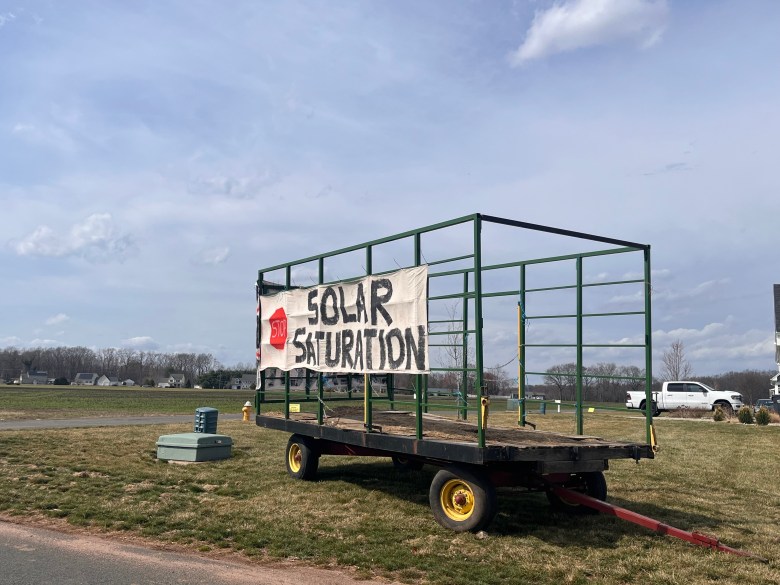
In East Windsor, however, residents expressed frustration with the Siting Council’s repeated approvals of new solar projects. At one stop along his tour Tuesday, Lamont was met with a large, hand-painted sign affixed to a trailer urging him to “stop solar saturation.”
The sign was the work of Amanda Berube, who lives across the street from a smaller solar array owned by NextEra that has faced persistent complaints from neighbors who say it emits a loud buzzing noise during the day. In addition, the array experienced a brush fire last year that was attributed to nearby utility equipment.
Berube and her neighbors are also alarmed over the latest proposal from Gravel Pit’s owners to develop another, 100-megawatt array known as Saltbox Solar on farmland within East Windsor and Ellington.
While the developers have yet to submit Saltbox Solar to the Siting Council for approval, online plans show it would leave Berube’s subdivision surrounded by solar panels on three sides.
“It would just be devastating to our neighborhood, it would be devastating to the neighborhood in Ellington,” and to local dairy farmers who use the land to grow corn to feed their cows, she said. “So I just really hope that something can be done, that the legislation can pass, so that we can finally put an end to this.”