



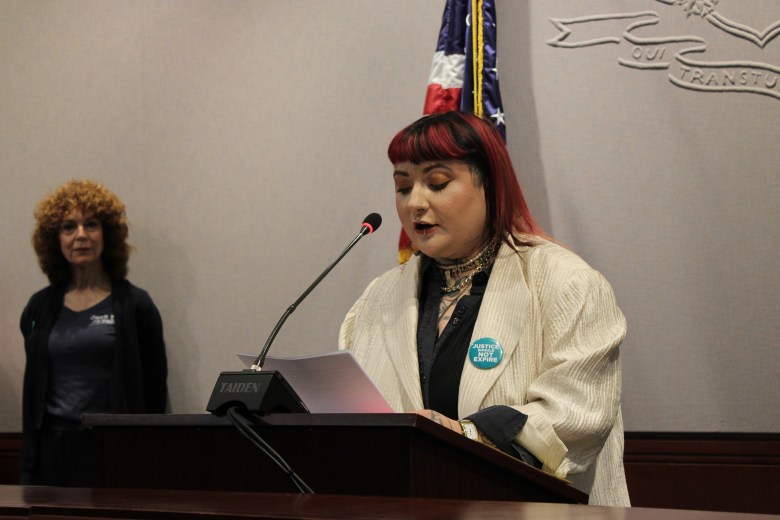
Leah Juliett was a 14-year-old student at Wolcott High School when the abuse started.
For nearly a year, a fellow student pressured her to share nude photos of herself. He then took the photos and spread them online. The photos were shared on Facebook and uploaded to another website where they remain still today.
At the time, the law had not yet caught up to changes in technology, and there was no name for the crime that had been committed against her. When she researched online, she found stories of people who had gone through similar experiences and killed themselves as a result. She said she barely survived her own high school experience.
“I wanted to kill myself, is the honest truth,” Juliett, now 29, told CT Mirror. “I really thought that I wouldn’t live to see the age of 20.”
Juliett and other survivors of child sexual abuse are now calling on members of the Judiciary Committee to commit to raising a bill next session that would eliminate the statute of limitations on such prosecutions. The bill would also create a three-year time period where people whose claims had passed the current statute of limitations — 30 years from the time a person turns 21 years of age — could bring those claims to court.
The survivors also want to expand the definition of child sexual abuse to include provisions around online exploitation of child sexual material and AI-generated material.
Afraid of being further targeted for abuse, or of getting in legal trouble herself for having sent the nude photos, Juliett said she kept silent and tried to make herself “as small as possible” during her high school years.
“ I walked through the hallways, and my peers looked at me as if they’d seen me naked, because they had. I lost all my friends. I changed my appearance. I dyed my hair. I changed my name,” she said. “But I self-harmed. I was suicidal. I barely survived. The day that I graduated high school at the time was the best day of my life because I felt like I could escape.”
At age 19, she started to speak to lawyers about pursuing her case in court. But she said that the attorneys she spoke with refused to work with her, saying that her case could be time-barred and noting that what happened to her was not a crime when the abuse took place. The person who spread the photos of her across the internet was ultimately arrested in relation to a different crime.
What ended up saving her, she said, was getting involved in advocacy work. She founded the group March Against Revenge Porn and led a four-year campaign of protest marches. She also supported the federal Take It Down Act, signed into law last year, which increases penalties for distributing non-consensual intimate images online and for the creation of these images using AI.
“ But here in Connecticut, where my abuse happened, there was never any justice. I don’t know if I will ever have justice, but I’m here because I want survivors like me who haven’t spoken up and come forward to be able to have justice not on a timeline,” she said.
According to Beth Hamilton, executive director of the Connecticut Alliance to End Sexual Violence, at least 14 states have already eliminated the statute of limitations for certain crimes around sexual assault. She said that advances in DNA and other technology and investigative techniques also allow for cases that happened years in the past to be investigated and proven.
She also noted the many reasons that survivors of sexual abuse delay in coming forward.
“ We know more about sexual violence now than we ever have before. We understand [that] … the neurobiology of trauma can impact memory and delay disclosure,” said Hamilton. “We understand why survivors so often wait — because of fear, because of shame, because of manipulation, because they were threatened, because they were children, because they knew the person who harmed them. And because too often survivors who come forward are not believed.”
Survivors who spoke noted that memories of sexual abuse often resurface decades after the abuse occurs. For Janet Orsatti-Duffany, who was sexually abused by a priest at the age of 3, the memories of what happened to her didn’t fully appear until four decades later.
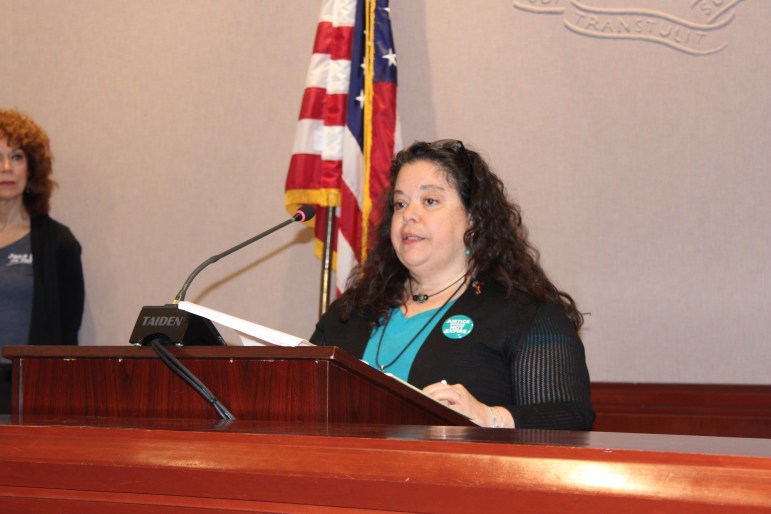
Orsatti-Duffany, now 55, said the effects of the abuse upended her life. As a child, she struggled with trust and with a fear of men, engaged in self-harm and used alcohol to self-medicate. As an adult, she couldn’t sleep in the same bed with her husband for years. She was institutionalized for attempting to hurt herself.
“I was an absolute wreck, mentally, physically, emotionally and spiritually. I started to realize that this was affecting my everyday life, and I needed help,” she said.
Therapy helped, but it took years before she was ready to come forward. When she eventually met with an attorney, she was told that she was too late — her claim had missed the statute of limitations by two months.
“ All that abuse, all those memories, all that suffering, all that work, only to be told I’m two months too late,” Orsatti-Duffany said. “ The halls of justice have been locked for many of us because of a date on a calendar.”
Carmelita Viega Rifkin, now 72, was 35 years old before she could access the memory of being abused by her uncle at the age of three. She said that as a parent of young children, she would constantly worry about how she was touching them when changing their diapers or bathing them. She said she was also haunted by feelings of unworthiness.
Although she never pursued a legal case — by the time the memory resurfaced, her uncle was already dead — she became part of the advocacy group Jane Doe No More, through which survivors run prevention and education programs around sexual crimes. She said she does education work in the school systems.
Juliett said that there should be more education for students in middle and high school, particularly from people who have lived experiences with sexual abuse crimes.
“ The reality is that kids are using Snapchat to send nude photos of themselves in middle school, and so they need to talk about it on a level at which people talk about it with a young person, with someone who gets where they’re at,” she said.
Juliett said she’s hopeful that if a law like this were to pass, she might be able to pursue a case through the courts. But she said she’s already gotten justice in other ways.
“My justice is still being alive. My justice is being 29 years old, is having five cats and a partner who loves me. My justice is being able to stand here and say, ‘I survived and I’m here for other survivors too,’” she said.
