




“Unlocking economic potential for underserved communities.”
This is the purpose of Connecticut’s Community Investment Fund, according to its masthead.
The fund, administered by the state Department of Community and Economic Development (DECD), has a total five year budget of $875 million authorized by the State Bond Commission.
On December 15th, another round of hopefuls (we’re already on the fourth round) will be submitting their proposals with fingers crossed. If it’s anything like round three, the dedicated DECD staff of five will review more than 200 applications in roughly six weeks, preparing summaries for the CIF Board by the start of session in early February.

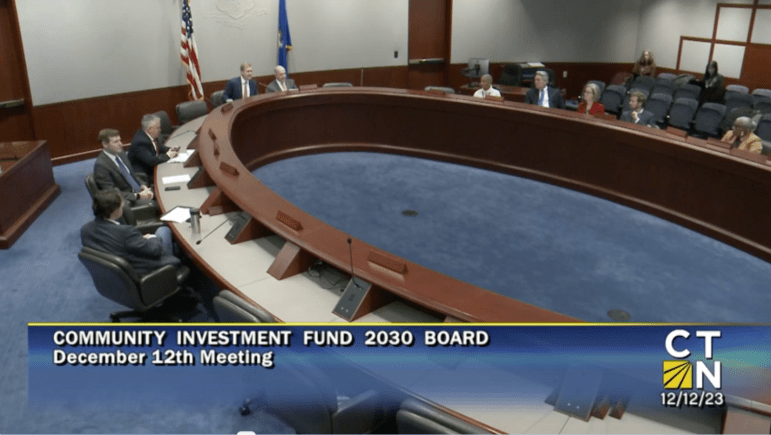
That 21-member board will have a month to review applications and make recommendations on where the cash should flow—allocating up to $175 million to qualifying applicants (municipalities, nonprofits, or corporations) from this list of 55 eligible municipalities for capital improvement programs, small business capital programs, or project planning.
You can stream the latest board meeting here.
With that much money on the table, accessibility is of the utmost importance. The project planning tract was new in the third round to delineate “soft-cost projects from shovel-ready projects” and garnered about 30 planning applications.
As of this round, there’s also a minimum grant size. Each applicant must request at least $1.5 million ($250k for planning) to be considered. Applicants are encouraged to creatively combine projects if need be. However, when we know that microgrants can facilitate community development due to their flexibility and more direct impact, this change might result in missed opportunities to help as many communities as possible—albeit more applications to review. Psssst, CIF — hire more staff!
If it’s positive change we seek then we must first change the methods of our approach. (Yes, I am paraphrasing my therapist). This is not a critique of the intent of the changes—nor the Board. While it’s too soon to analyze the CIF impact thus far, this is just the right time to recalibrate where we go from here. Community and economic development are said to be a reliable indicator of social wellbeing and quality of life. But what exactly does that mean? If nearly a billion dollars will be directed based on this idea, let us not fully embrace the opportunity to get radically honest about what has not been working, as a species, as a society, and as a community.
Let’s regroup—and use Bridgeport as a case-study!
Bridgeport accounted for five of the 75 projects awarded over the past three rounds, totaling $33,042,414 which is about 12% of the approximate $276.80 million in grants allotted thus far.

Round three included the largest grant awarded by CIF to the City of Bridgeport for $22.5 million to acquire and demolish the decommissioned coal power plant, PSEG Bridgeport Harbor Station Unit 3. This grant made waves given the large sum – and the fact that the potential development of the site was left unclear because the Metropolitan Council of Governments is currently in an evaluation process.
These waves crashed once the City backed off from buying the plant to avoid losing tax rolls and gaining the responsibility of remediation. When asked what will happen to the $22.5 million now, CIF Director Matt Pugliese answered that he could not comment since execution of the grant contract is pending review.
Despite being lauded as an environmental justice win by Mayor Ganim, the future of this CIF grant is uncertain; and the historic pollution of this coal plant stares in the face of the controversial construction of Bassick High School down the street.
No other CIF-awarded projects in Bridgeport prioritized sustainability and environmental justice; in fact, of the 75 awarded projects around the state, only seven have explicit or tangential connections to such work. This is a missed opportunity to accelerate Gov. Ned Lamont’s climate mitigation commitments. That said, perhaps it is the natural result of neither sustainability, climate, nor environmental justice being mentioned in the DECD Economic Plan.
Photo: Decommissioned PSEG Bridgeport Harbor Station Coal Plant.
Amid the COP28 controversy, we see how imperative it is to make proactive decisions towards a sustainable future that rejects fossil fuel consumption and pollution, remediates environmental degradation, advances ecological health, prioritizes indigenous stewardship and uplifts BIPOC leadership.
According to Pugliese, very few applications are climate resilience and/or energy efficiency focused despite eligibility. The top two categories applying are housing development and public facility renovation. Still, only about 15% of all applications receive funding. You can review the projects funded in rounds one, two, and three online.
So what hasn’t been funded?
One example is the Preservation Connecticut Washington Park Preservation Project. They proposed to renovate eight historic churches by restoring their structural integrity, energy efficiency, accessibility, climate resilience, and programmatic functionality—thereby facilitating community development. They were rejected. Twice. These churches provide essential services for community health and wellbeing, yet this care was not deemed a lucrative enough investment in economic development.
Therein lies the crux of this conversation. What is community development? What constitutes economic development? To what extent are the subjective answers to these questions driving the distribution of this exceptional funding opportunity? How can we expand these concepts to account for the realities of 2024 through 2027 and beyond?
Pugliese stated that there is no preference for community vs economic development but also shared that the CIF Board has no rubric or scoring process for project evaluation. They review the executive summaries prepared by CIF staff with consideration of DECD best practices and the applicants’ track record of ownership, securement of property and permits, bid and shovel readiness, community impact, etc. Unfortunately, the subjective nature of this evaluation process lends itself to personal bias and political whim.
“We need to be good stewards of state funds,” says Pugliese. He offers two pieces of advice to prospective applicants. “Think big! [And] take advantage of this resource, we as DECD staff are your friend.”
Each day we have the opportunity to witness the recreation of the world through our individual and collective force of will. No longer can we allow traditional models of economics and capitalism to shape our future. Change might be awkward, uncomfortable, and messy but it is essential. It is evolution.
This fund can be a catalyst for deeply impactful change in this state! To make that true, to seed the transformation of our communities, I invite applicants to get more creative and imaginative in your projects. Believe in your capacity to innovate solutions unique for your community. To the folks just learning about this now, apply in the next round! Go get that coin, it’s yours for the taking.
Lastly to the Board, with great power comes great responsibility, so keep your heart and mind open. You never know what pleasant surprises you’ll invite in.
Katharine Morris is a member of the CT Mirror’s Community Editorial Board.