


We often talk about northeastern Connecticut as the Quiet Corner — a region known for its rugged terrain, independent spirit, Victorian homes, spacious farms and beautiful country skies that offer unfiltered views of the constellations.
For young people, however, our part of the state is quickly becoming the Forgotten Corner. It’s happening before our eyes, on our watch. We can’t afford to stay quiet any longer. We have an obligation to act, and to act immediately.
If you grow up here, you are more likely to become disconnected from “para-social” institutions — school, work, job training, the military — than are young people from most other places in Connecticut. The hole of despair here can be quite deep, and bootstrap-pulling won’t help.
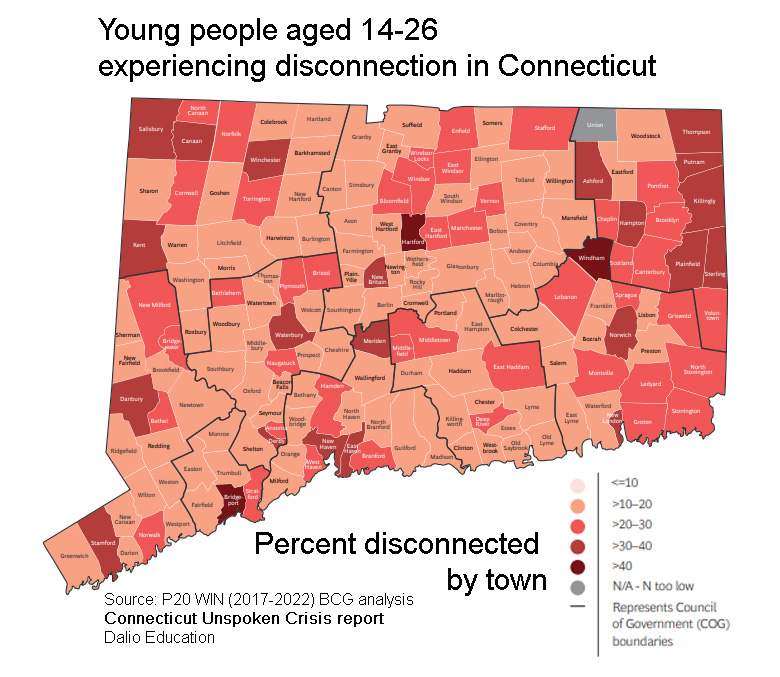
According to “Connecticut’s Unspoken Crisis,” the recently published Boston Consulting Group/Dalio Education report, between 20-30% of young people (aged 14-26) in Stafford, Lebanon, Pomfret, Brooklyn, Canterbury, Scotland, Chaplin, Sprague, Griswold and Voluntown are considered to be “disconnected.”
That percentage jumps to 30-40% in Plainfield, Killingly, Sterling, Putnam, Thompson, Hampton and Ashford. In Windham, our largest community (containing the borough of Willimantic), more than 40% of youth experience disconnection.
What do we mean by “disconnected?” Many of these teenagers and young adults have earned their high school credential but aren’t gainfully employed or enrolled in postsecondary education. Some never finished high school, do not have jobs, and may even be incarcerated. The younger ones may be at risk of not graduating from high school on time and/or are chronically absent from school.
[RELATED: Report: About 19% of CT youth ‘disconnected’ or ‘at risk’ in 2021-22]
Dan L., an 18-year-old resident of Plainfield, for example, has faced more challenges than most people experience in a lifetime. Born into a household with 14 people, his early years were marked by instability and hardship. His mother’s struggles with addiction led to her early exit from the family, leaving Dan and his siblings in the care of his father and a series of stepmothers.
“My childhood was far from easy,” Dan said. “There were times when it felt like everything was falling apart.”
When his father was injured in an accident, Dan became the primary breadwinner for the family, juggling school responsibilities while working multiple shifts — including overnights — at McDonald’s.
“I did what I had to do to keep us afloat,” Dan said. “It wasn’t easy, but I knew I had to step up for my family. I’ve faced obstacles at every turn, but I refuse to give up. I want to make a difference, both for myself and for others.”
Hannet N., 19, moved from Maryland to Killingly when she was 10. As her mother navigated through a troubled marriage, her family fell into temporary homelessness. Eventually, the family could afford a home in Plainfield, where Hannet and her three siblings felt a sense of stability and comfort.
Belonging to a tight-knit family with a single parent, however, has required Hannet to take on responsibilities beyond her years, caring for her younger siblings and supporting her mother in any way she can.
“My mom has always emphasized the importance of education,” Hannet said. “She’s sacrificed so much for us, and I want to honor her by succeeding in school and pursuing my dreams.”
There’s a term for young folks like Dan and Hannet — Opportunity Youth — and there are programs to serve them. We at EASTCONN — not Eastern CT State University (ECSU), but rather one of the six Regional Educational Service Centers (RESCs) statewide — know this population well.
The Eastern CT Workforce Investment Board’s (EWIB) youth workforce pipeline programs and Summer Youth Employment Program, delivered in partnership with high schools and youth service providers (including EASTCONN), enable at-risk and disconnected youth to explore career pathways, develop the job readiness skills employers covet, and gain the work experience that has been shown to increase lifelong earnings.
“Nearly half of the Connecticut municipalities with youth disconnection rates of above 30 percent are in Eastern Connecticut,” said Michael Nogelo, EWIB President/CEO. “Investments in programs that engage opportunity youth in career pathways provide a positive return for our young people, our employers and economy, and our communities.”
It’s not all gloom and doom. Last year, 93% of Opportunity Youth who participated in our regional employment and training program achieved an attendance record of 80% or better, while 95% returned to school or found jobs.
Still, we need a commitment from our lawmakers in Hartford to do whatever it takes — right now — while we still can. Connecticut doesn’t provide much funding to support services for Opportunity Youth; we must invest more in our future by increasing funding for programs that help young people find good jobs and provide wrap-around training and support to help them succeed.
We also need to ensure that state agencies make the most of available federal funding that isn’t being fully utilized. This funding could be directed towards supporting workforce development, education and social services for Opportunity Youth, whether administered publicly or privately.
These programs also help build a strong workforce for our state. While thousands of jobs remain unfilled statewide, Connecticut is ignoring some of its brightest, most promising young minds, whose potential can literally be measured in dollars — $650-$750 million, according to the Boston Consulting Group/Dalio Education report.
We’ve been quiet far too long. Let’s do something about this — for Dan, Hannet and thousands of other young people — and let’s start right now. They need us.
Eric S. Protulis is the Executive Director of EASTCONN. Kristin Hempel is the Director of Adult and Community Programs at EASTCONN.