



At the end of last year, Dalio Education published the report Connecticut’s Unspoken Crisis: Getting Young People Back on Track, prepared by the Boston Consulting Group (BCG), which found that that 119,000 young people ages 14 to 26 – one in five – are disconnected from school and work or at risk of dropping out of high school in Connecticut. And this spring, Dalio Education published a set of supplemental analyses from BCG offering a wealth of additional insights into this crisis.
Because BCG’s analysis integrates data from five of the 14 agencies that contribute to Connecticut’s state longitudinal data system, Preschool to 20 Workforce Information Network (P20WIN), following the 527,000 young people who ever attended a high school in Connecticut from 2014 to 2022, it creates a multi-dimensional view of each individual’s educational journey and employment trajectory. The richness of the data allows for the exploration of how different risk factors influence precursors of, and later associations with, disconnection.
In its supplemental analysis on long-term outcomes, BCG documents the impact of disconnection on later earnings in far greater detail than in the initial report, and uncovers the impact on wages of various in-school risk factors, such as attending a high-poverty high school or participating in alternative education, as well as out-of-school risk factors, such as previous involvement with the Department of Children and Families or Connecticut’s Homeless Response System. Following the two cohorts aged 14 or 15 in 2013, it identifies how earnings for these young people at age 22 are associated with previous educational attainment levels as well as risk factors, along with the interplay between the two.
The gaps in wages based on educational attainment for these cohorts at age 22 are wide, even before accounting for risk factors. Average earnings are $11,930 for a high school non-graduate, $22,690 for a high school graduate, and $32,590 for a post-secondary graduate – a multiplier on wages of nearly 2x and 3x associated with a high school and college degree, respectively. These data alone should ignite our sense of urgency around re-engaging young people who are disconnected, in furtherance of a better future for them as well as for our state as a whole.
The analysis further finds, however, that young people experiencing risk factors attain secondary and postsecondary degrees at lower rates relative to the overall population – and that even when they do, they still earn less, with wages that are persistently lower even when controlling for educational attainment.
For example, for young people who have received services from Connecticut’s Homeless Response System, their annual median wages at age 22 are $6,300 without a high school degree and $10,500 with a high school degree – representing 53% and 46%, respectively, of the overall population averages (see chart below). The typical young person in the overall population with no high school degree earns more than a young person who did graduate high school but has received services from Connecticut’s Homeless Response System.
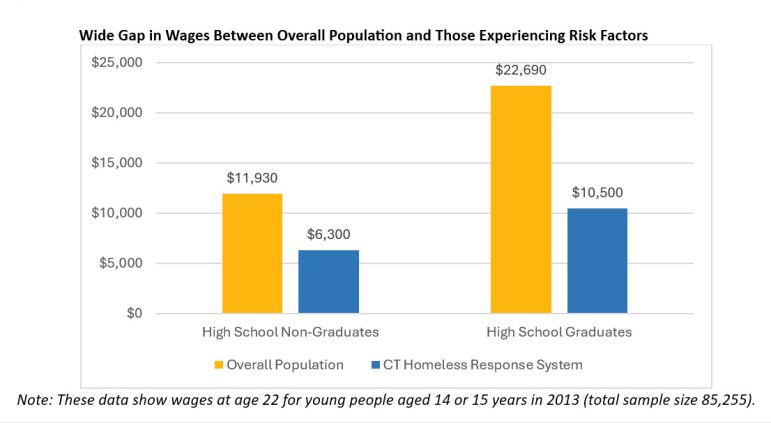
And when it comes to attaining a post-secondary degree, out of a total sample size of more than 85,000, and a sub-population of 2,600 individuals who received services from Connecticut’s Homeless Response System, only 70 were post-secondary graduates, making that sample size too small to offer a meaningful data on wages.
What we learn from this new analysis is that attachment to school alone is not sufficient to mitigate risk factors, and that the impact of risk factors persists even as young people age and attain higher levels of education, emphasizing the need for additional long-term supports and access to opportunities for vulnerable subgroups. And although these data show that continuing education can offer a pathway to higher income, we also see that it does not insulate young people who have experienced risk factors from also experiencing an associated negative impact on their wages.
For us at the Connecticut Opportunity Project (CTOP), the social investment fund of Dalio Education that invests in and builds the capacity of nonprofit organizations working with young people who are disconnected, these findings underscore the importance of the work our grantee partners do. Slipped through the grasp of schools, young people who are disconnected need intensive supports provided by community-based organizations to help them reconnect to education and employment pathways. And we as a state need to see this research as a call to action to invest far greater resources into the work these organizations are doing, if we are to reach at scale the 63,000 disconnected young people in Connecticut in need of supports.
Amanda Olberg is a Portfolio Director for the Connecticut Opportunity Project at Dalio Education