




Sometimes, the most harmful inequities in education hide in plain sight—and Connecticut’s teacher compensation is a prime example.
Consider Danbury, where the average teacher earns $82,682 —compared to $99,212 right next door in Ridgefield. These pay discrepancies have real-world implications for school districts competing to staff their schools with quality educators.
Indeed, according to the state’s Educator Vacancy Dashboard, Danbury began the current school year with 24 budgeted educator vacancies, compared to only one vacancy in Ridgefield. But an alarming new revelation in our report —Who Benefits? How Connecticut’s Financing of Teacher Pensions Reinforces Inequity in the Classroom -— is that the state is inadvertently reinforcing compensation inequities like these through the approach it takes to financing teacher retirement benefits.
Teachers earn pensions based upon their tenure and salary, and this creates a cost for every school employer in the state. Wealthier, often less-diverse communities can afford bigger salaries, so their teachers accumulate higher pensions. However, in Connecticut, current policy is to have the state pay for all of the school employer costs of pension benefits year over year.
For every pupil in Ridgefield, the state contributes $3,603 to the Teacher Retirement System, whereas it sets aside only $2,535 per Danbury student. That’s a 42% larger pension subsidy —largely because Ridgefield’s teacher pay is higher to begin with.
In fact, we find that Connecticut sets aside lower per pupil pension subsidies on behalf of districts that are poorer, more diverse, and lower-performing across the state. In other words, this subsidy creates a competitive downside for the very districts that are already the most disadvantaged —those that teach students with the greatest needs.
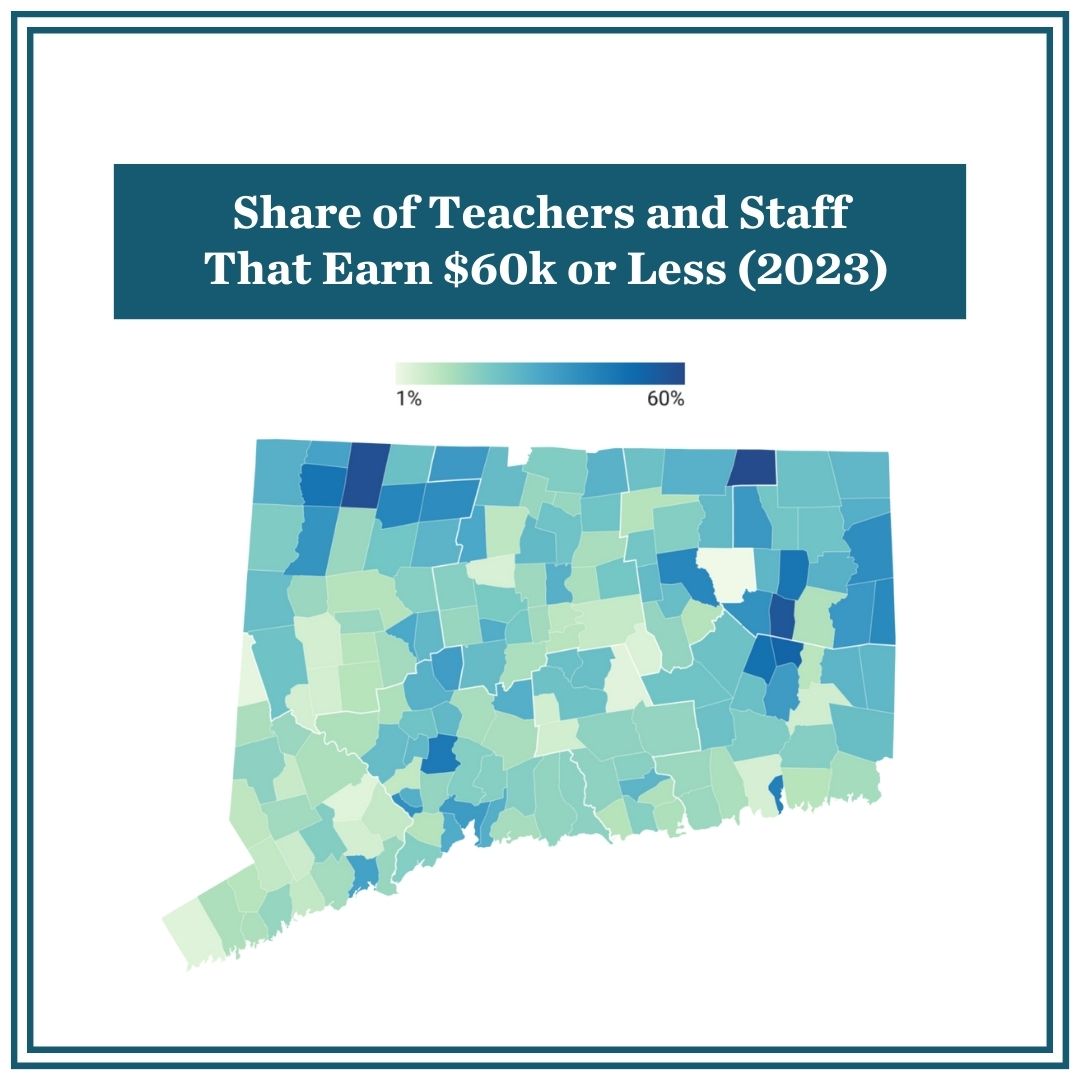
Since Ridgefield isn’t responsible for the relatively higher pension costs that come with offering higher pay, the state’s subsidies effectively mean Ridgefield has more resources to double down on salary compared to others like Danbury. With the state’s unintended thumb on the scale, 17% of Danbury’s staff make under $60,000 annually, while only 9% of staff in Ridgefield are paid at these lower compensation levels.
It is an illustrative comparison between neighboring districts, but it is just one example of many. Our report actually identifies that these are statewide trends: Connecticut’s financing of teacher pensions serves to amplify pre-existing inequities between districts. There’s also a significant price tag associated with this inequitable pension financing model. State-financed teacher pensions account for over a quarter of Connecticut’s overall K-12 education budget each year. For those who feel passionately about either resource equity or teacher shortages, the state’s teacher pension system simply cannot be overlooked any longer.
To be clear, there is nothing out of scale with the size of the pensions that teachers are earning in Connecticut; in fact, there are actually fewer teachers earning adequate retirement income benefits than there should be. The problem described here isn’t even the $16.4 billion in unfunded liabilities (as of 2023) that Connecticut has accumulated. Rather, the issue is that, by shielding districts and municipalities from the entire cost of teacher retirement, the state is compounding inequities and impeding the ability of the highest need districts to recruit and retain effective teachers.
For decades, teacher vacancies and education funding inequities in Connecticut have held students back. It’s refreshing to see so many state and legislative leaders, philanthropists, and advocates working publicly on these issues of late. It’s also time to find a more sustainable and fair approach to financing teacher retirement, because it is an undeniable part of the solution.
Anthony Randazzo is the executive director of Equable Institute.