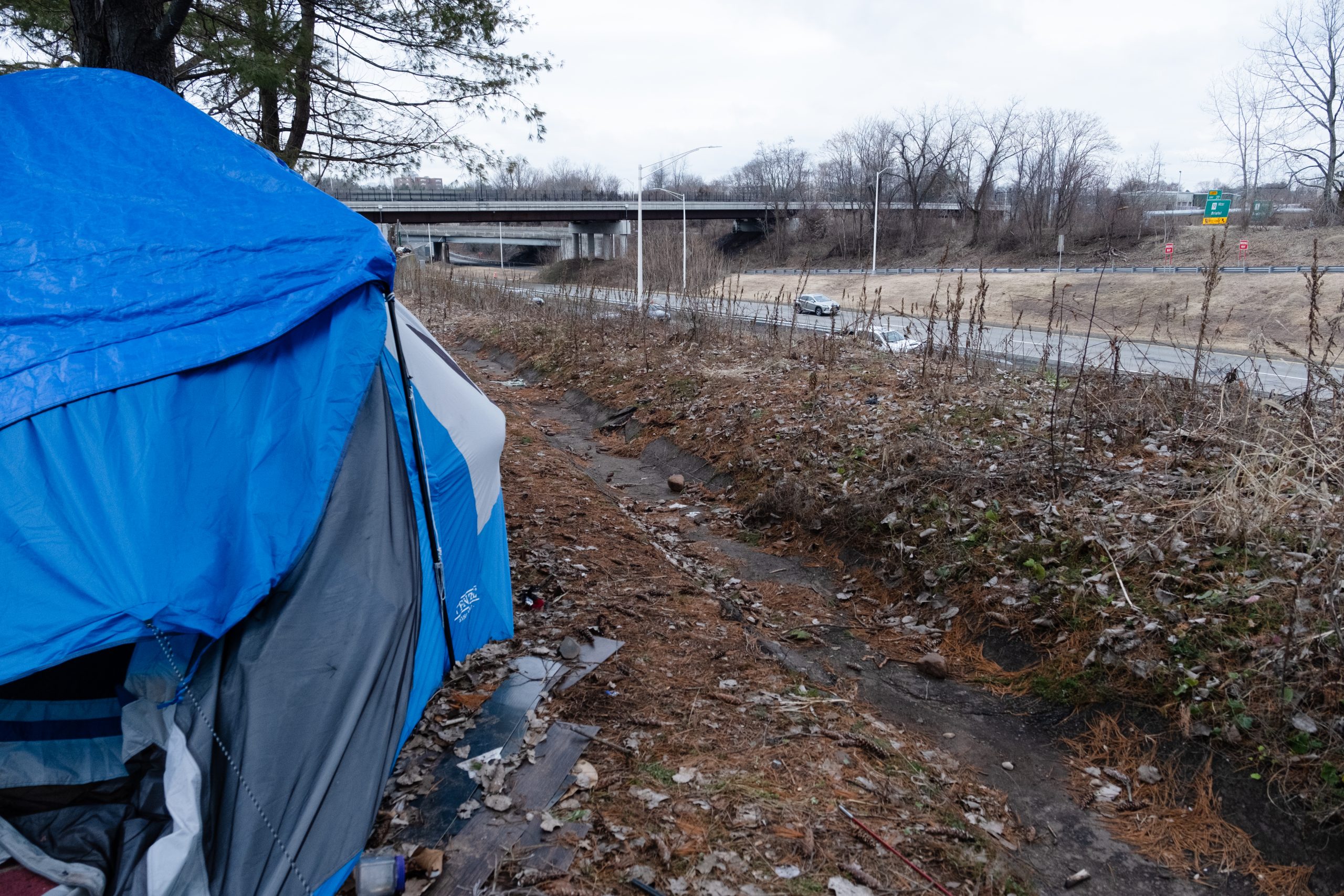
Lawmakers were asked Thursday to protect the unhoused population in Connecticut, who advocates worried might be ticketed or arrested following a Supreme Court decision last summer allowing towns to pass and enforce ordinances that prevent people from sleeping outside.
The Housing Committee heard public testimony on House Bill 7033, which would prohibit municipalities from penalizing people for conducting “life sustaining activities,” such as sleeping, eating and storing personal belongings, in public spaces. There are exceptions if there is adequate indoor shelter offered that includes transportation to the shelter for the person and their belongings or if people are impeding traffic.
The bill positions Connecticut to join a national movement of states and cities that are trying to protect people experiencing homelessness, particularly under a presidential administration many say could be harmful to the unhoused.
Homelessness has been on the rise in Connecticut for the past few years, which experts say is a result of rising rents and lack of affordable housing. The latest data from the Connecticut Coalition to End Homelessness showed that there were more than 5,000 people experiencing homelessness, and about 900 of those are living outside.
“What’s the alternative? Where do you put these people? It’s not like these people asked to be homeless,” said Michael Cutler, who lives outside in New Haven, in an interview. Cutler is a member of the advocacy group U-ACT and has been unhoused for the past three years.
He said he doesn’t go into a shelter because they’re often overcrowded and noisy. It’s hard to get privacy or a good night’s sleep, he said. Instead, he opts to try to find a covered place and stay warm in a sleeping bag.
“No person should have to go through that,” he said.
Connecticut’s shelter system is strained, and shelters often have to turn people away because the beds are full. Congregate shelter settings are also difficult for people who may have to leave their possessions behind, have pets or want to stay with their spouse.
The bill is a response to a summer Supreme Court decision that ruled in an Oregon case that towns can pass and enforce ordinances that prevent people from sleeping outside. Over the past couple of years, Connecticut has also had high-profile sweeps of homeless encampments, which some supporters of the bill say they hope will end if the measure passes.
“We’re people,” said Alexis Terry, who found housing a few months ago after a stint of homelessness in New Haven. “We’re complex human beings with complex emotions and it’s a shame that we have to keep humanizing ourselves.”
With its current language, proponents say that the measure will limit sweeps of homeless encampments. But Housing Committee ranking member Rep. Antonio Felipe, D-Bridgeport, said lawmakers would adjust the bill to ensure that it protected people seeking shelter and doesn’t enable people to create encampments.
This measure, or some version of it, has been a priority for Felipe since the Supreme Court decision came down last year.
“This is a blatant example of kicking people while they’re down,” Felipe said at the time. “It’s not like these people chose to be unhoused. It’s not like these people chose to be in the situation they’re in. These people are struggling mightily, and the housing market is hard.”
Some city officials have opposed the bill, saying it inhibits municipalities’ ability to keep public space clean, safe and usable for everyone.
“Public space is public for everyone,” said New Haven Mayor Justin Elicker in an interview. “ … The goal is to connect people to housing, and we’ve worked very, very hard to do that.”
He said the city has outreach workers who visit encampments and try to help people find another place to go before clearing encampments. He also said that the camps often have human waste, trash and unsafe heating methods.
“One of the things I want to talk about is also the alternatives to this bill that I think could work is to actually appropriate more funds for more shelters and beds and as well as provide wraparound services, support services,” said Brian O’Connor, director of public policy and advocacy at the Connecticut Conference of Municipalities. “I think that’s a better approach.”
Sarah Fox, chief executive officer at the Connecticut Coalition to End Homelessness, said more resources are needed to help the population. Encampments are a complicated issue, she said, and the goal is not to villainize anyone.
Advocates have asked for $33.5 million in the state budget, although it’s not clear how much they’ll receive. Elicker has testified in support of that additional funding.
Josh Michtom, a Hartford city council member, said that while more resources are needed, he wants lawmakers to think of the bill as a response to a humanitarian issue.
“This is not an ‘either, or.’ It’s a ‘both, and,’” Michtom said in public testimony. “We can’t criminalize human beings who are truly at the lowest point, at the point of greatest struggle, probably in their lives.”
In the Oregon case that inspired Connecticut’s law, a woman named Gloria Johnson was punished for camping in a park although she said there weren’t any adequate options for shelter.
In its first major ruling on homelessness in decades, the Supreme Court ruled that the ordinance was enforceable in a 6-3 decision. The decision has sparked a national movement.
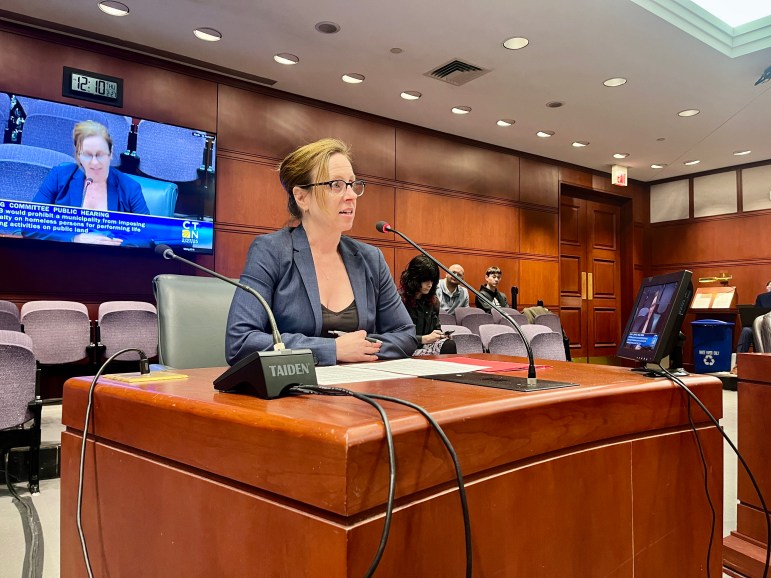
Other states such as Virginia, Illinois, Massachusetts and Maryland have introduced similar bills. The National Homelessness Law Center has advocated for passage of model legislation called the “Gloria Johnson” act that’s similar to Connecticut’s, said Jesse Rabinowitz, the center’s communications director.
“We will never be able to arrest our way out of homelessness,” Rabinowitz said. He said about 150 cities have passed ordinances that would allow people experiencing homelessness to be arrested or cited for doing things such as sleeping outside.
This often leads to fines they can’t pay or arrest records that make it harder to find housing.
Advocates say they haven’t heard many similar reports of arrests or fines in Connecticut, but that the bill is in part preventative.
Rabinowitz said his group is among those working to see a bill similar to Connecticut’s introduced at the federal level.
Sarah Gallagher, a Hamden town council member, is among those working with Rabinowitz. In January, Hamden passed an ordinance declaring housing as a human right.
The town has recently opened a warming center and is working to find ways to house people experiencing homelessness, Gallagher said.
“People experiencing homelessness have the same rights as everybody else,” Gallagher said.