


This story has been updated.
Law enforcement officials, policy experts and advocates are divided over whether to eliminate what are known as “non-safety related” traffic stops by police. Some say it prevents officers from addressing real safety concerns, and others counter that these traffic stops unfairly target racial minorities and divert police resources that could be used to address more serious crimes.
That debate came before state lawmakers Friday when the legislature’s Judiciary Committee heard public testimony on House Bill 7132, which would remove several equipment violations from a list of legal infractions for which Connecticut motorists can be pulled over.
Those infractions include: a broken headlight; having license plates displayed in a rear window, but “plainly legible”; or having a windshield ornament or sticker, as long as it doesn’t “significantly block or conceal” the driver’s ability to see.
Similar bills were proposed in 2023 and 2024. Both passed out of the Judiciary Committee, but neither made it through both the state Senate and the House of Representatives.
The Connecticut Police Chiefs Association said in written testimony that having only one working headlight presents safety risks to other drivers. “In addition to the confusion often caused to oncoming motorists, the lack of two working headlights negatively impacts the ability of the operator to see roadway obstructions and other roadway users, especially bicyclists and pedestrians,” the testimony read.
The association also said allowing a license plate to be displayed behind glass would make it more difficult for red-light cameras and speed cameras to capture the license plate number. And they said if the state logo were covered, police officers might have difficulty identifying the vehicle.
According to Commissioner of the Department of Emergency Services and Public Protection Ronnell Higgins, equipment violations have increased over the last three years, reaching about 3,800 in 2024. In testimony to the committee, Higgins said stops for broken headlights shouldn’t be eliminated, noting that most fatal crashes happen at night.
Republican members of the Judiciary Committee engaged in lengthly arguments against the bill during Friday’s public hearing.
State Rep. Greg Howard, R-Stonington, who is a police officer, repeatedly questioned whether secondary traffic stops were actually taking time away from policing more serious infractions. State Rep. Craig Fishbein, R-Wallingford, said the bill wasn’t clear enough about what could and could not be obscured on a license plate.
But Michael Harvey, a retired police captain and member of the advocacy group Law Enforcement Action Partnership, said in written testimony to the legislature that stopping people for “minor infractions” could lead to officer-related shootings, which can seriously damage trust between police and the community.
“These non-safety related stops, which often lead to negative police interactions, have little benefit to public safety,” Harvey wrote. “In the overwhelming majority of pretextual stops, no guns, drugs, or even lower-priority violations are found. … The time spent making low-level traffic stops would be much better spent preventing more serious traffic violations and working with residents to address their safety concerns.”
Harvey also cited a 2021 report from the Connecticut Racial Profiling Prohibition Advisory Board that found Black drivers were almost twice as likely to be stopped for headlight and license plate display violations compared to white drivers, and Hispanic drivers were 1.5 times as likely to be stopped for these violations as white drivers.
Daniel Bodah, a senior program associate with the Vera Institute of Justice, said that in addition to being more likely to be stopped, Black drivers are also more likely to be searched by police — thought they’re less likely to be found with contraband.
Jiadi Chang of the Center for Policing Equity, an advocacy group that has worked with several police departments in Connecticut, cited a study showing that when certain towns in Connecticut focused their attention away from equipment infractions, they saw other positive results. According to the study, New Haven saw a drop in car crashes by 15% over a single year.
Anderson Curtis, a senior policy organizer with the Connecticut chapter of the American Civil Liberties Union, said legislators also needed to consider the “human experience” of being pulled over, especially for people of color.
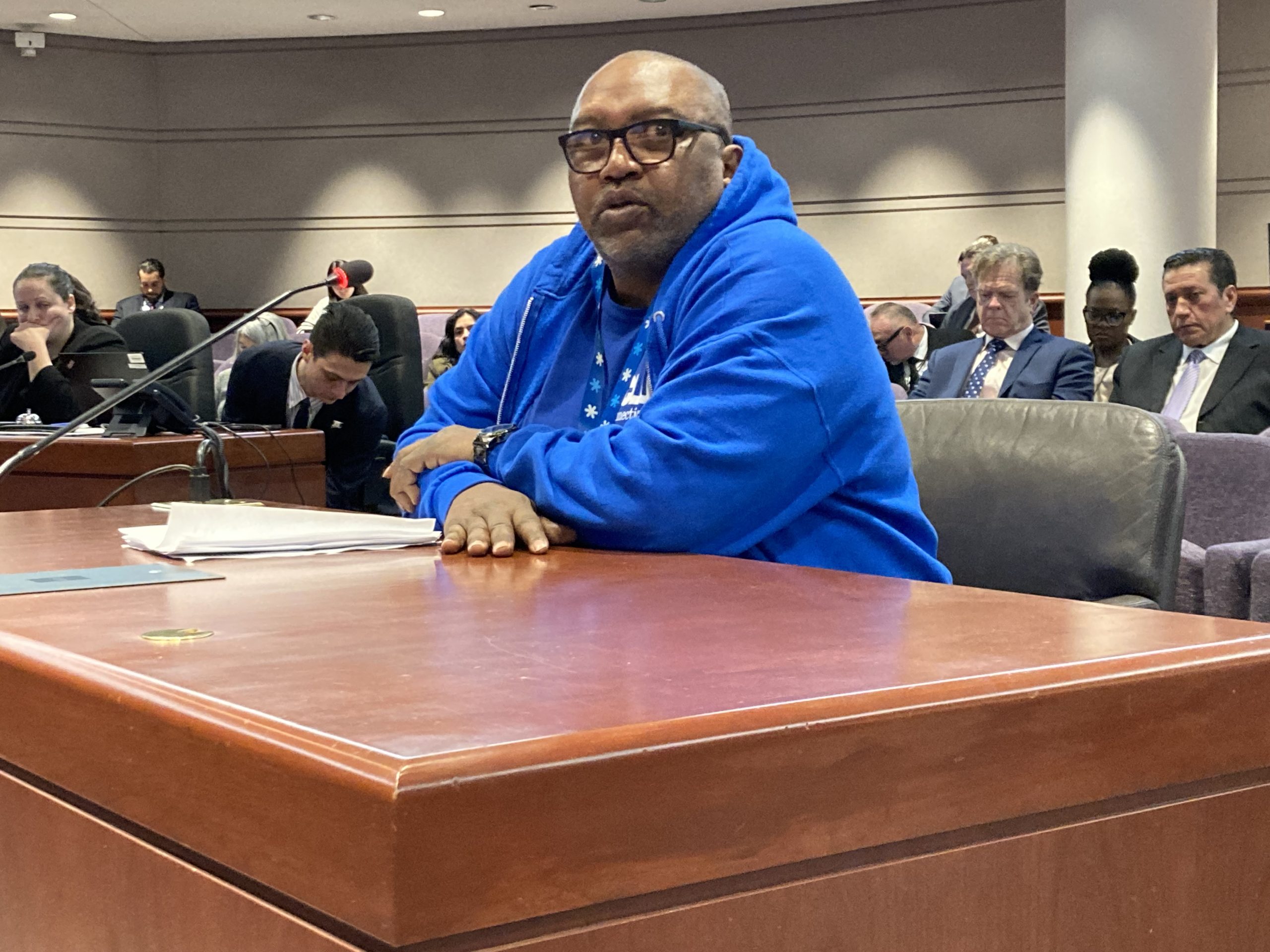
He shared his own experience of being pulled over in Vernon for a safety check. “ Even though I have insurance, even though my car is registered, even though I have a driver’s license, in those five to ten minutes when the officer goes back to his car, my trauma takes over and I believe I’m going to go back to jail. And those five or 10 minutes feel like an eternity for me,” he said.
Judiciary Committee Chair Sen. Gary Winfield, D-New Haven, said he could empathize.
“When I get pulled over — despite the fact that I’ve been told that there are not many people who are in law enforcement who don’t know my face — when I get pulled over, I’m very concerned too,” he said.
Correction:
An earlier version of this story transposed Anderson Curtis’ first and last name.
