



These news briefs were originally written for CT Politics, The Connecticut Mirror’s weekly newsletter providing updates on the 2025 legislative session. To sign up for CT Politics, click here.
Fifty years of advocacy
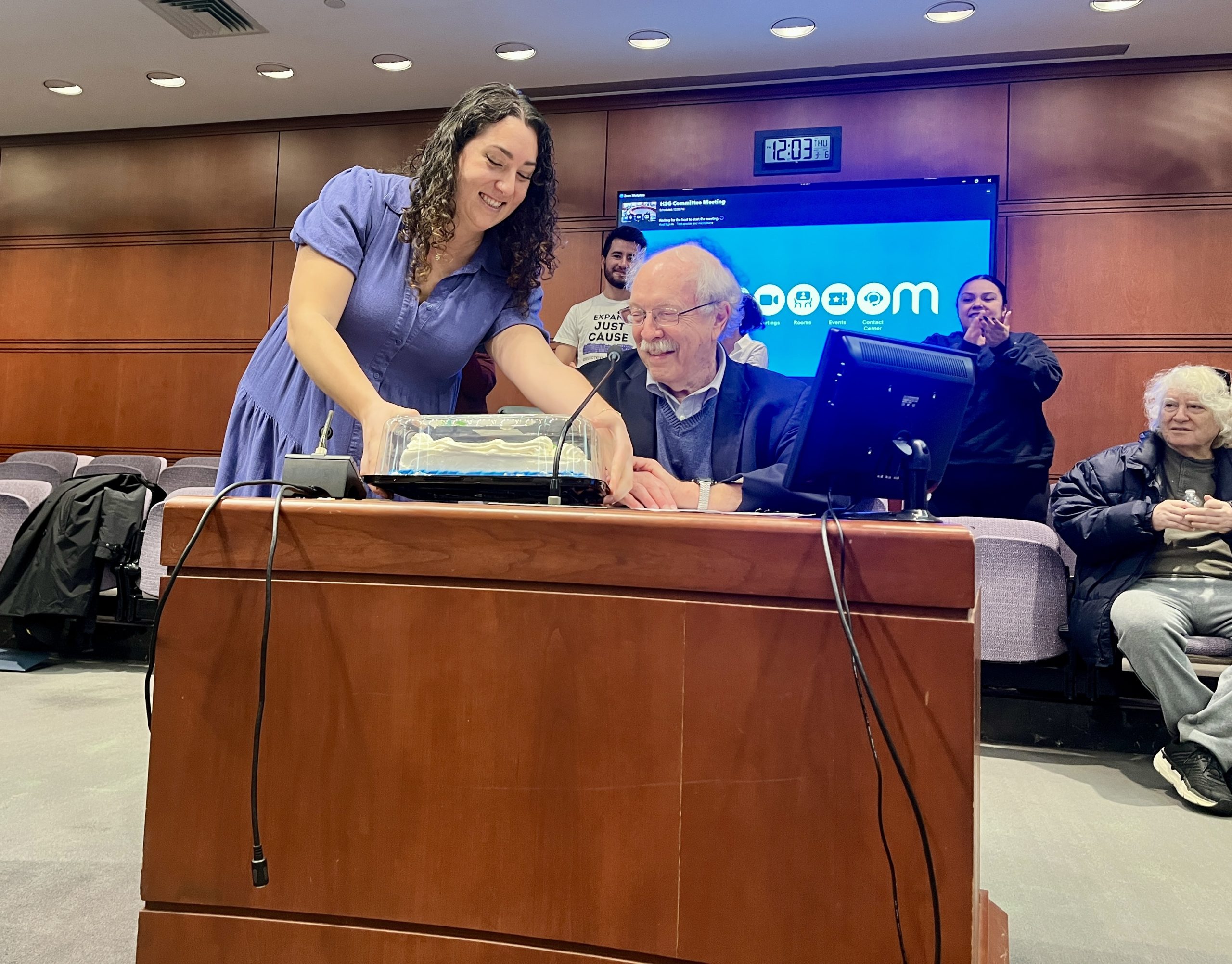
After 50 years of working as a lobbyist and advocate on housing issues, attorney Rafie Podolsky received a plaque recognizing his service, a signed basketball and a cake from lawmakers ahead of Thursday’s Housing Committee meeting.
Podolsky, who works for Connecticut Legal Services, is a longtime housing expert who has worked on a plethora of issues ranging from affordable housing law 8-30g, to fair rent commissions, to eviction law.
“Attorney Podolsky’s legacy includes the creation and protection of the state’s affordable housing appeals program, safeguarding tenants rights and enhancing the Rental Assistance Program,” Housing Committee co-chair Rep. Antonio Felipe, D-Bridgeport, read from the plaque. “Legislators continue to rely heavy on his advanced knowledge or robust, robust network of allies to advance housing legislation.”
Felipe and co-chair Sen. Martha Marx, D-New London, gave Podolsky a basketball signed by members of the Housing Committee and legislative leadership, a nod to one of Podolsky’s favorite sports.
“I’m the second person in my family who has received a plaque, and the first person – in 1978 – my daughter, who was then 1 year old, was given a plaque” for being an unofficial lobbyist, Podolsky said Thursday.
— Ginny Monk, Children’s Issues and Housing Reporter
2026 Governor’s race
Connecticut got its first declared candidate for governor last week: Jen Tooker, the Republican first selectwoman of Westport.
One of her qualifications for the 2026 gubernatorial race, she says, is being “elected four times in a town where Kamala Harris won over 70% of the vote in 2024.”
New Britain Mayor Erin Stewart, also a Republican, previously had opened an exploratory committee.
Gov. Ned Lamont, a Democrat, has yet to say if he will seek a third term. Republicans have not won a gubernatorial race in Connecticut since M. Jodi Rell’s victory in 2006.
Democrat Dannel P. Malloy won in 2010 and 2014, each time beating Thomas C. Foley, a Republican businessman. Lamont’s two victories in 2018 and 2022 also came against the same opponent, Republican business executive Bob Stefanowski.
— Mark Pazniokas, Capitol Bureau Chief
Long-term care insurance
The Aging Committee voted unanimously Tuesday to advance a bill that would provide a tax deduction for people with long-term care insurance policies and require public hearings for rate increase requests that exceed 10%.
The measure now heads to the Insurance and Real Estate Committee, which could incorporate portions of the bill into its own long-term care insurance legislation. Members of the Aging Committee have said they are pressing for relief for policyholders who struggle with large premium increases.
“It’s giving support to the issue,” said Rep. Jane Garibay, D-Windsor, co-chair of the panel. “This is important to us. We work with the aging population; we’re sending this bill to [the Insurance Committee] to give them support.”
Nearly 100,000 people in Connecticut have long-term care insurance – coverage that, depending on the policy, supports skilled in-home care, rehabilitation therapy, assisted living, nursing home stays and respite care.
So far this year, at least 14 bills have been raised to tackle the rising cost of these plans.
— Jenna Carlesso, Investigative Reporter
Child care costs
Georgia Goldburn, the executive director of Hope for New Haven, a child care and preschool center, and co-founder of the advocacy group CERCLE, gave emotional testimony at the Committee on Children on Tuesday about a bill that would fund early childhood care.
Goldburn said she had a testimony prepared but was upset by previous comments on the bill which indicated that some opposed the measure on the basis that they did not want to pay for child care costs for other people.
“As I’m sitting listening to a statement saying, ‘I don’t want to pay for anybody else’s child care,’ I’m reminded of that moment when my staff and so many other family child care providers in the CERCLE network and across the state put aside their fears for themselves and their family and served the state of Connecticut to deal with a pandemic and a crisis so that doctors can go to work and care for the elderly, care for the sick, and care for the constituents of this state,” she said. “That was such a selfless act of all of those people. So to hear a statement like, ‘I don’t want to pay for somebody else,’ well for years child care providers have been paying, picking up the check of the cost for this state.”
Goldburn said that providers are exhausted and that it was “deeply wounding” to see the sacrifices people in her industry make and have the state and some constituents respond that it’s too expensive. “For us, the providers on the ground, it has cost us almost everything.”
— Laura Tillman, Human Services Reporter
Private equity in health care
The Public Health Committee heard testimony concerning HB 6873, Governor Ned Lamont’s proposal to rein in private equity and give the state greater insight into major health care transactions. Among other provisions, the bill expands the types of transactions that would trigger the need to file a “notice of material change” with the Attorney General’s office, including acquisitions of at least 20% of health care entities, sale of a majority share of a physician practice to a private equity firm and sale of a hospital’s property to a real estate investment trust.
OHS executive director Deidre Gifford said the expanded reporting would give the state the ability to review the types of transactions that drained resources from Connecticut’s Prospect Medical Holdings-owned hospitals.
Much of the testimony supported the expanded oversight, but a handful of physicians said that the bill would cause reporting burdens to practices that turn to private equity ownership as the only option available to them if they want to remain independent.
Dinesh Kapur, a Norwich-based oncologist, said that joining a private equity-backed management service organization helped his practice survive COVID, offer state-of-the-art therapies, and continue providing high-quality community care. Kapur added that, despite the partnership, all clinical decisions remain with physicians. “We have full clinical autonomy, and our clinical judgment has never been questioned by our MSO partners,” Kapur wrote.
— Katy Golvala, Health Reporter
Wheelchair repair
Wheelchair users and advocates testified before the Human Services Committee on Thursday in support of House Bill 7106, which attempts to strengthen a law passed in 2024 to improve repair times for wheelchairs. That bill was unanimously passed by lawmakers and required companies to complete repairs within 10 business days of the request, as long as replacement parts were available and the repairs were authorized by insurance.
The new bill goes further, taking into account recommendations from the Wheelchair Repair Advisory Council, including provisions for quick emergency repairs, and express delivery options for needed parts. It also attempts to provide wheelchair users with more information about their rights through a public awareness campaign. And it requires Medicaid to pay for preventative maintenance and express delivery of needed parts.
Advocates say that while the 2024 bill was a needed step, it didn’t go far enough. Sheldon Taubman, litigation attorney with Disability Rights Connecticut and member of the Wheelchair Repair Advisory Council, told the committee that repair wait times remain about the same as before the 2024 law went into effect — it was then more than 49 days on average from request to repair.
Maureen Amirault, a wheelchair user and co-chair of the council, told the committee about how complicated it was for her chair to be get repaired late last year. “By October the chair was shutting down several times a day and sometimes I could not get it restarted, I was stranded so many times both in and out of my home,” Amirault said. She said that the company Numotion tried to get the chair remotely repaired by giving instructions to Amirault’s friends and family members. The process went on for a month during which Amirault was bed-bound at times until the company finally sent a tech out to fix the chair. “We need a stronger and more comprehensive law to hold them to account.”
— Laura Tillman, Human Services Reporter
Health care for incarcerated people
This week the Public Health Committee passed a bill that would require the Department of Public Health and the Department of Correction to annually evaluate the quality of health care services provided to incarcerated people in the state.
During a public hearing for the bill earlier this week, several people formerly incarcerated in the state testified to the lacking health care services they received while in correctional facilities. An annual breast exam Janice Parker had done while at York Correctional revealed a black image, but it took six months before she received follow-up care, she said, despite a history of breast cancer in her family. After getting another appointment, she learned that a DOC-provided bra was creating the black image, but the wait, she said, was grueling. “I felt like I was dying slowly in there. It took a lot out of me,” Parker said.
Interim correction ombudsman DeVaughn Ward, whose office is tasked with responding to complaints from people incarcerated in the state, testified in support of the bill, adding that at least 60% of the complaints his office has received since September 2024 relate to health care services. Department of Public Health Commissioner Manisha Juthani submitted written testimony that the bill would create challenges for the agency, including lack of scope for the annual review and lack of subject matter expertise in correctional health care at DPH.
— Katy Golvala, Health Reporter
School crisis response bill
A proposed bill that would change how crisis response drills are conducted in schools received broad support at an Education Committee public hearing Monday.
House Bill 7077 would mainly change how these drills are communicated to staff, families and students – with requirements that the practices be trauma-informed, consider traumatic experiences, are “designed to prevent emotional harm to and support the psychological safety of students and school personnel, with mental health professionals’ participation integrated throughout the crisis response drill.”
Before any drills, school staff will be required to provide “age-appropriate education” to “reduce the potential for confusion or emotional distress,” and clearly communicate the purpose of the drills to parents before they’re conducted. Students and school staff will also be notified ahead of time of the drill.
“Each time we do these drills, my fear of a tragedy occurring at my school increases. These thoughts don’t go away when the drill ends, but they keep going through our minds every single day,” said Skylar Urbina, a student from Newtown. “Instead of focusing on my education, my fear is overcoming me and I am thinking about what I would do if a shooter came into my school, into my classroom, and how I would escape. With the new approach, they can allow us to feel safer and actually more prepared, instead of increasingly anxious. Additionally, letting us know ahead of time that a drill is going to occur will be incredibly helpful. Instead of suddenly hearing the announcement that the school is going into lockdown mode and not knowing what is going on, giving us a heads up will allow us to mentally prepare so we are not surprised by this.”
— Jessika Harkay, Education Reporter
Push to strengthen move-over law
Friends and co-workers of Andrew DiDomenico, a worker for the Department of Transportation who was killed on the job last year, submitted testimony to the legislature’s Judiciary Committee in support of a proposal that would increase penalties for drivers who fail to move over when they see an emergency vehicle on the road.
DiDomenico was working on an on-ramp to Interstate 91 in Wallingford last June when he was struck by a motor vehicle and killed. He was 26 years old.
Denise Lucibello was charged with 2nd degree manslaughter, which has a maximum penalty of 10 years in prison. She was also charged with operating with a suspended license and driving under the influence. She pleaded not guilty in October.
But former colleagues of DiDomenico’s who sent testimony to the legislature’s Judiciary Committee said they felt the 10-year maximum penalty was too little.
The proposed law would increase the penalty for drivers who strike and kill emergency workers by failing to move over by raising it from 2nd degree to 1st degree manslaughter, doubling the maximum penalty from 10 to 20 years of prison.
Timothy McCue, who was the crew leader at the Wallingford maintenance garage where DiDomenico was working, identified DiDomenico as an “ideal coworker” and “like a little brother to me.”
“Andrew had such a bright future and that was taken from him. He never got a chance to start a family and have those traditions and memories of going to games, collecting cards and memorabilia with his kids,” he wrote.
Eric LeBarron, who worked with DiDomenico in the Wallingford garage for more than two years, said he could have been the one to die that day.
“Our lives matter out there performing duties to keep Connecticut roads safe and passable. I would like to go home to my wife and children at the end of my shift. Please find it in your hearts to pass this bill and better protect all roadside workers,” he said.
— Emilia Otte, Justice Reporter
Debt-free education bill
Dozens of faculty, staff and students in the Connecticut State Colleges and Universities system voiced support for a bill Friday that would expand a community college program, which supports the cost of tuition and fees, to also extend to the state’s four regional universities.
The Mary Ann Handley Award, which was previously known as the PACT Program, allows students to attend community colleges in Connecticut “debt-free” by covering the “unpaid portion of tuition and required fees” or providing a $500 grant for full-time students for the first 72 credits earned.
Chancellor Terrence Cheng said at a public hearing Friday he was joining union members “in their advocacy and support of House Bill 6885.”
The program “has been instrumental in expanding access to students who would otherwise not have the opportunity to receive a post secondary education,” Cheng said. “Expanding this program to CSUs will help more students pursue bachelor’s degrees – increasing earning potential and strength in Connecticut’s workforce.”
— Jessika Harkay, Education Reporter
Banning discrimination in health care
When Simon Amaya Price was 14 years old, he was diagnosed with gender dysphoria. During a visit to his pediatrician, the doctor asked his father: “Would you like a dead son, or a living daughter?”
Even so, his father refused to agree to hormones or surgical interventions, for which the 20-year-old said today he is “beyond grateful.”
Amaya Price is one of several people who spoke to the Judiciary Committee on Friday in opposition to a proposed bill banning discrimination in health care based on “a person’s race, color, religious creed, sex, gender identity or expression, sexual orientation” and other factors.
Nicole Hayes of the American Association of Medical Ethics said the bill forces medical professionals “to ignore biology, to ignore their medical training and their morals.” She said children with gender dysphoria should be met with “compassion, help and understanding,” not surgery or medical treatments. But an unnamed pediatrician who submitted written testimony said she often saw LGBTQ+ individuals presenting with higher rates of depression and suicide, and that Connecticuts hould “offer them equal protection under the law.”
State Sen. Gary Winfield, D-New Haven, said the bill came from a conversation about people not getting certain medical treatment based on certain characteristics — like Black people not being given adequate pain medication. “The reason for this bill has nothing to do with all of the testimony today,” he said. “The consideration was that when folks like me show up in medical spaces, oftentimes we are treated in a way that doesn’t comport with the reality of who we are.”
— Emilia Otte, Justice Reporter
Public benefits charge
More than a hundred people lined up to testify for a marathon public hearing on several bills related to energy policy Thursday — with many of them expressing outrage over the cost of Connecticut’s highly controversial public benefits charge.
One letter, penned by Kristin Robinson, echoed the sentiment of many others as she described turning her heat down to 58 degrees in the winter just to keep her electric bill manageable. “For once I’m not angry at Eversource,” Robinson wrote to lawmakers. “You shirked your responsibility. It matters how this is paid.”
Among the bills before the Energy and Technology Committee this week was the Republican proposal to address electricity costs, Senate Bill 647, that would shift the cost of the public benefits charge onto the state budget, cap the costs of power-purchase agreements and reclassify the Millstone Nuclear Power Plant in Waterford as renewable energy for the purpose of obtaining credits.
But many Democrats have objected to the plan, particularly moving the public benefits charge, which they argue supports programs such as energy efficiency and nuclear power agreements, which benefit all ratepayers in the long run. “I don’t believe in any way, shape or form that moving them out of the bill will fix anything,” said the co-chair of the committee, state Sen. Norm Needleman, D-Essex. “I think it will make things worse.”
Democrats’ legislation, Senate Bill 4, seeks to clear a pathway for the development of new nuclear reactors, along with geothermal heating and cooling systems in order to reduce demand on the grid and improve reliability.
— John Moritz, Energy and Environment Reporter
Housing bills pass committee
In what was likely their last meeting of the year, the Housing Committee on Thursday passed several of their highest-profile bills of the session on issues such as eviction, zoning and homelessness. The committee approved dozens of bills in a meeting that stretched into the early hours Friday morning.
After nearly six hours of debate, members voted along party lines to send a bill that would largely end no-fault evictions, which typically occur at the end of a lease. They also approved a measure that requires towns include in their affordable housing plans how they’ll zone for a set number of units, based on regional need. The number of units would be determined based on a study of a fair share policy set to be finished in the next couple of months.
They also passed a bill that ensures people experiencing homelessness aren’t fined or arrested for sleeping, eating or performing other activities of daily life in certain public spaces. That bill has been adjusted to ensure that it doesn’t allow people to build encampments and to exclude school grounds as public space. The bills will next head to the House for approval.
— Ginny Monk, Children’s Issues and Housing Reporter