


U.S. Rep. Jahana Hayes, D-5th District, fought back tears Monday morning as she spoke about President Donald Trump’s executive order last week that called for the dismantling of the U.S. Department of Education.
Hayes, a Waterbury native, described herself as a product of Connecticut’s public education system. She attended public K-12 schools and later got associate’s and bachelor’s degrees at state schools. A former educator at a Title I school in her hometown, Hayes was awarded National Teacher of the Year in 2016.
She said those experiences helped inform her work in Congress for the past six years. “Angry wasn’t the word,” she said, to describe her feelings toward what she and many lawmakers across the country are calling an attack on public education.
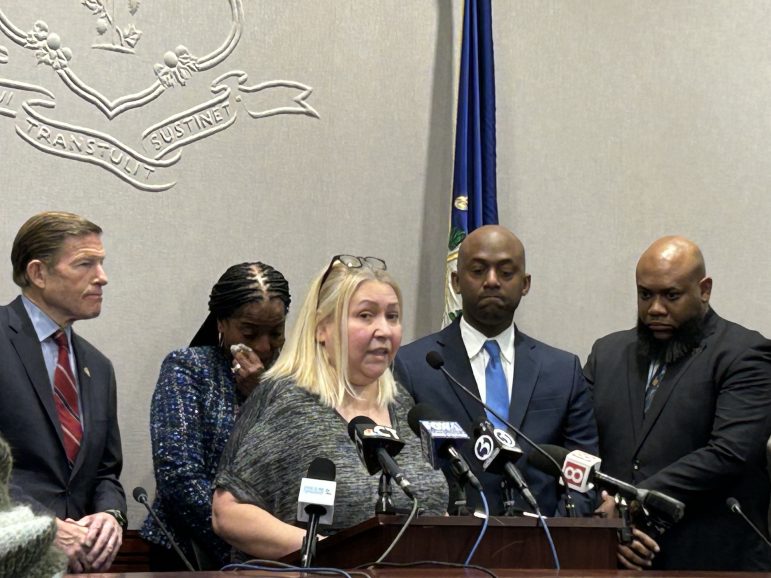
“I am not going to sit by and let us go back to a time where special education students were placed in the basement and not allowed to be educated alongside their non-disabled peers. I am not going to go back to a time where students came to school and didn’t get a hot meal or a book or computer or broadband — or all the things they needed to learn,” she said, her voice cracking, at a news conference in Hartford Monday.
Hayes — joined by U.S. Sen. Richard Blumenthal, Gov. Ned Lamont, several local superintendents, community faith leaders and parents — dabbed her eyes with a tissue and asked: “Why isn’t everybody angry about this?”
The president’s executive order assigned U.S. Education Secretary Linda McMahon the task of taking “all necessary steps to facilitate the closure of the Department of Education … while ensuring the effective and uninterrupted delivery of services, programs, and benefits on which Americans rely.”
Trump called the federal Department of Education “a public relations office,” and he said its closure would “provide children and their families the opportunity to escape a system that is failing them.”
Connecticut Senate Republicans shared that sentiment. In a statement Monday, Senate Minority Leader Stephen Harding, R-Brookfield, said Connecticut Democratic leaders were “rushing to a microphone to defend a broken education system.”
“The status quo isn’t working,” Harding said. “An illiterate student just graduated from Hartford High. Chronic absenteeism in Bridgeport schools is nearly 30%. We don’t need the status quo.
“We need reforms which support educators, maximize student achievement and respect the role of parents,” Harding added. “The education system in our state has failed far too many, and our children deserve far better than business as usual.”
Trump’s order came just days after mass layoffs at the Education Department, which cut the workforce by roughly half and left states bracing for potential interruptions or cuts to services that support early childhood education all the way up to college.
On Monday, the Trump administration was sued in a federal court in Massachusetts by the American Federation of Teachers, the American Association of University Professors and some public schools.
An earlier lawsuit, filed by two dozen state attorneys general including Connecticut’s William Tong, challenged the layoffs at the department. Tong continues to argue the administration “does not have the legal authority to unilaterally incapacitate or dismantle it without an act of Congress.”
While Republicans control both chambers of the U.S. Congress, a formal closure of the Department of Education could not pass without support from Democrats.
Blumenthal vowed that would not happen. “I will promise you, we will deny them the votes to destroy our department,” he said at the news conference Monday. “I promise you, Democrats will stand against this effort to destroy American public education. We will be united. We will be strong, and we will have support from places like Connecticut, where we know the importance of public education.”
It’s likely, however, that Congress will decide to direct less money for education programs when it negotiates upcoming spending bills.
McMahon has said the federal government will continue fulfilling the statutory requirements currently housed within the Education Department — formula funding, student loans, Pell Grants and funding for special education — despite mass layoffs.
Education programs mandated by law need to continue regardless of staffing levels. But outsourcing those responsibilities to other agencies, or changing funding during congressional appropriations, could create confusion and make them more vulnerable.
Trump has said he’ll shift the federal student loan program to the Small Business Administration, and he said he’ll move special education programs under the Individuals with Disabilities Education Act over to the Department of Health and Human Services.
In an apparent effort to push back against the executive order, the U.S. House of Representatives has recently introduced a resolution of inquiry, which will require the Trump administration to provide documents within 14 days explaining why there’s been “downsizing measures” within the Education Department and what the future will look like, Hayes said.
“As a teacher, I could never walk into an [Individualized Education Program] meeting and say, ‘Don’t worry about it, special education students will be taken care of,'” Hayes said. “The law requires more of me [as a teacher], and you should require more of the President of the United States.”
Education is largely funded and administered at the state and local level, but the U.S. Department of Education — created in 1979 under President Jimmy Carter — has been tasked with providing federal assistance and funding to schools, which includes grants to high-needs communities and additional funding to schools with high concentrations of low-income students (Title I) and multilingual learners (Title III). It also administers student financial aid for students attending college.
McMahon, who has several ties to Connecticut, including previously sitting on the state Board of Education and serving on Sacred Heart University’s board of trustees for many years, pledged that the department’s closure would “not mean cutting off funds from those who depend on them.” But, lawmakers are skeptical about that promise.
“McMahon is just a puppet. She’s taking the job to destroy American education and put herself out of a job,” Blumenthal said Monday.
As part of the president’s reasoning for wanting to shutter the department, Trump said he will end federal bureaucracy and shift education back to the states. If the Department of Education cedes some of its work and oversight responsibilities, Connecticut would likely need to fill in those gaps.
Gov. Ned Lamont and other state officials have said they will step in if needed. But at Monday’s press conference, Lamont expressed some doubt Connecticut would be able to make up the full difference if federal education funding slows down.
“We prioritize education, but if feds cut $550 million out of education going to each and every one of our communities, we’re going to do what we can to help the most vulnerable,” Lamont said. “I’m not positive we can make up all that shortfall, but we’re going to do everything we can.”
Connecticut’s federal funding makes up a small portion of the money it spends on education. The Education Department delivers much of that federal aid, while some money for states comes from other federal agencies supporting school meal programs and Head Start programs for low-income families with infants and kids under age 5.
Beth Bye, commissioner of the Connecticut Office of Early Childhood, noted that 7,000 children in the state got special education services in its Birth to Three system over the past six months. That early intervention program receives about $6 million a year from the U.S. Department of Education.
“We talk a lot about March Madness. It’s a big deal, right? This is March Madness that I am standing here before you today, talking about the Department of Education being dismantled when it oversees Birth to Three,” Bye said.
Connecticut received about $553 million in federal funding for education during the 2023-2024 school year, according to School and State Finance Project. About half of that funding goes toward Title I and special education through the Individuals with Disabilities Education Act, also known as IDEA.
Only 7% of the state’s total education funding comes from the federal government. But towns and cities with higher concentrations of low-income students rely more heavily on those grants. Cities like Waterbury, Hartford, New Haven and Bridgeport would be disproportionately affected.
For Hayes’ hometown of Waterbury, 22% of school funding comes from the federal government — with much of it geared toward Title I.
“Where is the humanity?” asked Maribel Rodriguez, a Waterbury resident, mother and grandmother, at Monday’s event.
“As a child who grew up in the ’70s in the public schools, I was one of those children that went to school without eating. I know what it is to be hungry in school and not be able to learn because you’re hungry, so I appreciate all these programs that these elected officials have done to help us to make sure that we all thrive,” Rodriguez said.
With school food programs also at risk, Rodriguez had a plea for her fellow Connecticut residents. “Please call Congress to make sure that they put a stop to this and that every child in our country gets the quality education they deserve,” she said.

