


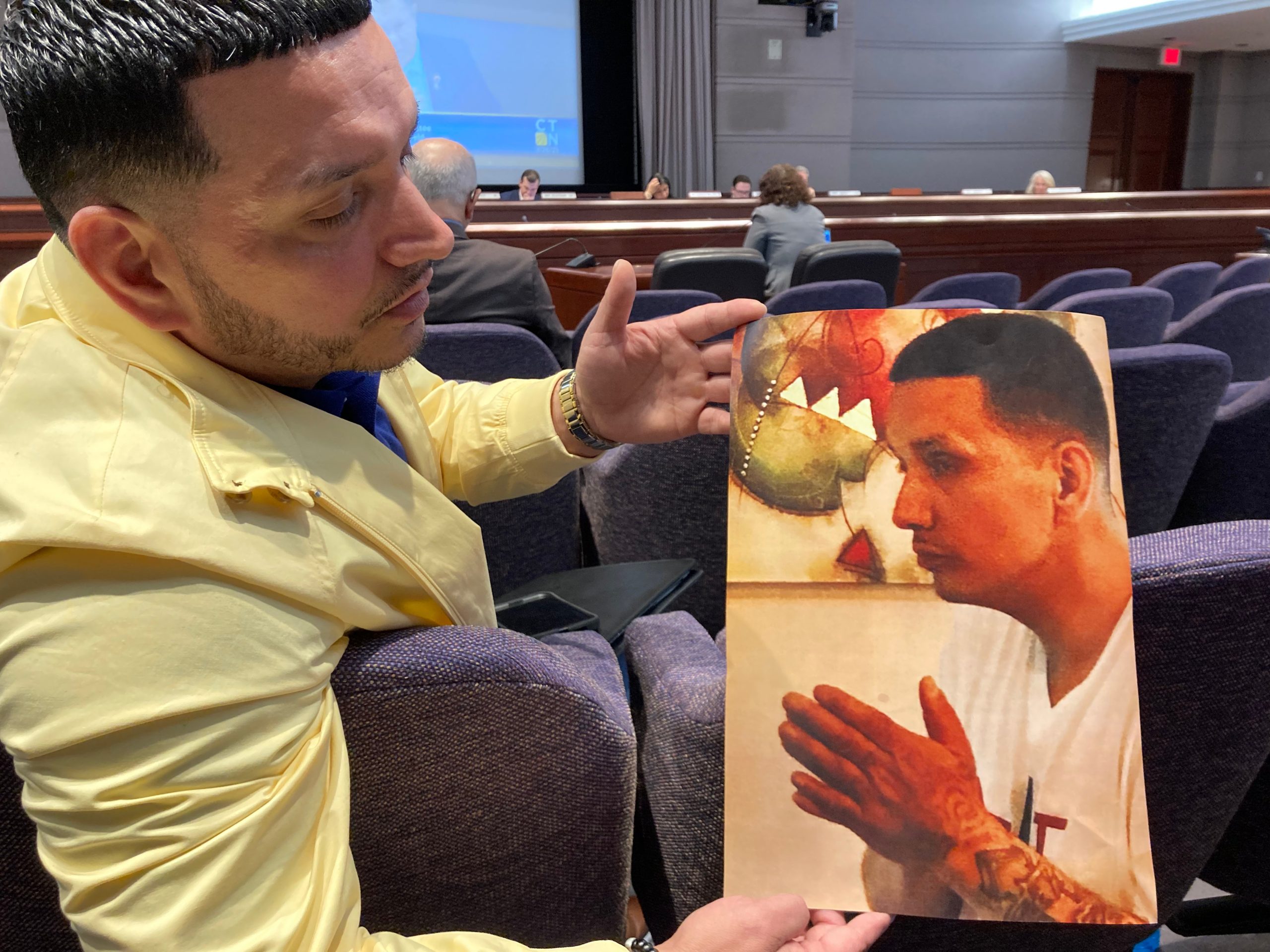
At age 12, Edgardo Patron was arrested for the first time, for selling drugs. He was arrested again at 13, again at 14 and again at 16. He spent time at Long Lane School, a former juvenile prison in Middletown. Eventually, at 18, he was sent to an adult prison.
Patron, who is now 47, said he still remembers what it was like the first time the police put handcuffs on him.
“I was 110 pounds when I was placed into cuffs and forced in to take a two-minute shower. I was ultimately placed in a single cell. To cope with that situation, I went crazy, counting the cinder blocks over and over again to pass the boredom,” Patron told lawmakers during a public hearing on Wednesday. “And just for the record, I wasn’t a violent child,” he said.
Patron was speaking in support of a proposed bill that would raise the minimum age for a child to be arrested — from 10, the current minimum age, to 12 in 2026, then 14 in 2028. The bill would also bar police officers from using handcuffs on children under the age of 14.
Lawmakers in Connecticut have proposed raising the age of arrest before. And in 2021, the legislature passed a bill raising the minimum age of arrest from 7 to 10.
In 2023, lawmakers introduced two bills — one to raise the minimum age of arrest to 12, and one that would have raised it to 14. Neither made it to a public hearing.
Under this year’s proposal, children between the ages of 10 and 14 who commit a crime would be referred to a Juvenile Review Board, a local program designed to keep young people who have committed crimes out of the court system. The Juvenile Review Board would conduct a needs assessment for the young person and develop a plan, as laid out in the bill, “in a manner that maintains public safety and results in such child taking responsibility for such child’s actions, which may include, but need not be limited to, restitution for any harm done by the child or services for substance abuse.”
Marc Donald, the chief executive officer of Catalyst CT, a non-profit that runs youth diversion, mediation and other programs, said that his organization — which serves Bridgeport, Torrington, Norwalk and Salem — has had success working with young people who have been arrested.
Donald said Catalyst begins by doing a needs assessment for the child, which could include an analysis of psychological and psychiatric needs. They then develop a treatment plan, and link the young person with a “credible messenger” — someone who has spent time in prison and can provide perspective. The organization also develops a restorative justice plan, in which the young person engages in mediated dialogue with the victim of their crime and discusses how to make amends.
Republicans on the committee raised questions about what would happen if a young person refused to engage with the Juvenile Review Board, or repeatedly committed the same crimes, or committed a violent offense that is not among those exempted in the law.
The bill would not prevent children between the ages of 10 and 14 from being arrested for serious felonies, including murder, sexual assault, kidnapping, arson, first degree robbery, and possessing child pornography.
But Rep. Craig Fishbein, R-Wallingford, said 2nd degree manslaughter, a class C felony, would not result in a child’s arrest under the proposed law. Nor would class A misdemeanors like strangulation or criminally negligent homicide, he said.
Fishbein, a ranking member on the Judiciary Committee, expressed concern that a Juvenile Review Board could not securely hold a child who had committed a violent offense. He said he has observed a “revolving door” of young people going before Juvenile Review Boards but then ending up back in the courts.
But Donald said only a “handful” of the cases he’s seen have dealt with repeat offenders.
According to data from the state of Connecticut, about 5,800 children under the age of 18 were referred to state criminal courts in 2023. That same year, about 481 juveniles were placed in detention.
The data also reveals that children of color are more likely to get referred to the juvenile courts — between 2019 and 2023, 43 in 1,000 Black children were given a delinquent referral, compared to 16 in 1,000 Latino children and 9 in 1,000 white children.
Corrie Betts, president of the Greater Hartford NAACP, called for the state to focus instead on root causes — why children end up getting arrested. He said many young people who come into contact with the judicial system grew up in places with concentrated and entrenched poverty.
“When we criminalize children from these communities instead of investing in them, we reinforce generational cycles of incarceration. We cannot claim to care about justice if we are still incarcerating babies while failing to confront the system that failed them,” he said.
Christina Quaranta, the executive director of the Connecticut Justice Alliance, said that the majority of children under 14 who pass through the judicial system do not end up in a residential placement or community supervision.
“And so that just really begs the question of, why did these young people have to go through the legal system process to begin with, when their needs could have been addressed pre-arrest after all?” Quaranta asked. “The purpose of an arrest is to improve community safety and teach children not to do wrong. We should probably be choosing the less traumatic, inexpensive way of doing that. And that’s the diversionary programs.”
According to Quaranta, about 475 children ages 10 to 13 would have been diverted from arrest had the law passed last year.

Rep. Greg Howard, R-Stonington, said he agreed that a child shouldn’t be arrested for crimes like shoplifting or schoolyard fights, and he said most of those cases were already being referred to Juvenile Review Boards. But he said he was concerned that without the threat of arrest, young people would have no incentive to cooperate with a Juvenile Review Board.
“I’ve always said that the way we need to approach juvenile justice is a healthy balance of opportunity and accountability … but in my opinion, as drafted, this bill removes accountability. And when you can’t put accountability on that kid … I think you’re doing him an injustice, in my opinion. But more importantly, you’re doing society an injustice,” he said.
The Connecticut Police Chiefs Association submitted written testimony in opposition to the bill, saying police already direct children to diversionary programs but they’re concerned about repeat offenders. The testimony said police use handcuffs as a way to keep people safe and they make those decisions before assessing a child’s age.
The association also wrote that the bill’s lack of a requirement for children to pay the victim back if their crime did any damage would encourage them to commit more crimes. “At a time when we are seeing more violent crime, firearms related offenses and stolen motor vehicles committed by juveniles, this bill will only lead to more of these offenses,” the testimony read.
But Donald said mediation, which Catalyst CT facilitates, can provide “powerful” accountability for children who committed a crime. “If I steal from a vendor, a shop owner, a small business owner, and I have to sit across the table from them and hear the impact on them and the increased cost … that hurts a lot more than a ticket or an arrest. Because you’re sitting across the table from somebody that you’ve caused harm to,” he said.
Donald said his program also cost substantially less than bringing a child to court or incarcerating a child. He said it costs Catalyst between $2,000 and $3,000 to mediate a case, which often involves two or three young people. In contrast, he said, bringing each individual child to court costs between $6,000 and $8,000.
Patron told the Connecticut Mirror that after that first arrest, when he was 12, the police officers released him to his parents and he ended up getting involved with a gang. As an adult, he was incarcerated four different times. While in prison, he said, he found God, started studying and sought out further education. He was most recently released in 2021, and now works as a Recovery Coach Professional Facilitator at CASA. He’s sober from drug use, and said he tries to help other people who have also been incarcerated.
But Patron said he believed things might have been different if he’d been offered a diversionary program after that first arrest, three and a half decades ago.
“A diversionary program would’ve saved the state of Connecticut millions and millions of taxpayer dollars had they given me help — like a jail diversion [program] versus [hand]cuffs,” he told lawmakers.