


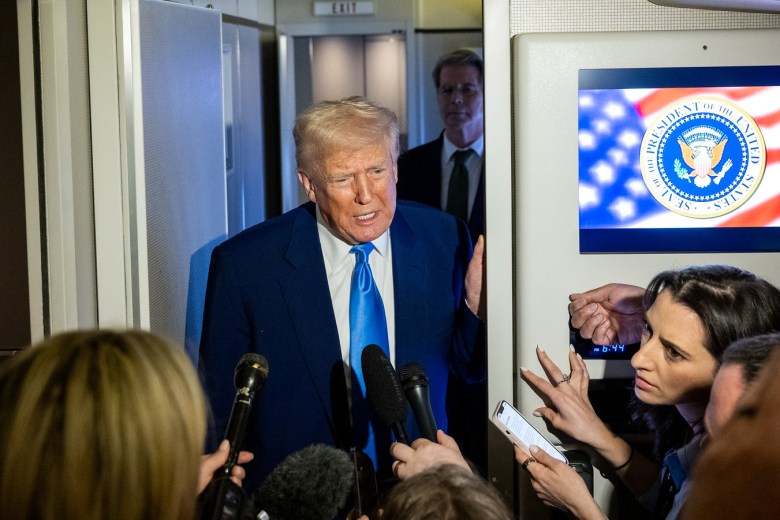
Although President Trump has paused his order imposing high tariffs on many countries, the threat still hangs.
Two reasons this is a terrible idea:
- It is like returning to a world without money, a primitive barter economy.
- Citizens and companies no longer buy and sell freely, but only when the government lets them.
On the first point, consider your household budget. It is well balanced if your monthly income is close to your expenses. If it’s not, the difference is savings or debt. But it needn’t balance between any two parties. I never bought anything from my employer, nor sold a thing to Stop & Shop.

But what if I had to barter my labor for everything? If I worked in an old-time coal mine, I might “owe my soul to the company store.”
If instead, I bought groceries, gasoline, and housing from different companies, I’d have to figure out what to barter with each one. That could get complicated. The volume of trade under barter is typically low – it’s hard to find a ‘match’ between would-be traders. That’s why early civilizations invented money.
Similarly, if trade between every country has to ‘balance,’ even if only on an annual basis, we can expect the total volume of U.S. imports and exports to be much lower. That would make us all poorer.
But it’s even worse than that, and here we come to the second reason it’s a bad idea. It’s one thing for a pair of individuals to keep trade balanced. But how could we ensure that millions of individual trades between two countries balanced out at the end of every month or year?
Each government would have to tell “its own” companies when they could and couldn’t trade. This is the opposite of a ‘free’ market, that Republican ideal.
It would be like the old Soviet Union, where I once studied. At the end of the month, that economy fell into a kind of madness – shortages of the things people wanted most, but factories working extra shifts to make things few people wanted, just to meet their monthly quota.
Trump’s tariffs were not popular with the billionaires surrounding him. They know they are bad for the economy – and their stock portfolios. The New York Times reports that Musk lost $31 million in stocks right after Trump’s tariff announcement.
It is hard to feel too sorry for him. The oligarchs’ libertarian commitment to free trade got put on hold when they kissed Trump’s ring. But their ideas about why tariffs are bad were still correct, and they paid a price. But the rest of us shouldn’t have to.
Trade wars also make real wars more likely. People used to say China would never attack us. “What would they do, bomb Walmart?” They won’t have to worry about that now. If we do get into a shooting war with China, Russia, and/or Iran, who’ll be on our side? All those allies we just threatened?
If Trump puts back his tariffs on everyone, the U.S. will not remain “leader of the free world” for much longer. We’ll be giving up much of our power – political, economic, even military.
Jim Stodder of West Hartford is retired, but taught economics at Rensselaer Polytechnic Institute and Boston University.