


Want text alerts about Bridgeport? Sign up here.
For decades, Bridgeport’s public housing developments — P.T. Barnum Apartments, Trumbull Gardens and Charles F. Greene Homes — have stood as symbols of both failed housing policy and the unshakable resilience of the people who call them home. Their stories stretch beyond concrete and brick, past peeling paint and patchwork repairs, into something harder to measure: the slow, collective work of residents who are tired of waiting for someone else to fix what’s broken.

When Vanessa Liles, project co-director at PT Partners, walks through the courtyards of P.T. Barnum Apartments, residents recognize her, wave at her and know that there’s someone who has their back. Liles leads PT Partners, a resident-led, grassroots nonprofit that operates right inside this community. “People here have lived through generations of neglect,” she says. “But they’re also the ones who have the answers. We just help them build the structure to make those answers heard.
“This is about giving residents the tools to advocate for themselves,” she said.
The 18 buildings that make up P.T. Barnum were built in 1946. Red brick rowhouses on the edge of the Black Rock neighborhood, overlooking Bridgeport Harbor. Most are two or three-bedroom units, stacked closely together, connected by narrow walkways and exterior stairs. There are no elevators, the buildings show visible signs of aging and maintenance challenges. For many, this is the only home they’ve ever known. For others, it’s a place to rebuild.
For years, P.T. Barnum was a shorthand for everything wrong with public housing: underfunded, overpoliced, and forgotten. But inside, the story has always been more complicated. “We call this community resilient for a reason,” says Liles. “People are organizing, building leadership teams, translating documents so everyone can participate, and sitting across the table from housing officials to hold them accountable. That’s not hopelessness. That’s power.”
When Jillian Baldwin took over as CEO of Park City Communities, Bridgeport’s housing authority, Baldwin inherited a backlog of more than $70 million in capital repairs. “If we’re one of the longest-standing troubled housing authorities in the nation, that means there’s a lot of pain and trauma in communication with residents,” she says. “We try to validate that experience, but at some point, we have to come together and work through it.”
Baldwin’s tenure has brought measurable change. Since 2022, Park City Communities has invested more than $42 million in capital improvements: new roofs, windows, elevators, and community spaces. The U.S. Department of Housing and Urban Development inspection scores have jumped dramatically. Trumbull Gardens, once rated 37, now stands at 76. P.T. Barnum rose from 41 to 78. Greene Homes, near the downtown, went from 45 to 85. Those numbers, Baldwin insists, aren’t just about construction. “You don’t get a $20 million improvement without being plugged into residents,” she says. “They know what needs to be done.”
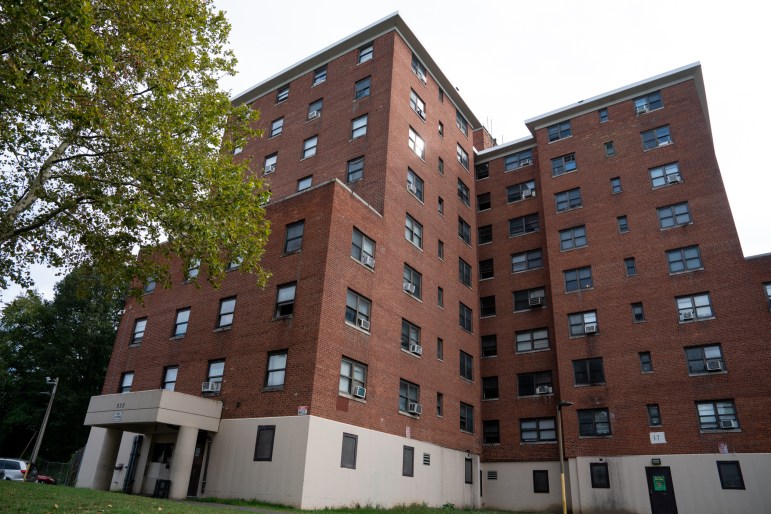
At Greene Homes, a cluster of seven-story towers built in 1951, longtime resident Desiree Gonzalez has seen the change firsthand. “It started off with a lot of drama… shootings, needles, drug dealers,” she recalls. “It was violent. But now, it’s calmer.” She points to the little things: elevators that work more often, benches and swings for the kids, events that bring families together. “The housing does events for us to come together,” she says. “It’s nice to speak about what we need.”
Still, Gonzalez worries about the elderly neighbors who live on upper floors. “They should be downstairs,” she says. “It’d be safer. It’s hard for them.” Her words echo a larger truth: progress can be uneven.
Residents like Nilsa Heredia, who has lived at P.T. since 1970, have seen both sides. “Back in the old days, it was crazy,” she says. “Now it’s calmer. Kids can play safely outside.” Her neighbor, Evelyn Medina, agrees but adds that some trust has been lost. “We can’t trust the housing,” she says quietly. “They’re not helping people like they used to.”
For every repaired roof, there’s still a leak in another building waiting to be fixed. Safety remains a constant concern, residents said. Several people described incidents of gunfire near their buildings, with one resident recalling a bullet entering her apartment. Many said they no longer feel comfortable letting their children play in the on-site playgrounds, often choosing nearby parks instead.

Residents also cited ongoing frustrations with slow maintenance responses, broken elevators and overflowing dumpsters. Still, amid the challenges, many spoke about the sense of community that persists.
Liles sees this tension daily. Through PT Partners, she works with resident leaders to create systems of accountability. Holding monthly meetings between tenants and management, training on tenants’ rights, and outreach in multiple languages. “The system was never built for residents to lead,” she says. “It was built for compliance. What we’re doing is teaching people how to change that system from within.”
The organization’s model is built on “resident tables” — small groups of tenants who meet regularly to identify problems, propose solutions and push for systemic changes, from maintenance timelines to translation services. “One of the biggest barriers here is language,” Liles says. “We have residents who speak Spanish, Haitian Creole, Portuguese. If you can’t understand the paperwork or the meetings, how can you participate in your own community?”
The organization’s approach has inspired similar organizing in other developments across Bridgeport. Trumbull Gardens, for instance, a sprawling mix of towers and townhouses built in 1952, now hosts monthly leadership meetings where residents talk directly with management. It’s a far cry from the days when residents said their calls and emails went unanswered. “We’ve had residents who used to be scared to speak up,” Liles says. “Now they’re running meetings, writing letters, and talking about budgets. That’s power that can’t be taken away.”
Still, organizing inside a public housing system that has seen decades of disinvestment isn’t easy. Liles says progress often comes in cycles. Small wins followed by new challenges. “We’re seeing improvements, yes. But the structural barriers, underfunding, bureaucratic delays, policies that treat housing as a privilege instead of a right; those things are still real. People are still living with mold, with rodents, with mental and physical health impacts from years of neglect.”
On a recent afternoon, Liles set up a table in the courtyard at P.T. Barnum Apartments, offering clothes, school supplies, snacks, and other essentials for families in the community. Parents stopped by with their children, picking up what they needed and chatting with neighbors. A volunteer stood nearby to translate for anyone who needed it — a small example, residents said, of how people in the community look out for one another.
“This is what community looks like,” Liles said. “We don’t have to wait for a new policy or a new director to care for one another. We’re already doing it.”
Baldwin, for her part, welcomes this kind of engagement. “We want residents to have a say in these decisions,” she says. “Everything is a trade-off — parking, green space, security. Residents are helping us decide what matters most.”
That collaboration has led to new initiatives. From expanded security cameras and ShotSpotter technology to partnerships with local police. “We’ve applied for safety and security grants in every HUD round,” Baldwin says. “From 2023 to 2025, we’ve brought in $12.5 million for safety and development.”
But money and metrics can’t capture everything. Sharon Truman, better known as “Ms. Peaches” in the neighborhood, first moved into public housing in the 1960s, and believes the progress feels both real and incomplete. “We had a good life,” she says. “It was wonderful. But the young people now… they don’t respect no more.” She pauses, then smiles. “Still, I’m thankful and grateful for this place. I feel safe here. I’ve seen worse.”
Her gratitude speaks to a tension both Liles and Baldwin recognize between appreciation and exhaustion. Many residents worry about what’s next. Rumors of redevelopment, new voucher policies, and future demolitions create uncertainty.
City officials first announced plans in 2018 to demolish and rebuild the aging Charles F. Greene Homes, citing long-standing maintenance issues, sanitation concerns and crime, but the process has moved slowly as the housing authority worked to stabilize operations and secure funding.
The redevelopment would follow the model used at former public housing sites like Marina Village and, decades earlier, Father Panik Village, which were torn down and replaced with mixed-income housing.
Baldwin doesn’t deny the fear. “Imagine if we tore down Greene Homes, P.T. Barnum, Trumbull Gardens,” she says. “Residents wouldn’t have anywhere to go. We’re making generational decisions for people’s housing resources.”
Liles argues that those decisions must start with residents themselves. “Too often, systems are designed around people instead of with them,” she says. “We’re changing that. Residents are co-designing the solutions now — not just reacting to decisions made behind closed doors.”
Her push for systemic change isn’t just about policy; it’s about redefining what dignity looks like. “People think of public housing as a failure,” she says. “But what I see are people raising families, caring for neighbors, working, organizing, showing up. That’s community. That’s success.”
Across Bridgeport, that idea is beginning to take root. Residents are leading cleanups, organizing block parties, translating newsletters, and advocating for fair housing protections. “Everybody is going through something,” says Gonzalez, the Greene Homes resident. “But if we just take the time to understand someone before judging, we can all live better.”
