



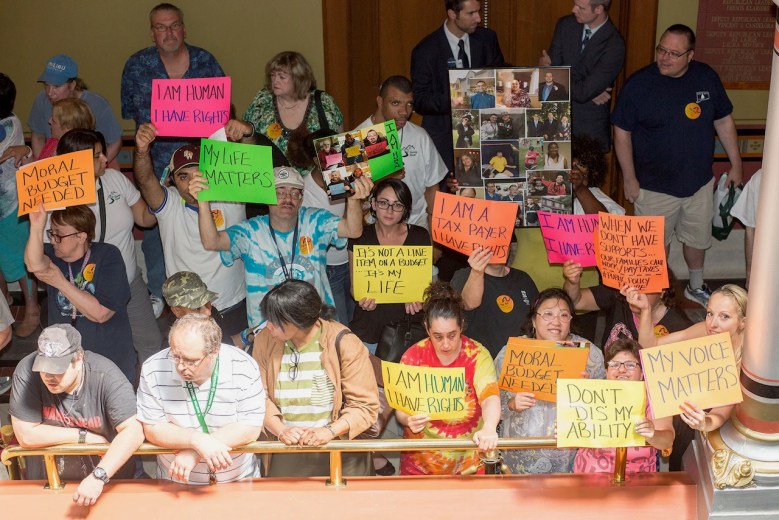
When my daughter Salome was born with Down syndrome and a congenital heart defect, I was told she might not survive. In that moment, I made a promise — to God and to her — that every breath she took would be matched by my fight for her right to live fully and with dignity.
That promise drives me today as Executive Director of The Arc Connecticut, representing thousands of families like mine—families who know what it means to fight every day for inclusion, healthcare, and survival.
Now, almost one month into a federal government shutdown, those families are being pushed to the brink once again. And this time, it’s not just one child’s life at stake—it’s an entire community’s future.
The Crisis Behind the Headlines
For many, this shutdown may sound like another political fight in Washington. But for people with intellectual and developmental disabilities (IDD) and the caregivers who support them, it has become a slow-motion disaster.

Federal funds that sustain vital programs are frozen or delayed. Medicaid reimbursements, which pay for therapies and home-based supports, are stalling. Direct-support professionals (DSPs)—the backbone of our care system—are missing paychecks and leaving the field. And SNAP and WIC benefits, lifelines for food security, are running out.
The Connecticut Department of Social Services warns that 36,000 residents could lose SNAP benefits under new federal rules. For many ALICE families—those Asset-Limited, Income-Constrained, Employed—this isn’t an inconvenience; it’s the difference between dinner and an empty plate.
According to United Way’s 2025 State of ALICE Report, nearly 38 percent of all Connecticut households cannot afford basic needs like housing, healthcare, and transportation. For households that include someone with a disability, the burden is far heavier. Almost half of people with disabilities in Connecticut live below the income needed for stability.
When SNAP payments are delayed, when paychecks are missed, when care workers leave—families from Bridgeport to Danbury, Norwich to New London, Hartford to Litchfield County all feel the ripple effects. Hunger deepens. Therapies stop. Progress erodes.
Real People, Real Pain Across the State
Every corner of Connecticut is feeling this strain.
- In our cities, parents are skipping meals so their children can eat.
- In small towns, adults with disabilities are losing access to transportation that gets them to work.
- In our suburbs, caregivers are stretched beyond exhaustion as agencies cut hours or furlough staff.
These are the human consequences of a political stalemate. You can’t “pause” autism services. You can’t “furlough” cerebral palsy care. For people with IDD, consistency is life. Every missed therapy session, every lapse in nutrition, every broken support chain chips away at years of progress.
Connecticut Must Act While Washington Waits
We in Connecticut cannot afford to wait for Washington to remember its conscience. Even before this shutdown, provider agencies were struggling to recruit staff and stay solvent. Now, as federal dollars freeze, the pressure is unbearable.
I call on our Congressional Delegation—Senators Richard Blumenthal and Chris Murphy, Representatives John Larson, Rosa DeLauro, Jahana Hayes, Joe Courtney, and Jim Himes—to demand immediate action. Pass a clean funding resolution. Protect Medicaid, SNAP, and home- and community-based services for the disability community.
I call on Governor Ned Lamont and state legislators to prepare emergency bridge funding and support providers who are holding the line. The Arc Connecticut and our partners are ready to help—but we cannot replace a federal lifeline with goodwill alone.
And I call on you—the public, employers, neighbors, and faith communities—to act. Support local food pantries. Donate to organizations serving the IDD community. Call your representatives. Ask them one question: Who will protect the most vulnerable when the government won’t?
We Must Not Normalize Suffering
Every shutdown is a moral test. Nearly a month in, our nation is failing . Behind every “budget impasse” are children missing meals, adults losing care, and caregivers giving up.
When Salome smiles, I am reminded that hope can survive anything—but only if we nurture it. We cannot allow political dysfunction to silence that hope for millions of Americans with disabilities.
The government may be shut down, but our humanity must never shut off. Connecticut has a choice: to stand idle or to stand up.
Let’s choose compassion over calculation, urgency over apathy, and justice over neglect—before another month passes and more lives unravel.
Shivonne McKay Annan is Executive Director of The Arc Connecticut, a statewide advocacy organization serving individuals with intellectual and developmental disabilities and their families.