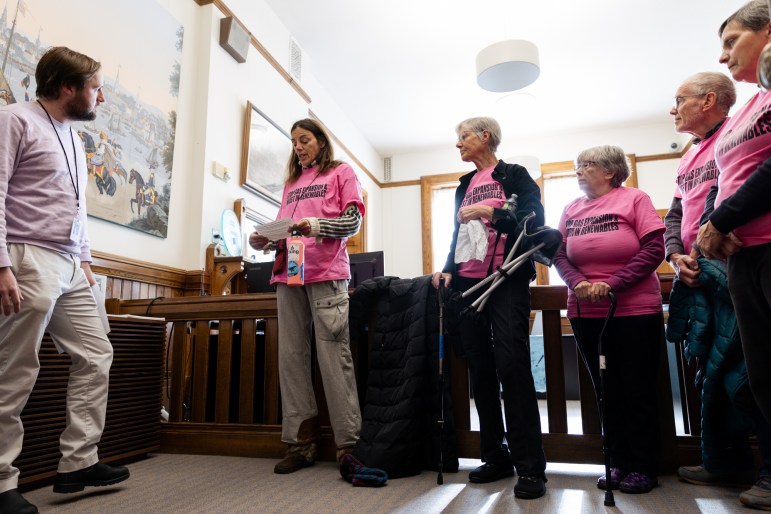
Around 30 activists in neon pink T-shirts gathered around Gov. Ned Lamont’s office on Monday afternoon, singing “This Little Light of Mine,” to protest his support for new methane gas construction in Connecticut.
The protest was organized by a new coalition calling themselves Don’t Destroy Our Future, a group organized for the sake of this protest by members of climate justice groups including Sunrise Movement Connecticut, Third Act and Interreligious Eco-Justice Network.
Activists called for Lamont to deny permits for new projects expanding natural gas usage in Connecticut. They argued that these buildouts contradict the state’s goal of achieving net-zero carbon emissions by 2050, a target Lamont signed into law earlier this year.
“Gov. Lamont has been clear that he wants to bring new energy resources into New England to increase our energy supply and lower costs for ratepayers,” said Rob Blanchard, a spokesperson for Lamont’s office. “We look forward to continuing the conversation with regional partners on how we can best achieve this goal, while protecting the state’s investment in renewable energy.”
Nine of the activists entered Lamont’s office and explained their demands to a Lamont staffer, who nodded and said he would pass their concerns along. In a planned political arrest, those nine activists then refused to leave the office and were peacefully escorted out by Capitol Police.
They were charged with obstruction of free passage, a misdemeanor, and released, according to Lt. Greg Wimble of the Capitol Police.

Claudia Allen, a 79 year-old Thompson resident, said she felt a generational responsibility to be arrested for the first time in her life, because she doesn’t have the same career considerations as young people.
“I really feel that my generation has to make the right decisions in order for [the younger] generation to have a livable future,” she said. “It’s really all about the young people for me.”
Most of the protesters were around her age. Two of the arrested protesters walked with canes, and one had been arrested protesting the Vietnam War.
Kate Donnelly, a former first selectman of Hampton, said she saw Lamont’s approval of natural gas projects as incompatible with his support for climate goals.
“When Gov. Lamont ran for office, he made a lot of promises about addressing climate, and he hasn’t kept them,” she said. “We’re here to say, Gov. Lamont, we need to secure our future for the planet and our children and future generations, and we want him to address these issues.”
Lamont, a Democrat, has long expressed an openness to natural gas as a means of keeping energy prices in check while reducing emissions from older, dirtier forms of power such as oil and coal.
In July, his administration gave tentative approval to a plan to expand the capacity of the existing Iroquois Pipeline by building a series of compressors capable of pumping an additional 125 million cubic feet of gas each day through the pipeline. The decision angered both environmental activists as well as local residents in Brookfield — the town where the compressors will be built — who have raised concerns about the pipeline’s proximity to a nearby middle school.
The Department of Energy and Environmental Protection has yet to issue a final permit for the Iroquois project, which is scheduled for an informational public hearing in January.
A spokesperson for the Iroquois Pipeline did not respond to a request for comment Monday.
During his state of the state address in January, Lamont urged lawmakers not to “rule out natural gas” as a way of addressing the state’s spiking energy costs, despite concerns about methane and other greenhouse gas emissions.
Connecticut, like most of its New England counterparts, relies on natural gas to produce the majority of its electricity. In addition, more than a third of the state’s homes are heated with natural gas during the winter.
“We bring in very inexpensive natural gas from Pennsylvania, but that pipeline is at capacity,” he said. “And we bring in [liquid natural gas] by foreign ships, which is more polluting and more expensive.”
Critics of natural gas, however, argue that the commodity is subject to volatile price swings that could undermine promises of long-term savings.
“His embrace of more gas is really unfortunate,” said Peter Millman, the vice president of People’s Action for Clean Energy, an environmental group. “I think that he and his advisors are underestimating what the future cost of gas prices will be.”
Millman was not in attendance at Monday’s protest.
The Lamont administration has also drawn criticism over a plan to invest $42 million in a new gas heating system to power a network of pipes that deliver heating and cooling to more than a dozen buildings in downtown Hartford, known as the Capitol Area System.
Advocates had pushed for lower-emission — and costlier — alternatives that would replace the aging gas-powered system with either all-electric boilers or an underground geothermal system.
A previous version of this story incorrectly stated Peter Millman’s title. He is the vice president at PACE, not a director.