



This story has been updated.
Seeking to prevent a wave of local prohibitions on wake surfing, advocates of the fast-growing sport are asking state officials in Connecticut to step in with a common set of rules for lake goers.
That effort kicked off Tuesday in response to a recently enacted ban on wake surfing in northwestern Connecticut’s Lake Waramaug. A group opposed to the ban, Lake Waramaug Friends for Common-Sense Regulation, filed a petition asking the state Department of Energy and Environmental Protection to rescind its support for the ban and instead establish a common set of regulations governing wake surfing.
“The appropriate thing to do, in our opinion, is to have statewide rules that address wake surfing throughout the state, because right now you have several bodies of water with several different methods of regulating wake surfing,” said Lee Hoffman, an attorney who is representing the group in its appeal to DEEP.
“That’s a little puzzling to recreational users,” Hoffman added. “And the other thing is, there’s been no demonstration by anyone that wake surfing when done properly, causes either environmental harm or a safety risk.”
In October, DEEP announced that it would conduct a study of wake surfing and solicited public comment from stakeholders. The agency’s final report on the subject is expected to be released in February.
“DEEP has received significant outreach on this topic, demonstrating that the regulation of wakesurfing is an issue of growing significance to many residents and businesses in Connecticut and one that merits additional study,” spokesman James Fowler said in statement. “Since DEEP anticipates receiving additional ordinances to review, we are preparing an informational study on the operation of wake boats and the activity of wakesurfing in the state.”
Wake surfing enthusiasts say they want to avoid a patchwork situation, where different rules apply across the state’s hundreds of lakes and ponds.
“I think everybody’s open to regulation,” said Tom Godward, a wake surfer who owns a home on Lake Waramaug. “There’s a lot of very, very thoughtful ways to do it, but a lot of it is really just recognizing that these resources are shared-use, and just devising a set of regulations and rules that will accommodate as best you can everybody’s wishes and desires on the lake.”
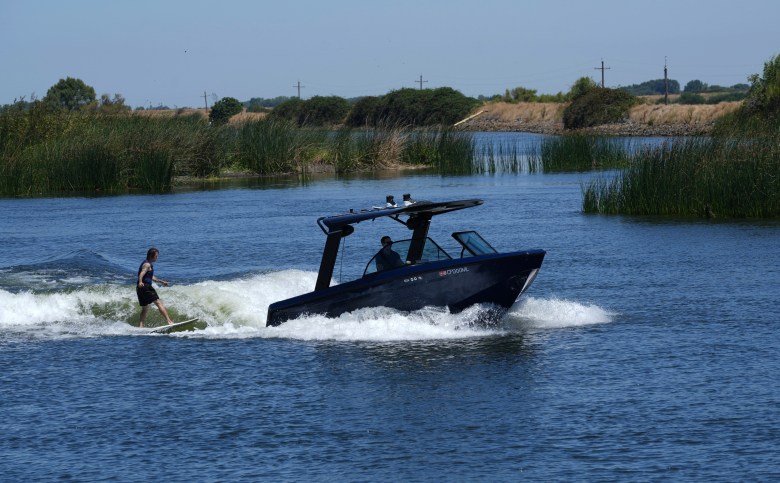
Wake surfing is similar to other towed water sports except that the rider drops the rope once they are standing in order to “surf” the the artificial wave created by the boat’s wake. Surfers often use boats that are modified with special weights or wake shapers to produce waves up to 3 or 4 ft. high.
It is the presence of a larger wake, however, that has also attracted controversy.
Critics say that so-called “wake boats” churn up sediment, reducing water quality and disturbing underwater habitats while producing large waves that can erode the shoreline and create hazards for other boaters. The use of ballast tanks to weigh down the boats can also contribute to the spread of invasive species, such as hydrilla.
“People are outraged about the big waves,” said Kelly Williams, a co-chair of Protect Lake Waramaug, a group of local residents that pushed for the ban on wake surfing.
Last year, the towns surrounding Lake Waramaug — Washington, Warren and Kent — commissioned a study which reported that the propeller downwash created by wake boats had caused a temporary increase in phosphorus levels on the lake. (The report also cautioned that its findings were preliminary, and warranted further study.)
“Even before we understood how significant the environmental damage could eventually be to the lake… the safety and nuisance concerns about the big waves were already compelling the selectmen to say, ‘No,'” Williams added.
Wake surfers and their supporters argue that those concerns have been overblown, and that the report commissioned by Protect Lake Waramaug was flawed in its methodology. As for safety, they said records of boating accidents show that wake surfing is no more dangerous than other watersports such as wake boarding or jet skiing.

The wake surfing ban on Lake Waramaug was overwhelmingly approved by voters in the three towns surrounding the lake in August. It followed a similar ban on Bashan Lake that was approved by officials in East Haddam the same month.
Voters in Morris, meanwhile, voted down a proposed ordinance that would have restricted wake surfing and wake boarding within 500 ft. of the shore on Bantam Lake.
Hoffman, the lawyer for Lake Waramaug Friends for Common-Sense Regulation, suggested that the state could restrict wake surfing within around 200 ft. from shore, to avoid causing conflicts with surrounding homeowners.
Similar restrictions have been put in place by states such as Pennsylvania and Tennessee, the latter of which also restricts wake surfing in lakes under 50 acres in area. In Vermont, use of wake boats is limited to certain “wakesport zones.“
Those who supported the ban on Lake Waramaug, however, said uniform rules around wake surfing would ignore the unique features of each lake and pond. For example, Williams said that wake surfing could be better suited for nearby Candlewood Lake, which is several times as large and deeper, on average, than Lake Waramaug.
“What doesn’t make sense about a statewide ordinance is every every body of water is different,” said Washington First Selectman James Brinton. “In other words, some are deeper, some are larger acreage. It couldn’t be that way. It couldn’t be a one-size-fits-all.”
Still, surfers such as Sherman Baldwin, said they felt unfairly maligned by a vocal group of residents on the lake.
“We always are respectful and give people a wide berth if we see people kayaking or paddle boarding,” said Baldwin, who was encouraged by his children to take up wake surfing after purchasing a home on Lake Waramaug four years ago. Since then, he’s bought a specialized wake boat that he keeps on the lake.
“Other motorsports, whether they’re tubing or water skiing, can create just as significant a wake depending on how many people are on the boat or other things,” he added.
Correction:
An earlier version of this story inaccurately identified who commissioned the study on wake surfing on Lake Waramaug. It was the towns of Kent, Warren and Washington, not Protect Lake Waramaug.