



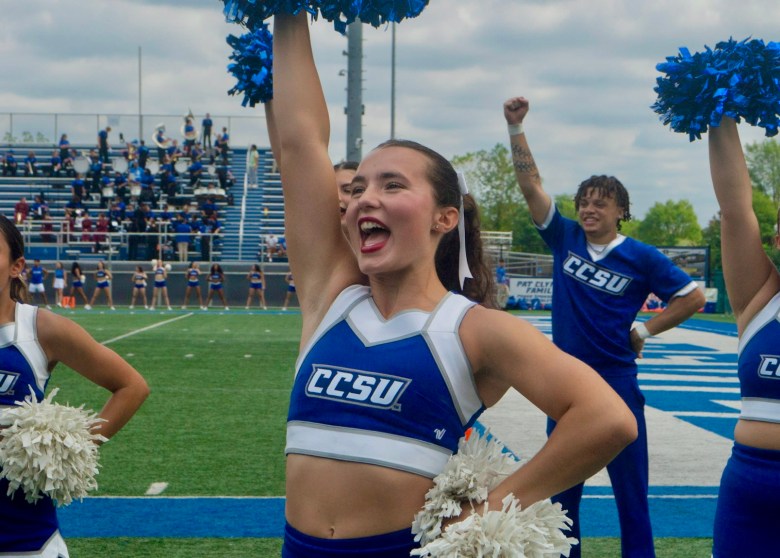
Tears swell in my eyes, my legs feel limp and my mind goes blank. Defeat has taken over my body as my mind gives in to the anxiety of doing a skill I thought I had mastered. Despite being a cheerleader for over a decade, I am hit with a mental block.
Mental blocks are known to psychologists as lost move syndrome. This is a condition in which an athlete is unable to perform a skill that was once automatic. Mental blocks can be challenging obstacles for cheerleaders and require resilience and patience to overcome.
This past year I experienced mental blocks. I have been a competitive cheerleader for 14 years and a youth cheer coach for four years. In all this time, I have never run up against an obstacle as debilitating as a mental block.

When I became a collegiate cheerleader at Central Connecticut State University, I knew I needed to improve my tumbling skills and to learn a standing back handspring. Every day during the summer, I would practice in my backyard with my sister or dad. After hundreds of tries, I finally was throwing the back handspring with ease. I was proud of my hard work and grateful to do the skill I’d dreamed of.
Until one day I couldn’t.
At practice I tried to transfer the skill from the cushioned mat onto the hardwood floor in preparation for basketball season. When I began to count myself in like I have done hundreds of times, my body froze up, my mind went blank, panic set in and fear clouded my head.
I had heard stories of cheerleaders and gymnasts experiencing mental blocks but never imagined it would happen to me. Was all my hard work this summer for nothing? Would I have to start over? Was I no longer good enough to be a college cheerleader? These were the troubling thoughts that flowed through my mind every time I stood at the edge of the blue mat preparing to throw my back handspring.

Many people do not understand the physical and mental demands that go into perfecting competitive cheerleading skills. Cheerleaders are taught to smile and perform no matter what. If the stunt falls, keep going. If you mess up, keep smiling. This pressure of perfection can mask the physical and mental difficulties we athletes face in preparing to take the floor, knowing that we could get hurt. The National Center for Catastrophic Sport Injury Research said that collegiate cheerleading accounted for 70.5% of all female catastrophic sports injuries between 1982 and 2007.
Lost move syndrome, however, can be overcome. Jada Wooten, featured on Season 2 of the Netflix series “Cheer” was the 2021 NCA Collegiate National Champion with Trinity Valley Community College in Athens, Texas. She said in the YouTube video “How She Overcame Her Mental Block” that after making her dream team and suffering from a mental block, she considered giving up the sport she loved: “So I fought and fought, and yeah, I fell, but I kept fighting. … It was part of my growth. It taught me to keep battling. … I still go through hard times, don’t get me wrong. But I have learned not to fear them.”
Mental blocks were not the end of my cheerleading journey. I dedicated the following months of practice to regaining my confidence and changing my mindset. I tested my limits and pushed myself beyond my mental barriers.
By continuing to show up for myself and practicing patience, my hard work paid off. I was able to compete with my back handspring at the National Cheerleaders Association’s College Nationals Championships.
Mental toughness is still a challenge I work on every day, both on and off the mat. But like Jada Wooten, my experience working through mental blocks has made me into a stronger athlete and individual.
Emily Sousa is a junior majoring in Media Studies at Central Connecticut State University.