


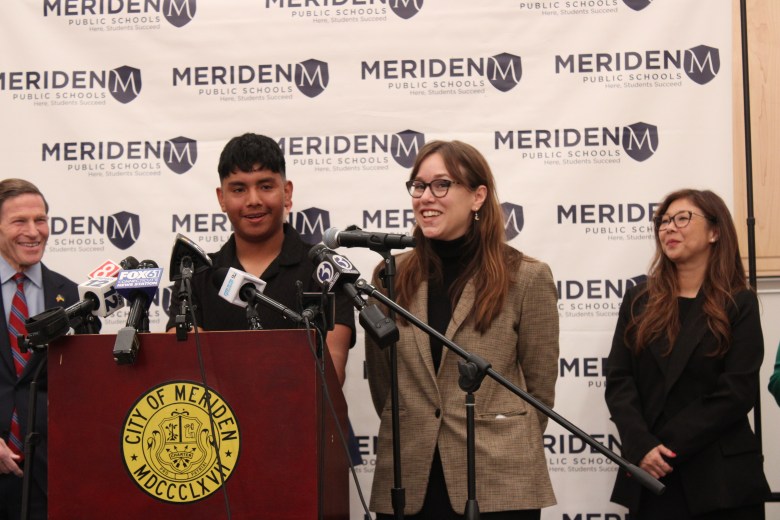
Advocates, attorneys, politicians and members of Meriden’s community gathered on Wednesday to celebrate the return of Kevin, a 16-year-old immigrant who had been detained in a federal detention facility for six months in Texas before his recent release.
An attorney who worked on Kevin’s case said he saw the case as the first success in a much larger effort to provide legal representation to immigrants who are at risk of deportation by the federal government.
Glenn Formica, a Connecticut-based immigration attorney, with support from the organization Connecticut Students for a Dream, has been bringing together lawyers and legal service organizations with different specialties to offer their services pro bono to immigrants who cannot afford to hire legal representation. They call the project The American Immigrant Legal Clinic, or TAILC.
Formica said that during the first Trump administration, he’d been representing “crazy numbers” of immigration cases. In 2020, he said, he was representing 140 pro bono cases in his private practice.
“This time around, I needed something different,” he said.
In the past, he’d done some work with community groups, trying to teach people about “red folders” and “blue folders” — methods for organizing the documents they would need if they were detained by ICE, Formica said. Red folders contain documents regarding employment and familial ties that can help persuade a court that the person is not a flight risk and should not be held on bond. Blue folders contain documents that make a legal case for the person to remain in the U.S.
But this time, Formica wanted to go further.
“I want the community to stop being lambs and I want them to be wolves, and I want them to learn what they need to learn to go hire lawyers and manage lawyers,” he said.
Formica said the organization, which now includes 20 lawyers, was planning to open a clinic in New Haven in January, where people could bring the documents and have their cases transferred to panel attorneys and legal service organizations who could help.
Frances Bourliot, a partner with the legal firm Gonzalez Olivieri in Texas, who also assisted with Kevin’s case, said the new American Immigrant Legal Clinic was meant to fill a void that existed in the immigration system.
“Too many people in our community never get a real chance to be heard — not because of any judgment on the merits of their case, really, just because they don’t have access to legal support where it matters the most,” said Bourliot.
Bourliot said the clinic also works with communities to teach them about what documents they might need and how to navigate the court system.
“Organization in the beginning can be the difference between chaos and clarity,” she said.
Maegan Faitsch, an attorney with Connecticut Legal Services, said she got connected to Kevin’s case after receiving a call from the pastor of St. Rose of Lima Church in Meriden, a church with a large immigrant congregation.
Kevin, whose last name has been withheld out of concern for his safety, and his father were detained by Immigration and Customs Enforcement after a routine immigration check-in in Hartford in June, shortly before Kevin was set to graduate from Maloney High School.
The two were transferred to Texas. Kevin’s father was deported. Kevin was transferred to a detention facility for children run by the Office of Refugee Resettlement, where he remained for six months.
Faitsch said ICE attempted to deport Kevin twice, once in the middle of the night. According to Faitsch, ICE had granted Kevin a single phone call before his departure, which he used to call her. She said she was able to stop Kevin’s removal from the U.S.
ICE officials did not respond to a request for comment.
Kevin’s lawyers connected with Bourliot in Texas and with Rep. Matt Blumenthal, D-Stamford, who works with the firm Koskoff Koskoff & Bieder. Blumenthal filed a petition in U.S. federal district court for Kevin’s release. The federal government decided to release him after that, they said.
“I think sometimes putting the pressure on the government and letting them know that there are people out there who care about these kids, who are looking at what’s happening and who are there ready to fight for them and to protect their rights — It seems to be working for now,” said Bourliot.
Kevin told reporters in Spanish that conditions in the detention facility weren’t bad, but that they had little communication with family members. He said he spent his days reading or looking for things to do. He said that the other young people in the facility were often under stress, having taken risks to leave their countries of origin, and having no knowledge of what had happened to the family members with whom they had arrived in the U.S. Some of them, he said, had been in the facility for a long time, and the experience had taken a toll on their mental health.
“It’s very hard to go through this process, and I’ve seen a lot of people that have had a hard time because of it,” he told the crowd gathered on Wednesday. “It’s not easy and we’re all human and we shouldn’t be treated like this.”
Kevin said he still misses his father, with whom he was close. Andrea Sanchez, an executive consultant for CT Students for a Dream, said the organization planned to help Kevin access college when he is ready.
His immigration case is still ongoing, and Formica said the attorneys planned to request Special Immigrant Juvenile Status for Kevin, which, if granted, would give him the ability to remain in the U.S.