


On cold winter nights in Bridgeport, dozens of unhoused residents line up outside the Alpha Community Services YMCA warming center because there are no shelter beds available elsewhere in the city.
When Connecticut activates a cold weather emergency, Bridgeport’s shelter system stretches beyond its limits. The warming center, Bridgeport’s only overnight option during extreme cold, opens at 7 p.m. and has space for just 30 cots. It operates on a first-come, first-served basis. On many nights, far more people arrive than the center is funded or designed to accommodate.
“We refuse to turn anyone away,” said Nicholas Hoffman, executive director of Alpha Community Services YMCA. “But we’re funded for 30 spaces, and many nights we’re serving 60 or 70 people. We collaborate with Prospect House a block up the road, which offers us some beds.”
This winter, Connecticut has activated its cold weather protocol multiple times as temperatures dropped to dangerous levels across the state. While the protocol is intended to expand emergency shelter access, service providers in Bridgeport say the system is already operating beyond capacity.
Homelessness is increasing, while shelter space is shrinking.

According to Opening Doors Fairfield County, which coordinates homelessness response efforts across the region, the number of households seeking assistance increased by 24% from 2023 to 2024, while available shelter beds declined by 23%. From 2024 to 2025, the number of households needing help rose another 29%, while shelter capacity dropped by an additional 10%.
Homelessness across the state rose by 9.5% from 2024 to 2025, according to the state’s annual point-in-time count.
As a result, warming centers like the YMCA are functioning as full-scale shelters, despite not being designed, staffed, or funded to do so. Hoffman said the building, a former day care center owned by the city and repurposed years ago, was never designed to function as a full-scale shelter.
“We’re seeing the vulnerabilities of the infrastructure,” he said. “We need to feed people, provide hygiene, basic human needs. But we also have to ask bigger questions about how the system is structured and whether this is the right space or if services need to be spread across multiple providers.”
Gov. Ned Lamont last month assigned an additional $6.9 million for grants to organizations fighting homelessness and to maintain vouchers for supportive housing that were previously federally funded. The funds were part of the state’s $500 million emergency fund created to address the impact of cuts at the federal level. Connecticut has reported significant budget surpluses for years and has a healthy budget reserve.
But advocates say funding decisions at the state level aren’t helping enough.
Homelessness providers across the state are calling for an annual $5 million allocation for cold weather resources through proposed legislation. The funding would allow for more emergency beds, faster responses during extreme cold, and long-term planning, without requiring providers to reapply for emergency funds each winter, they say.
“It’s cold every winter in New England,” Hoffman said. “This shouldn’t be a yearly emergency.”
For people staying inside the shelters, the conditions can still be difficult.
Shirley Hurd, 68, said she became homeless after losing the house she was renting, which she believes was sold without proper notice.
“They sold the house I was in,” Hurd said. “I was paying. I had receipts. Then I had to go.”
Hurd said navigating shelter life is physically and emotionally exhausting, especially during the winter months. Overcrowding, limited bathroom access, and heightened tensions make survival more difficult.

“You’ve got almost 60 people and only two bathrooms,” she said. “People talk to you any kind of way. Some nights, there aren’t even beds and you just end up back outside.”
Frieda Brooks, 74, has lived in Bridgeport her entire life. Disabled and unhoused for more than three years, Brooks said she lost her housing after her son was shot and killed.
“I’ve lost a lot,” Brooks said. “But I’m still hanging in there.”
Without a phone, Brooks relies on word of mouth to learn about available resources. She said churches and community organizations have helped her survive, but accessing information remains difficult.
“There is help out there,” she said. “You just have to find it the best way you can.”
Epi Carrera, who has been unhoused since December 2023, said the YMCA warming center has been critical to his survival during cold weather. Still, he said overcrowding and stress can create challenges.
“When it gets really cold, people’s temperaments change,” Carrera said. “You’ve got different people, different cultures, different problems all in one space.”
Carrera said the solution requires more than emergency shelter.
“We need more beds,” he said. “We need more services, vocational help, and people who understand what folks here are dealing with.”
Inside the Alpha Community Services YMCA, staff and volunteers provide food, showers, hygiene supplies, and overnight supervision. By morning, they are exhausted, Hoffman said, but the focus remains on keeping people safe.
“This building was never meant to serve this many people overnight,” Hoffman said. “It’s not sustainable.”
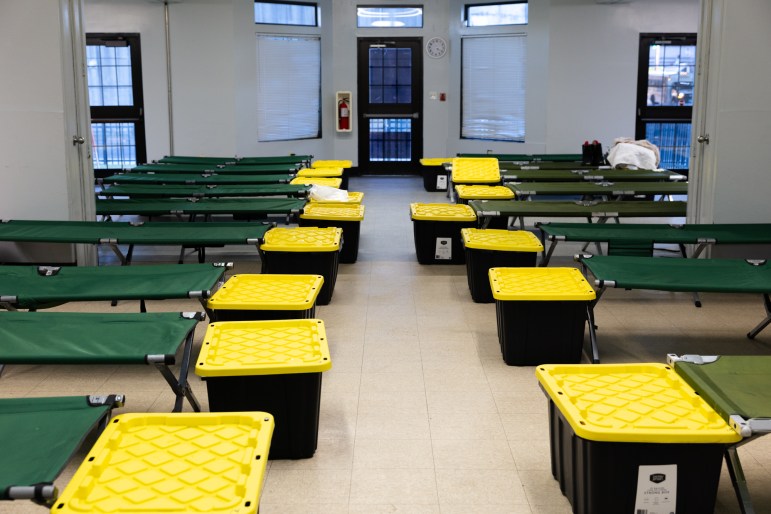
The facility, owned by the city, operates as a community space and navigation hub for most of the year. During winter months, it becomes a warming center, a model Hoffman said exposes serious infrastructure limitations, particularly as the number of families and seniors experiencing homelessness continues to rise.
“Our space is funded and designed for single adults,” Hoffman said. “Families and seniors need more room and more support. What we’re doing right now is a temporary fix.”
The warming center is scheduled to close March 31. Service providers warn that without changes to funding, infrastructure and coordination, next winter could be even more dangerous.
For people like Hurd, Brooks, and Carrera, the stakes are high.
“This is about survival,” Hurd said. “People shouldn’t have to freeze just because there’s no space.”