


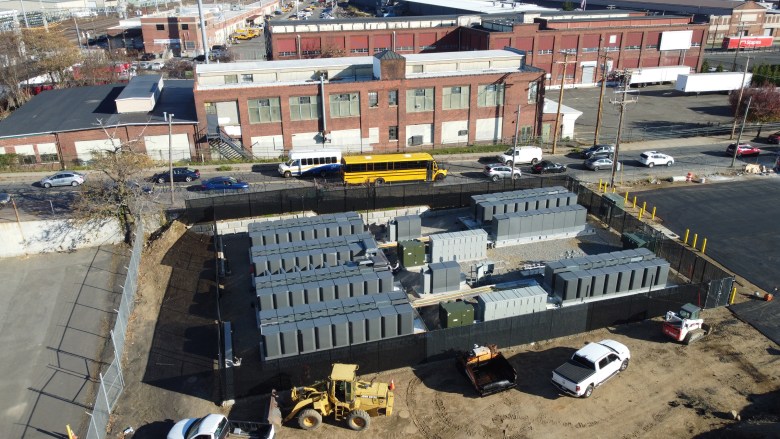
The long-abandoned site of a former plastics manufacturer in downtown Bridgeport is now producing enough low-carbon electricity to power more than 3,000 homes, a conversion that officials say could be a model for other post-industrial brownfield sites in Connecticut.
Earlier this month, Dispatch Energy — a New York-based developer of distributed energy projects — announced that a 4-megawatt fuel cell facility located within the Bunnell Block, a former brownfield site in the city’s East End, was up and running.
The project is the third fuel cell facility to open on a former brownfield in Bridgeport, according to Ed Lavernoich, the president of the Bridgeport Economic Development Corporation. A fourth fuel cell sits atop a former landfill in the city’s Seaside Park.
Because it is more costly to remediate old industrial sites to a standard that would allow residential development, Lavernoich said, fuel cells offer a relatively easy path toward finding a productive — and taxable — use for those properties, particularly those located on smaller or oddly shaped tracts of land.
“The return in that sense for the city is a very good one,” Lavernoich said. “Also these contribute to the resilience of the electrical grid here in this region and certainly within the city. So, it wins in both ways.”
Fuel cells utilize a chemical reaction to convert natural gas or hydrogen into electricity without having to burn it. The natural gas reaction produces about half of the CO2 emissions of a typical gas-fired power plant, and much lower amounts of nitrogen oxides, sulfur and other harmful pollutants. Hydrogen fuel cells produce only water as a byproduct of the chemical reaction. Fuel cells are not intermittent, meaning they can dispatch electricity onto the grid whenever it is needed — a factor that proponents tout as a way to manage the region’s growing demand for electricity.
However, because most fuel cells rely on natural gas and produce some emissions, fuel cells have also faced criticism from climate advocates and, in some cases, local community members.
Samantha Dynowski, the president of the state chapter of the Sierra Club, called the growth of fuel cell development in Connecticut “unfortunate” and driven by incentives for the industry enacted by lawmakers, including the availability of renewable energy credits.
Connecticut is home to more than 100 fuel cells, with dozens more slated for development.
“That was a policy choice, and it’s a policy choice we think should end, and that we should be focusing on true renewables,” Dynowski said. “It just it furthers our over-reliance on methane gas.”
Developers and some state officials, however, argue that fuel cells offer a unique solution for both meeting energy demands and revitalizing blighted brownfields.
Ray Frigon, the director of the Department of Energy and Environmental Protection’s Remediation Division, called such projects a “win-win” for the state’s efforts to cleanup brownfields and boost the development of renewable energy. DEEP’s most recent inventory lists nearly 900 brownfield sites around the state.
“DEEP very much promotes the use of green energy as either the end-use or a part of the end-use for a brownfield site,” Frigon said. “Many of these brownfield sites across our state are located within urban centers where you have public water, sewer, natural gas, the electricity infrastructure necessary for connection.”
The Bunnell Block site that is home to the Bridgeport’s newest fuel cell had been contaminated with petroleum, lead and other pollutants that are often left over from the burning of coal, oil and gas. A state and federally funded remediation effort, which included the razing of old industrial buildings, was completed in 2005.
In 2018, Willie McBride purchased the site from the Bridgeport Economic Development Corporation to build a new headquarters for his electrical contracting business. After completing that project, he said, he began looking for some way to make use of a leftover piece of the property that remained undeveloped.
That’s when he came across a solicitation from the local utility, United Illuminating, seeking proposals to build fuel cells in response to a 2021 state law intended to spur development of the technology. The law, Public Act 21-162, gives preference to projects located on brownfield sites or former landfills.
After submitting a proposal and having it accepted, McBride partnered with Dispatch to design and develop the project. McBride’s electrical company also served as the general contractor on the project.
McBride, who grew up in the area, said that the fuel cell is a better fit for the neighborhood than larger fossil fuel plants that have long dominated the city’s skyline. Solar panels also would have been impractical, he said, as it would have required acres of land to produce a similar output.
“It’s not industrial with smoke stacks and smoke coming out of it,” McBride said. “It’s really slick looking and modern.”
The city’s first fuel cell project to be located on a former brownfield was the 14.9 megawatt project developed by Dominion Energy and Danbury-based FuelCell Energy Inc. At the time that project opened in 2013, it was the largest facility of its kind in North America.
FuelCell Energy later purchased the fuel cell from Dominion for $36 million. Kat Blomquist, a spokeswoman for the company, said in an email this week that the re-development of brownfields into fuel cells can help Connecticut attract investment in data centers and other digital infrastructure projects, which often require huge amounts of electricity.
“Our fuel cell platforms are mission-critical, always-on, distributed baseload power assets,” Blomquist said. “They operate quietly, have a compact footprint, and produce virtually no criteria pollutants at the point of use. That makes them well-suited for brownfield redevelopment, where minimizing disruption and environmental impact is essential.”
As more and more fuel cells have come online in Bridgeport, some residents have pushed back against their concentration in neighborhoods already struggling with poor air quality and a legacy of hosting much of the state’s power generation.
Kate Rivera, a resident of Seaside Village, was involved with a group that fought the development of NuPower Energy’s 9.66-megawatt fuel cell on a triangle-shaped lot wedged between the Metro-North tracks and Interstate 95. The project, which was not identified in its application records as being located on a former brownfield, began construction in mid-2025.
“We are inundated with these industrial sites in our residential neighborhoods,” Rivera said.
“It’s really environmental racism, it’s environmental classism,” she continued. “They wouldn’t even approach a more affluent area to put this crap there, let alone build it and then have us bear the burden of several fuel cells and the gas company and I-95.”
According to the data from the Connecticut Siting Council — which typically handles permits for fuel cells and other grid-scale energy projects — at least two other fuel cell projects have been approved for construction on former brownfield sites in Ansonia and Stratford.
Ben Samways, a senior director at Dispatch said that the appeal of brownfield properties for fuel cell development is largely the result of the infrastructure, particularly access to gas pipelines and nearby transmission wires that are leftover from prior industrial uses. (Due to local support for the project, Samways said Dispatch obtained permits from officials Bridgeport, rather than going through the Siting Council).
“What these brownfield sites are like, it’s not always, but often it’s like an old manufacturing facility,” Samways said. “It’s right in somewhere downtown or something … so a fuel cell fits in really neatly.”
Samways said Dispatch is looking to build three additional fuel cell projects in Connecticut, and is eyeing potential brownfield sites for all of them.
“It’s now a function of finding the best site,” he said. “If we can reuse a brownfield site that has a low cost of rent, that’s great for the community. But it’s also a function of how expensive the utility is going to make it for us to connect from a power perspective.”
While Samways said the exact cost of those projects is confidential, he said the Bunnell Block facility was in the range of $16 million. The project is supported by an agreement to sell its power to United Illuminating for 20 years under the state’s Shared Clean Energy Facilities program.
Editor’s note: Artificial intelligence was used to assist the reporting in this article.