



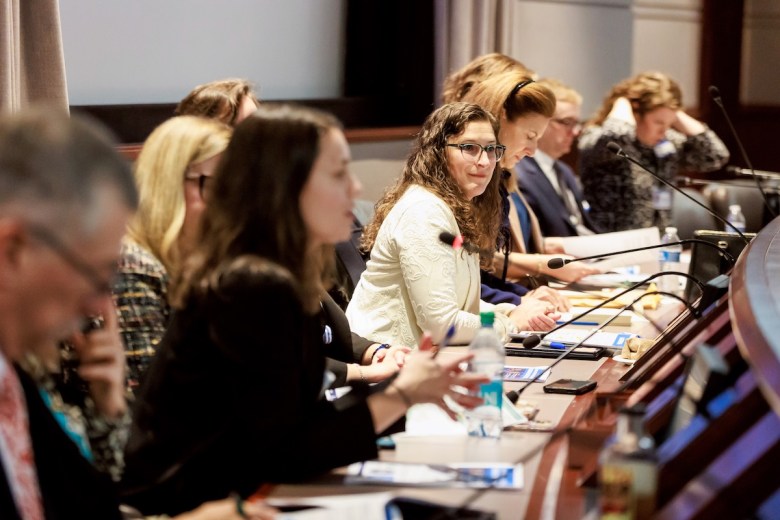
Connecticut has a reputation for thoughtful and practical governance, as well as rebuking the toxic partisanship of Washington, D.C. But even with our best intentions, lawmakers are often unable to access additional scientific data to guide decisions because the data is often not available, papers are locked away behind a paywall, they’ve not been able to connect with researchers, and so many other reasons.

That’s why, three years ago, we helped launch Moving Beyond Implications: Research into Policy, a conference designed to bring researchers and policymakers together in the same room.
The idea for the conference was born on a Sunday afternoon text exchange, the kind that seems small at the time, but can lead to a big change. We asked: What if lawmakers and scholars could meet regularly to talk about evidence — not just implications. What if scientists could shape legislation from the earliest stages all the way through the last-minute drafting tweaks, and even implementation conversations?
That first conference drew over 150 people and featured 15 research presentations across eight legislative committees. It sparked new connections and provided lawmakers with access to science that too often sits behind paywalls or is translated poorly by the time it reaches the Capitol.

Today, Moving Beyond Implications is bigger and stronger. This year’s conference drew more researchers, more policymakers, and expanded topics. From behavioral health to energy policy to education, they all shared one goal: ensuring Connecticut lawmakers can draw on the best available evidence when crafting policy. You can view the past programs for all Moving Beyond conferences here.
You may ask, why does this matter? Well, despite our best aspirations, legislators, by necessity, are generalists. We try to understand many issues deeply, but the sophistication of research methods and the pace of new findings can outpace the pace of drafting or conceptualizing law changes.
Researchers offer the ability to synthesize the state of their science and advise policymakers. When this piece is missing, lawmakers miss out on critical input to successful legislation. However, when science can be articulated to legislators, it can help ensure bills pull the exact right policy lever in the right moment and the right way. Together, we sharpen our work.
The payoff is already visible. For example, presentations at our earlier conferences helped inform conversations around low-cost indoor air purification strategies in schools and connected policy wonks in agencies, the legislature, and our universities.
But this is not a one-off endeavor. Our state needs more sustained, structured opportunities for exchange. Legislative sessions are short, agendas are packed, and emerging issues demand evidence-based responses. When researchers and lawmakers speak regularly, we identify new questions, refine old assumptions, and accelerate policy that improves lives. The conference may take place in one day, but the conversations can be ongoing and sustained.
Connecticut is becoming a model for this kind of collaborative policymaking. We lack the hubris to believe this is all because of our conference, but hopefully days like these increase relationships forged, the trust built, and the commitment to shared goals.
As we look toward future sessions, our message is simple: the promise of better policy is within reach if we continue to invest in forums that bring data and decision makers together. When we do, we deepen understanding, strengthen policy outcomes, and ensure that government reflects the best of what science and our communities have to offer.
We invite researchers across sectors and policymakers of every background to join us again in December for our 4th iteration. The work is hard, but the results — better health, a stronger economy, and a more equitable Connecticut — are worth it.
State Rep. Jaime Foster represents the 57th House District (East Windsor, Ellington, and Vernon). Kerri Raissian is a Senior Research Scientist at the Yale School of Public Health and Co-Leader of the Connecticut Chapter of the Scholars Strategy Network.