



There are moments when the world seems to tilt, when the ordinary rhythm of daily life collides with something far larger, far more wrenching, and the ground beneath us no longer feels familiar.
I have felt that shift before.
It was May 4, 1970 — a day etched into the soul of a generation. I was a freshman in college, moving between classes like any other student, when the word spread across campus: four students had been shot and killed by the Ohio National Guard at Kent State University.
Their names were Allison Krause, Jeffrey Miller, Sandra Lee Scheuer, and William Knox
Schroeder — young Americans, barely out of adolescence, whose lives were extinguished in a matter of seconds by the very authority sworn to protect them.
In those days, the nation was fractured over the Vietnam War, and college campuses across the country had become arenas of protest and passion. We knew the names of those four students as intimately as our own. On many campuses National Guard troops stood in quads and parking lots — steel‑toed boots on turf that should have been reserved for learning, laughter, and the promise of youth.
That afternoon, as the news filtered through dorm halls and dining rooms, something within us cracked. It wasn’t merely grief. It was the sudden realization that the country we believed in — the one whose Constitution we recited, whose flag we saluted — could turn its power inward and kill its own children.
It was a rupture in the psyche of a nation.
Now, more than half a century later, that rupture has widened again. Two lives were lost in Minneapolis — Renée Good and Alex Pretti — civilians whose deaths have raised profound questions about power, restraint, and the use of force in our own streets. Their names now enter that quiet lineage of Americans whose lives became symbols of a deeper national reckoning.
An even deeper question — the one that reverberates through history — is not simply what happened in Minneapolis. It is what it feels like to watch your own government take a life on your own soil, against your fellow Americans. That feeling is not new.
It is in the frozen ground of Wounded Knee. It is in the ashes of Ludlow. It is in the
tear‑stained bridges of Selma. It is in the dormitories of Kent State. It is the same wound, reopened in different generations. Each time power turns on its own
people, something fundamental shifts in the national psyche. The social contract — the
unspoken trust that authority exists to protect rather than punish — fractures.
At Kent State, those four names became rallying cries. They were not abstractions. They were students like us. They ate in cafeterias like ours. They walked to class like we did. Their deaths taught us, brutally, that citizenship alone was no shield against fear wielded as authority.
Memory, I have learned, is not passive. Memory is resistance.
When we say the names — Allison Krause, Jeffrey Miller, Sandra Lee Scheuer, William Knox Schroeder, Renée Good, Alex Pretti — we are not merely reciting history. We are refusing to allow their stories to dissolve into statistics. We are insisting that these lives meant something. That they demand reflection. That they deserve accountability.
The true danger to a democracy is not simply when power overreaches. It is when the people no longer feel disturbed by that power overreach.
The question that confronts us now is the same one that haunted us in 1970 is: who are we becoming? Are we becoming a nation that accepts the deaths of civilians as collateral to order? Are we becoming a people who grow accustomed to fear? Are we becoming a society that trades conscience for comfort?
Or are we still capable of moral discomfort — of that sacred unease that compels us to
question authority, to demand restraint, to insist that government power must remain
subordinate to human dignity? Because the health of a nation is not measured only by its laws or its institutions. It is measured by the conscience of its people. And once that conscience goes silent, no constitution can save us.
But beneath all of this — beneath the grief, the anger, the confusion — lies something even more fundamental.
The right to protest is not disorder. It is not rebellion. It is not subversion.
It is constitutionally protected patriotism.
The First Amendment does not whisper this principle. It declares it plainly: the people have the right to speak, to assemble, and to petition their government for redress of grievances. These are not privileges granted by the state when convenient. They are rights that pre-exist government itself — rights the Constitution was designed to protect from government power.
Kent State was not simply a tragedy of four lives lost. It was a crisis of constitutional
meaning. Students gathered to protest a war they believed was unjust. Whether one agreed with them or not is irrelevant. What mattered — what still matters — is that they were exercising a right explicitly guaranteed to them as Americans. And for doing so, they were met with bullets.
Minneapolis confronts us with that same uneasy question: when civilians die amid protest, when power responds with force rather than restraint, when the machinery of the state turns toward suppression instead of protection — are we still honoring the Constitution we claim to revere?
Because if the right to protest exists only when it is polite, convenient, or comfortable to those in power, then it is not a right at all. It is performance.
Must we be destined to live in a country where we must one day tell our grandchildren that the freedoms we inherited — the right to speak freely, to question authority, to gather in protest, to demand justice — have been surrendered in the name of order.
That is not the America I was raised to believe in. That is not the America generations fought to preserve.
And that is not an America we must watch dissolve quietly into something smaller,
colder, and more fearful. Because history teaches us this: tyranny does not begin with tanks in the streets. It begins when citizens grow afraid to speak. When dissent is treated as danger. When protest is treated as threat rather than as the lifeblood of democracy.
The right to protest is not the problem. The erosion of that right is.
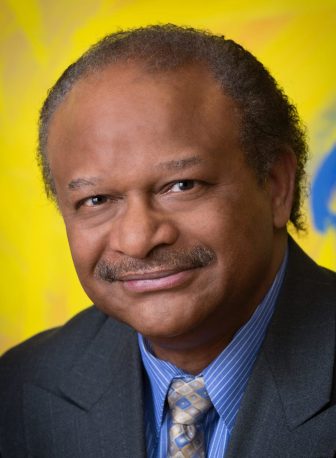
Carlton L. Highsmith is the retired Founder & CEO, Specialized Packaging Group, Inc. and currently the Board Chairman at ConnCAT and ConnCORP in New Haven.