


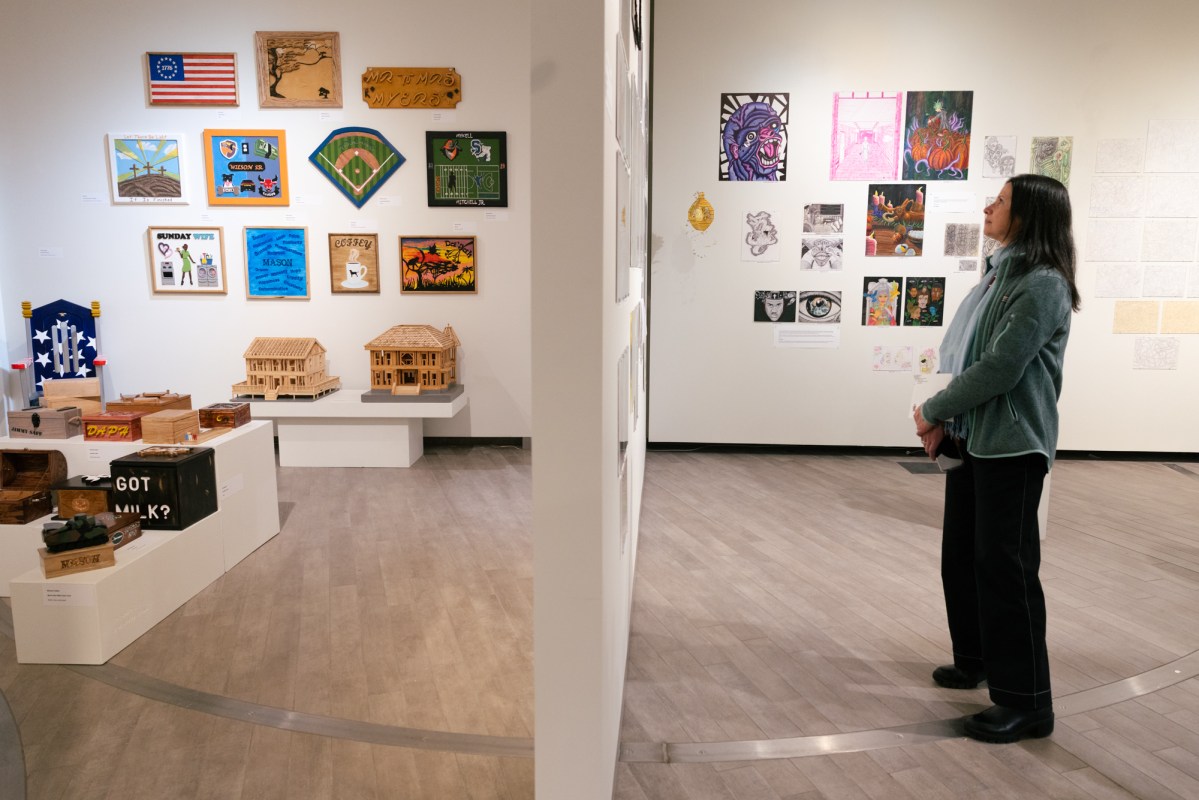



The sculptures are made from things you’d find around the house: bread, Q-Tips, thread, soap, dental floss, floor wax, coffee.
With a bit of ingenuity and a few additional supplies — like pencils, pastels and glue — those items are fashioned into sculptures of the devil, the grim reaper, a castle and Garfield the cat.
These are some of the works on display at the gallery at Eastern Connecticut State University as part of the annual exhibition of the Prison Arts Program. This year, 161 participating artists, all of whom are incarcerated in state prisons, submitted more than 600 pieces.
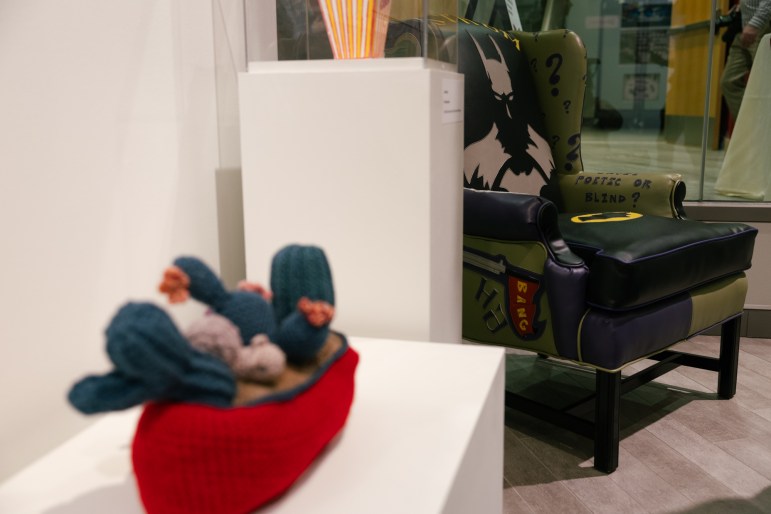
The artists draw cartoons. They crochet cacti. They decorate envelopes and letters to family members. They carve boxes and wall hangings, and they build chairs.
The Prison Arts Program, which is run by the organization Community Partners in Action, has been in existence since 1978. Jeffrey Greene, the program manager, has been working with the program since 1991.
The program operates “artist’s collectives” in five of the state prisons. Every two weeks, the artists gather together to work on their art. In prisons without a collective, the organization provides supplies and other resources, and in some cases meets with artists individually.
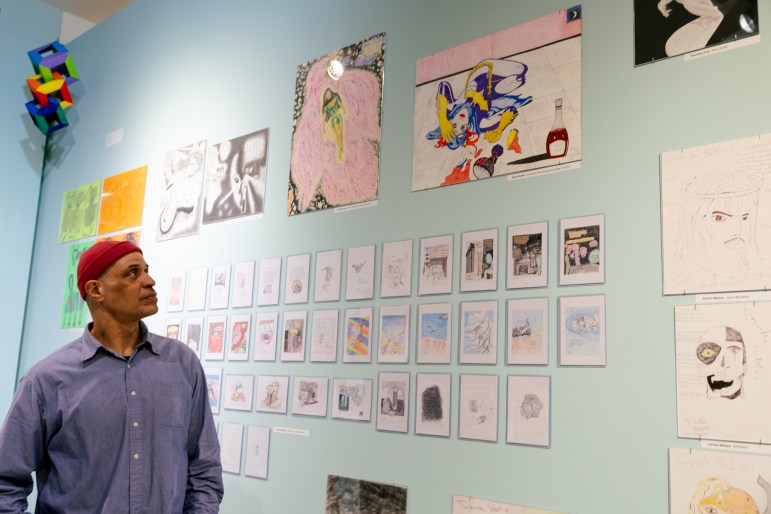
Many of the artists work in more traditional media, like colored pencils, ballpoint pens and pastels. Others, like the sculptors, use whatever they can find — potato chip bags, toilet paper rolls, even nail clippers. During their meetings, they can employ items that are otherwise contraband, like glue.

Bryan Moore, who was released from Department of Correction custody in January, said he started participating in the program in 2022. The combination of getting access to supplies he didn’t have before, plus being able to make art in a community, was “an absolute game-changer,” he said.
“Just to discover a collective of like-minded artists who were looking to create art for themselves, for their families, and [to] use as a means to escape the bleak prison surrounding,” Moore said.
Although he came from an artistic family, Moore said he only started tapping into that creativity once he entered prison. He began doing portraits of other incarcerated people, celebrities and animals, sketching portraits of someone’s grandchildren or the family dog.
“It’s a lonely place [in prison], but when all of a sudden you have a skill that’s useful to people within the prison community, that ability to socialize is increased tenfold,” Moore said.
Moore estimated that during the seven years he was incarcerated, he drew around 350 portraits. He said the art was a tangible way to show love to his family members outside. He also said art helped to rehabilitate incarcerated people.
“ Every hour … that I’ve spent drawing somebody is an hour that I’m not thinking about reoffending. Every hour that somebody’s creating one of these paintings, he’s not thinking about his addiction. It’s replacing anti-social behaviors that got us there with pro-social behaviors,” Moore said.
Greene said the organization worked with vocational programs that operate through the Department of Correction, and some of the men and women spend time making boxes or wall signs in carpentry class or doing art through the prison industries. One man, Edwin Leon, upholstered an armchair in leather, carving out the silhouette of Batman and the word “Gotham” on the chair back, and marking the seat cushion with the Batman logo.

“ In his downtime in that industries workshop, he made that chair. And it’s been there, and we finally convinced them to let us show it to the world,” said Greene.
After the show, most of the artwork will be sent to the artists’ families.
Several of the artists used carpentry classes to make jewelry boxes for family members. Two built dollhouses for their daughters. One of the dollhouses, which includes tiny furniture and miniature television screens showing scenes from Bluey and Spiderman, has a pink painted roof with the name “Aviana” carved on one side and “Peanut” on the other.
Greene said that he was once asked by the family of a victim of crime why he worked with the incarcerated man who had committed it. “ And I said, ‘The way that any one person lives in the prison affects everyone living in the prison,’” he said.
Positive action, he said, affects the other people living in the facility.
The other reason, he said, is that the artwork can give family members a reason to feel proud of their incarcerated relative, when previously, he said, they might have felt only shame.

Karim Ismaili, the president of Eastern Connecticut State University and a criminologist by training, said the point of the exhibition is to move beyond defining the men and women in Connecticut’s prisons by the single criminal act that led to their incarceration.
“This artwork that we see today was created under very difficult circumstances, often with limited materials, yet it speaks clearly to imagination, persistence and humanity,” said Ismaili.
For Greene, the program is also an opportunity to create a different “reality” than the one presented inside prison walls.
“We have created a totally horrendous reality in our correctional system. It’s horrendous. It doesn’t make any sense,” said Greene. “It’s very easy to change that environment, and that’s what prison arts is about.”
The exhibition will be on display until Feb. 28 in the art gallery at the Fine Arts Instructional Center at Eastern Connecticut State University.
