


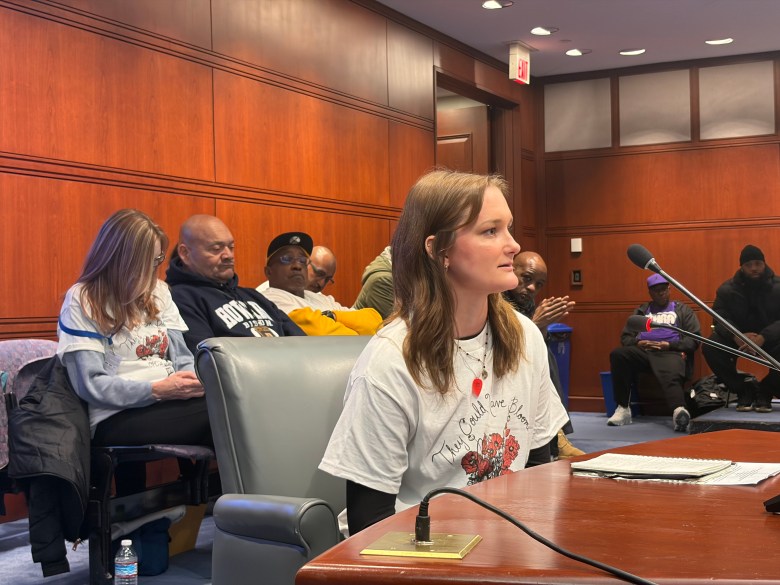
Dozens of advocates gathered at the state Capitol on Wednesday to testify in support of a bill that would make Connecticut one of few states in the country to establish an overdose prevention center.
The proposed legislation marks a continuation of an effort that nearly gained passage last year, but ultimately failed when it ran into opposition from Gov. Ned Lamont.
Supporters of overdose prevention centers — also known as supervised consumption or safe injection sites — say they are a crucial part of the fight to save lives, one that has for too long been avoided in the U.S. out of stigma and fear. The facilities allow people to bring illegal drugs and use them under the supervision of trained staff, equipped with supplies, like Narcan, that can prevent and reverse overdoses.
Gabrielle Bogut told legislators Wednesday about her brother, Patryk Bogut, who died alone at home of an overdose in 2023.
After his death, Bogut and her family found out that the drugs Patryk had used before his death contained a lethal dose of fentanyl. Bogut said an overdose prevention center could have helped Patryk get access to mental health treatment, the ability to test his drug supply and the option to use under the supervision of trained professionals, instead of alone.
“A substance use disorder ultimately took my brother’s life, but an overdose prevention center could have saved it,” Bogut told the legislature. Bogut is currently studying for a masters in public health at Yale University, where she is focusing on the socio-political determinants of substance use disorders.
Last year, a measure to establish an OPC won approval in the state Senate as part of a sprawling public health bill. But reports swirled around the Capitol that Lamont was threatening to veto the bill if it included the provision, and legislators ultimately decided to remove it before sending the bill to the House for a vote.
[RELATED: Lamont nixed overdose prevention centers, but advocates fight on]
After the 2025 legislative session ended, Lamont said he was open to establishing an OPC in Connecticut, but wanted to see results from some of the country’s first OPCs, which had opened in Rhode Island and New York City.
“We have harm reduction sites already,” Lamont said. “We do everything in terms of Narcan and prevention and counseling and clean needles and such. We do everything except for the drug injection. And I just figured it was worth a little more wait-and-see.”
On Wednesday, Cameron Breen, a street outreach case manager with Liberation Programs, a non-profit treating substance use disorder, addressed the governor’s “wait-and-see” approach directly.
“Last year we were told to wait and see,” Breen said during his testimony on Wednesday. “How long do we have to wait and see while our friends die, while our community members die?”
Evidence from around the world indicates that no one has ever died of a drug overdose at an OPC and that the facilities reduce public drug use and decrease demand on local emergency services without increasing crime. But accounts from advocates and community leaders in Rhode Island, New York City and Canada show that, even with evidence, it can take time to build approval among a public that isn’t familiar with the concept.
[RELATED: What’s an overdose prevention center like? We went to RI to find out.]
Republican legislators on the Public Health Committee listened intently as advocates shared their experiences, but they were honest about their concerns regarding whether OPCs encourage drug use and if establishing one might violate federal law.
Public Health Committee co-Chairs Sen. Saud Anwar, D-South Windsor, and Rep. Cristin McCarthy Vahey, D-Fairfield, have thrown their support behind OPCs. Last year, when the measure failed, McCarthy Vahey said the work needed to start immediately to bring people along and show them the research regarding how the facilities can save lives.
“We have to be thinking about, if we can’t get this passed now, how do we start that conversation today so that we can do this bill next year? So that the governor’s on board, so that some of my colleagues on the other side of the aisle are on board,” McCarthy Vahey said.
On Wednesday morning, Lamont said he hadn’t spoken much about the revived OPC legislation with the co-Chairs.
Anwar said he had been in touch with members of the governor’s staff about the bill, but not with Lamont directly. McCarthy Vahey said she is in “regular contact” with the governor’s team and looks forward to “talking more with him about this issue and many others.”
