


Alexi and Lorra Jorden love the personal care attendants who come to their home to assist Alexi with a range of daily activities.
Many mornings, one of Alexi’s PCAs helps him brush and floss his teeth and get dressed. Then they prepare a meal and help Alexi, who has multiple disabilities including profound autism, learn to use his “talker” communication device.
Two of the attendants are biomedical students at the University of Connecticut who study speech and language, making them deeply interested in Alexi’s progress with the tool. Even more important, according to Lorra, they are a good match for her son’s joyful, bubbly personality.
But the state program that allows the Jordens and other qualifying families to access this at-home care, called Community First Choice, is under threat.
Gov. Ned Lamont has proposed ending Community First Choice, which offers people a greater amount of autonomy in choosing and managing their care. Instead, Lamont has proposed transitioning people to home- and community-based “waiver” programs that are not as flexible and often have long waiting lists.
Community First Choice and waiver programs are both paid for through Medicaid, which covers long-term care for those who require it, and it’s a big part of the state’s Medicaid budget.
In fiscal year 2025, Connecticut spent more than $4.3 billion on long-term care, accounting for almost 40% of its entire Medicaid budget. Roughly 60% percent of that spending went toward home- and community-based care, while the rest went toward institutional care.
Unlike CFC, the number of people who can participate in waiver programs is capped, meaning people can often wait years before receiving the care they want, leaving them in the care of their loved ones or in an institutional setting.
But a key difference is that waivers have higher income limits than traditional Medicaid. CFC does not — traditional Medicaid requirements apply.
Enrollment in CFC has never been capped. Anyone who qualifies can sign up.

Families like the Jordens are confused, worried and angry about why the governor would eliminate a program they say is working well and saving the state money.
“For the governor to even propose cutting this program is just unbelievably cruel,” Lorra said. “The legislature should just throw it back in his lap and say, ‘No.'”
Community First Choice gives Alexi and other people enrolled in Medicaid the funds to hire PCAs of their choosing to assist with daily living tasks, like eating and bathing. The program also allows Alexi to employ Lorra as a PCA; she is reimbursed for a fraction of the hours she spends caring for him in a given week.
Around 7,000 individuals are served by Community First Choice, or CFC, in Connecticut, which allows people with significant needs to stay at home, rather than living in an institution with 24-hour care.
State officials agree that community-based care, which includes both waiver programs and CFC, is more cost effective than institutional care, in most cases.
But they say CFC enrollment and costs have exploded — to the point where they’re diverting resources away from other home- and community-based programs. Between 2018 and 2025, CFC enrollment more than doubled. The program’s costs increased from $88.8 million to $371 million a year.
“We then have these years-long waitlists on our waiver programs,” Chris Collibee, a spokesperson for the governor’s budget office, said. “Our goal is to reinvest some of those [CFC] savings into the waivers so that you’re not on the waitlist for years.”
Mary-Ann Langton, a West Hartford resident and disability rights advocate, has participated in CFC since its inception in 2015. She told the Connecticut Mirror she appreciates that the program allows her to manage her own time and stay in her home.
“I don’t belong in a nursing home. I belong in the community,” said Langton.
While testifying at the legislature last month, Department of Social Services Commissioner Andrea Barton Reeves called the level of enrollment “unsustainable.”
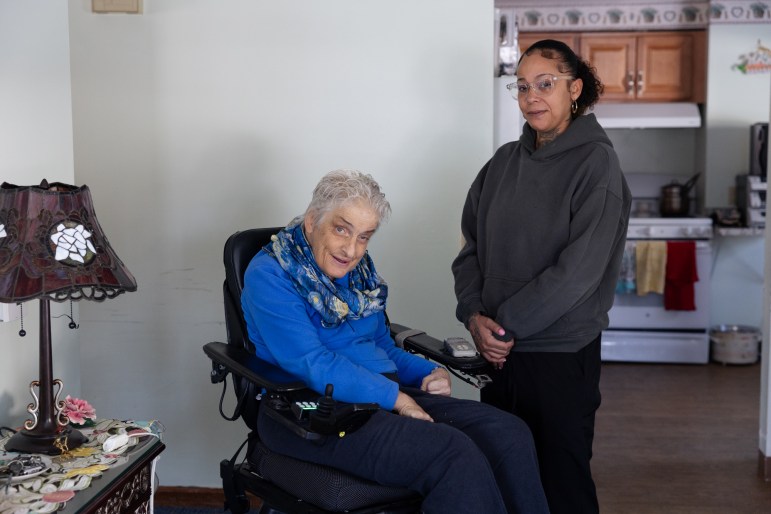
The Lamont administration has also argued that the program actually creates a burden for some enrollees, who are responsible for recruiting their own caretakers and may find that overwhelming. A spokesperson for Lamont said the program would be replaced with a system that funnels services through an agency while retaining some options in selecting a caregiver.
“Right now, participants often have no choice but to act as employers themselves, taking on responsibilities like recruiting, managing, and, at times, the emotionally difficult process of dismissing a caregiver — all while tracking their budgets and care plan hours,” spokesperson Rob Blanchard said. “Through the governor’s proposal, those who choose to hire their own PCA will have access to enhanced support and case management to better manage their care and service budgets.”
Anyone currently enrolled in CFC would have the option to keep their current services, Commissioner Barton Reeves told lawmakers at a hearing in February. But people looking to newly enroll in community-based care would likely have to qualify for a waiver, meaning they could end up on a waitlist.
Advocates say the Lamont administration is not accounting for a number of factors in the proposal, including the likelihood of long waitlists, an expected surge in need for group home or nursing home placements, and the possibility that such agency-based services could be offered without doing away with the Community First Choice program.
Waitlist times

Sheldon Toubman, an attorney with Disability Rights Connecticut, called the governor’s assertion “bogus.” He said that while some families might find the logistics of the program burdensome, that alone isn’t reason enough to overhaul it.
“If that’s what they were really trying to do, they would offer agency-based services as an alternative to self-directed care,” which could be offered alongside the Community First Choice program, rather than eliminating it, Toubman said.
If CFC is eliminated, residents newly requiring a nursing home level of care — who want to receive that care in their homes — would be placed on a lengthy waitlist, Toubman said, making the solution impractical. Many DSS waiver programs have long waiting lists, some as long as 10 years, he said, and in the meantime, the vast majority would be forced to enter into institutional settings.
“Even if we came up with the money for these people, what about the people already waiting on the waiting list for years?” Toubman asked members of the Appropriations Committee during a public hearing.
Fran Traceski, who is the parent of an adult with disabilities and serves on boards of various organizations for the disabled in Connecticut, told lawmakers that the program has been highly successful for 11 years and that the governor’s proposal has significant gaps.
Traceski called the proposal a step backwards into an era of institutionalization that advocates have fought to overcome. “Savings are claimed, promised support is an unfunded fallacy,” he said.
Tom Fiorentino, head of the subcommittee of the Department of Social Services that advises on the program, likened the move to a situation where “someone is desperately in need of oxygen and you come in and say, ‘We’re gonna replace that tube,’ pull out the tube and go, ‘and we’ve ordered a new one.'”
“That’s not how you run programs,” Fiorentino said.
Fiorentino is also a member of the board of directors of The ARC Connecticut, a group that advocates for and runs programs that benefit people with disabilities. He said his community had spent the past year terrified about potential cuts coming from the Trump administration. “We did not expect to be blindsided by our own state government with a cut,” he said.
“We hear as a rationale that this is an expensive program, costs too much. Well, it is a bargain on a per-person basis when compared to other state Medicaid programs that have somehow evaded the same kind of scrutiny in review,” Fiorentino said.
For Lorra Jorden, the logic of Community First Choice speaks for itself.
“It has been a wonderful, successful, program to keep people like my son at home, safe and sound,” she said.
This story has been updated to correct the spelling of Tom Fiorentino’s name.