



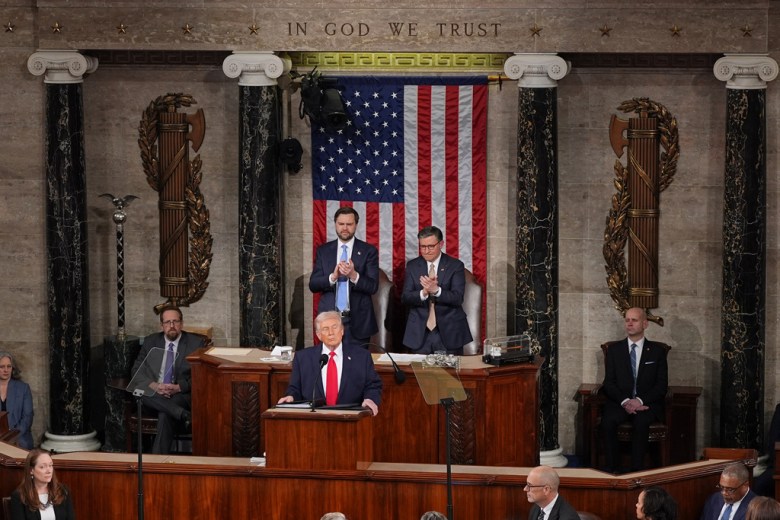
President Donald Trump delivered the first State of the Union address of his second term with a poised, confident, and notably measured tone — presenting what he described as America’s return to strength and the beginning of a new Golden Age.
He explored our past and outlined our future.
Unlike some of his earlier addresses and general campaign speeches, this address to the nation carried a more humble and somber tone. While he drew clear contrasts with the policies of the previous Joe Biden administration — particularly on energy, border security, inflation, and regulatory expansion — he did so without the sharp abrasiveness that has often characterized his approach. He wasn’t an angel in his delivery but he wasn’t a devil either.
The critique was firm but restrained and framed. In a ranking of his other speeches, it is probably as close to a call to corrective action rather than partisan attack as he is capable of. There were clear attacks on the fraud of Minneapolis and the modern day Somali fraud pirates and the fraud around the country larger than many state budgets. He noted that the budget could be balanced by stopping these frauds.
He also chastised the prior administration and support for open borders resulting in crime and the unnecessary deaths of Americans from illegal drug traffickers and from the hands of illegal alien criminals. He highlighted the death of Iryna Zarutska, a a 23-year-old Ukrainian refugee who had fled her country because of the Russian invasion, only to be stabbed from behind three times while seated on the train.
At the heart of the address was a celebration of American exceptionalism and determination. The President emphasized that the United States remains uniquely capable of overcoming adversity through grit, faith, innovation, and resilience. He celebrated American workers, small business owners, service members, law enforcement, and everyday citizens, presenting their perseverance as the true engine of the country’s renewal.
The speech highlighted efforts to restore economic strength and global stability, including initiatives to end long-term foreign conflicts through strength and negotiation. He underscored policies designed to rebuild domestic industry, protect American jobs, and maintain tariffs as a strategic tool to safeguard national manufacturing and as an alternative to our income tax structure with historical evidence of its economic success for this nation.
Among the legislative priorities discussed were measures to ban insider trading in Congress, aimed at restoring public trust in government, a crackdown on illegal immigration and drugs and new English-language proficiency requirements for Commercial Driver’s License (CDL) holders, framed as a public safety standard and a reaffirmation of national cohesion. He also reiterated continued enforcement of border laws and regulatory reforms intended to reduce burdens on American businesses.
Throughout the evening, the President honored American heroes — from military families to first responders — grounding the policy discussion in stories of sacrifice and service, including the unsung heroes of our greatest generation. He also celebrated our USA hockey Olympic medal and our country’s success at the Olympics while touting the return of the 2028 Olympics to Los Angeles.
The address concluded on a powerful and optimistic note, tying the nation’s resurgence to the upcoming 250th anniversary of American independence. He described this period as the beginning of a historic chapter — “a Golden Age of America” — driven not by government alone, but by the strength of its people.
He closed by declaring that America’s future will be defined by courage, unity, and confidence — that the nation is not in decline, but rising — and that the next great chapter belongs to the American people.
The State of the Union is on solid ground.
The fact that an alternative state of the union was created by sitting U.S. Congress members, including only those of the Democratic Party, is a sad state of affairs upon which reconciling political differences may be impossible.
The only hope is more will start following the lead of Sen. John Fetterman who broke from the pack of the Democrat party and has been a lone voice for the principles of the Democrats when the party changed under JFK as a voice of the American people.
Jonathan Goldstein and Dr. Michael Goldstein
Dr. Michael Goldstein is a physician (and lawyer) based in Connecticut who has been active in politics.
He has run for the Republican nomination for U.S. Congress in Connecticut’s 4th District, focusing on healthcare reform and related issues.