


Connecticut lawmakers were expected to give final passage Thursday to legislation establishing a working group to “address antisemitism in public schools.”
The working group’s task would be to propose amendments to school district policies, recommend antisemitism training and provide guidance on the creation of curricula relating to antisemitism, Jewish heritage and Holocaust and genocide awareness.
The provision was included in a 98-section “emergency-certified” bill that passed the majority-Democratic state Senate Wednesday and was expected to pass the majority-Democratic House Thursday. Emergency certification allows legislation to bypass public hearings and committee votes, sending them directly to the chambers for debate.
Under the legislation, the working group’s members would be appointed by legislative leaders and would include a teacher, a school administrator, a higher education leader, a curriculum developer and two members of the Jewish Federation Association of Connecticut, JFACT.
The Connecticut Mirror reached out to JFACT for comment and was directed to the Jewish Federation of Greater Hartford, but did not hear back from that organization by publication time.
Speaker of the House Matt Ritter, D-Hartford, said, “I have great confidence that between myself and my staff … we’ll find the right people to serve on those that I think have views that are mainstream.”
The state education commissioner, the Connecticut Association of Public School Superintendents, the Connecticut Association of Boards of Education and the Connecticut Education Association teachers’ union would each have a seat, as well. The state’s other major teachers union, AFT Connecticut, was not included.
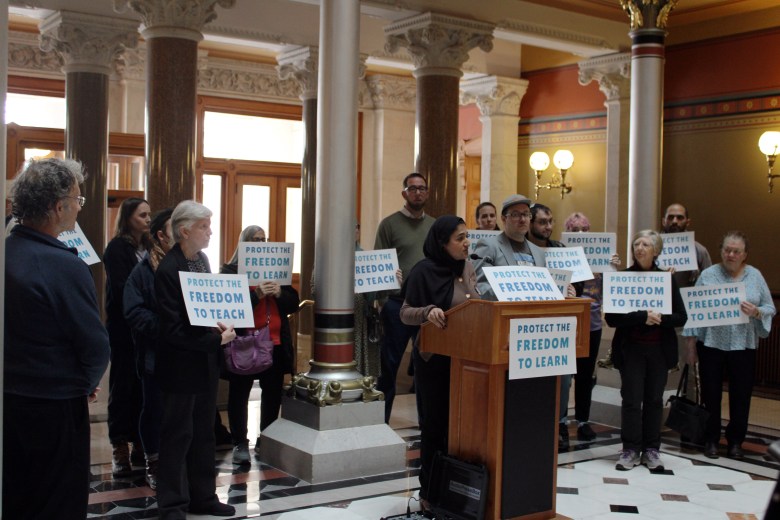
On Wednesday, the Freedom to Learn Coalition, which includes multiple Jewish organizations and condemns antisemitism, held a press conference to raise opposition to the inclusion of the working group provision in the emergency legislation.
“It isolates Jews from our Muslim and Palestinian neighbors, and it could serve more to divide us rather than to create understanding and safety,” said Megan Fountain, a spokesperson for the coalition and a member of Jewish Voice for Peace.
Fountain said the coalition was concerned the working group could become a vehicle for suppression and censorship in the classroom. Those concerns, she said, are connected to trends at the national level — in particular, what she described as the Trump administration’s use of antisemitism as a pretext to defund universities, as well as the high-profile cases of students detained for statements deemed critical of Israel.
The bill does not explicitly take a stand on any of that, but the fact that JFACT was the only Jewish group with guaranteed seats on the working group was troubling to Fountain. She said the group’s views do not represent those of all Jewish people in Connecticut.
One area this might conceivably come up: The Jewish Federations of North America have supported the International Holocaust Remembrance Alliance’s working definition of antisemitism, which critics say enables the weaponization of antisemitism to suppress speech, particularly speech that’s critical of the Israeli government.
The United States is a member of the IHRA and adopted the non-legally binding definition in 2016.
Fountain said if the working group pushes for widespread adoption of the IHRA’s definition, it could have a chilling effect in classrooms across Connecticut. She pointed to Massachusetts, where the ACLU is raising similar concerns after an antisemitism commission in that state adopted the IHRA definition.
“I think the federations stand for much more than perhaps that one position,” House Majority Leader Jason Rojas, D-East Hartford said Thursday, ahead of the House session. “And I think the general topic of antisemitism is something that can be informed by representatives from the federations, despite perhaps that one position that they hold.”
Hartford Federation of Teachers President Carol Gale expressed concerns that teachers could lose their jobs for offering a perspective that doesn’t align with the working group’s. She also said the fact that the working group is exclusively focused on antisemitism raised a “red flag” for her.
“Particularly in a day and age when intersectionality has become common language, so that … we recognize that one oppression overlaps with all other oppressions,” Gale said. “When we’re only focused on antisemitism, who then are we excluding?”
Matt O’Connor, a spokesperson for AFT Connecticut, said he felt his members’ concerns had gotten through to legislators.
“With teachers at the table, we expect that recommendations — and their eventual implementation — will have the stamp of actual classroom practitioners. That’s how to ensure the voices of thousands across the state committed to honest teaching and open discussion are heard,” O’Connor said.
Ritter noted that the group will report its findings to the General Assembly, and any implementation thereafter would follow the regular legislative process.
Fountain said said her group would rather see a joint working group on antisemitism, Islamophobia and anti-Palestinian racism instead. “There’s growing authoritarianism in the United States, which threatens all of us — Jews, Muslims and immigrants. And that’s why we need to tackle it together,” she said.
There is an effort in the legislature’s Education Committee this year to create a separate working group on Islamophobia in public schools. The concept was raised at a Feb. 18 meeting and passed by vocal vote without discussion. No bill has yet been introduced.
