



Yale has agreed to increase its annual voluntary payments to New Haven by $5 million for each of the next six years — bringing the university’s total annual contribution to the city to around $30 million.
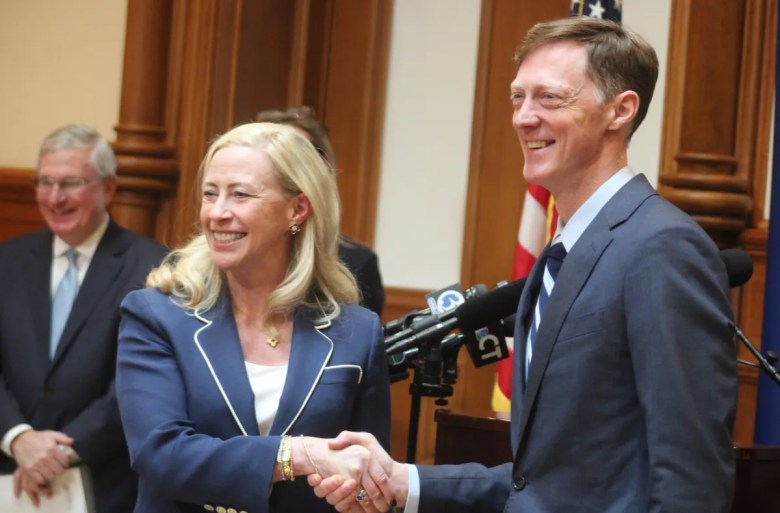
That voluntary-payment bump is at the center of a new town-gown deal announced by Mayor Justin Elicker and Yale President Maurie McInnis Friday afternoon during a celebratory press conference on the second floor of City Hall.
The announcement comes more than four years after Elicker and then-Yale President Peter Salovey agreed to a previous six-year accord in November 2021.
That soon-to-expire agreement saw Yale increase its annual voluntary payments to New Haven by around $10 million. This updated deal — which extends through 2033 — preserves that $10 million annual bump and adds an extra $5 million on top, plus a 2.5% annual “escalator” for the agreement’s first three years.
The 2021 agreement also saw Yale’s annual voluntary payment drop by $8 million in its final year, creating a funding cliff in Fiscal Year 2026-27 (FY27). As part of this new agreement, Yale has agreed to scrap that planned $8 million drop. Translation: No more funding cliff.
Yale has also committed to making a one-time $8 million payment to the city to resolve an accounting oddity that Elicker said dates back to 2005, when the city first started applying Yale’s voluntary payment — received each year in August or September — to the prior fiscal year, which ends June 30. While the city’s accountants have long deemed that back-payment kosher, Elicker said, this one-time $8 million payment from Yale ensures that, going forward, the city will apply Yale’s voluntary payment to the budget year in which that payment’s been received.
“We’re increasing our voluntary payments as the federal tax on our endowment is rising,” McInnis said.
Such is the nature of a commitment, she continued. “We don’t make commitments because we know what is going to happen. We make commitments because we don’t know what will come, but we do know we want to go through it together.”
McInnis described this deal as building off of three decades of increasingly closer partnership between the city and the university, including with Yale’s contribution of $10 million towards creating the new Yale Teaching Fellowship program.
As was the case with the 2021 deal, the lead city negotiator this time around was Henry Fernandez — a local nonprofit leader and former top city official and mayoral candidate — and the lead Yale negotiator was Jack Callahan, a recently retired university vice president.
Elicker, McInnis, and Yale Associate Vice President Alexandra Daum said that — on top of the $5 million annual increase to Yale’s voluntary payment — the university and the city have also agreed to consider “pedestrianizing” one block of Cedar Street between York Street and Congress Avenue. That block, right by Yale’s medical school, is currently a popular lunch spot that features more than a dozen different food trucks.
The last six-year deal included a similar pedestrian-plaza-plan for one block of High Street between Chapel and Elm, right near the heart of Yale’s downtown campus. Yale wound up not following through on converting that city-owned street to a space for pedestrians and cyclists only, citing concerns around federal funding uncertainty under the second Trump administration.
The previous six-year agreement also included a provision whereby Yale has to pay the city a portion of a property’s taxes for 13 years after acquiring that property and transitioning it to a tax-exempt use. Elicker and McInnis said that this new six-year deal preserves that tax-phase-out agreement. Without such an agreement, Elicker said, property taxes on newly acquired Yale properties that the university makes tax-exempt would immediately transition to $0.
Daum also said that the university has committed to creating a new three-year fund to support local nonprofits. Yale is still working through the details for that program, which will allow local nonprofits to apply for grants. The new six-year deal does not include any additional funding for the Center for Inclusive Growth, which was created under the 2021 deal. Daum said that that center has not yet spent the full $5 million that Yale seeded it with upon its creation.
Finally, Daum acknowledged that New Haven has a housing crisis in regards to affordability and supply. She said that Yale will be looking at existing vacant and underutilized university-owned properties and considering building new housing there.
“As far as we are aware,” Elicker said, this new roughly $30 million annual payment by Yale to New Haven marks the largest voluntary contribution by any university to any host city in the country.
The New Haven Register’s Brian Zahn asked what Yale’s new voluntary-payment bump means for the mayor’s recently proposed city budget, which includes a 4.01% tax hike for the fiscal year that starts July 1.
Elicker said that, if all $5 million in extra revenue from Yale were applied to reduce taxes, that would drop the proposed tax increase to around 2.5%. That said, Elicker’s proposed budget is now in the hands of the alders, who are slated to hold three months of hearings before amending and voting on a final fiscal document in late May or early June.
This story was first published March 6, 2026 by New Haven Independent.