


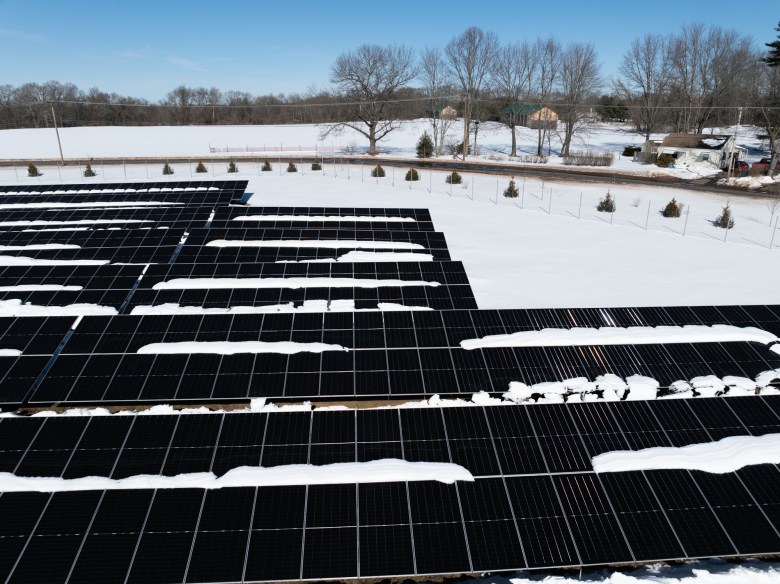
The Connecticut Siting Council voted Thursday to approve a proposed expansion of East Windsor’s Gravel Pit Solar facility that would add 150 acres to the project and increase its output by 30 megawatts.
Gravel Pit Solar, owned by New York-based DESRI Holdings, is by far the largest solar installation in Connecticut and among the largest in New England. But the developer’s efforts to expand the facility have drawn growing opposition from residents in the surrounding community.
In its draft opinion, the Siting Council wrote that the expansion would provide “additional renewable capacity to meet future demand; reduce dependence on imported energy resources; diversify the state energy supply mix; and provide additional generation capacity during times of high demand.” It also concluded that the facility did not raise significant environmental concerns.
DESRI Holdings, which also operates two smaller solar arrays in Simsbury and Sprague, celebrated the decision.
In an emailed statement, Executive Director Aaron Svedlow thanked the council for “recognizing the public need for this project as part of the state’s clean energy future.”
“From the beginning, our focus has been on building long-term value for East Windsor while delivering reliable, cost-effective renewable power for Connecticut and the region,” Svedlow went on. “This expansion reflects our ongoing commitment to providing lasting benefits for both the community and the state.”
But some local residents responded with dismay. They pointed out that East Windsor is already home to more than a quarter of all the existing grid-scale solar power produced in Connecticut.
[RELATED: In some CT towns, clouds form over new solar developments]
“East Windsor cannot absorb all of the solar in Connecticut,” said Christina Dahl, an East Windsor resident who lives close to the project and leads opposition group East Windsor Citizens for Responsible Solar Development.
The expansion would cover dozens of acres of farmland previously used to grow corn and tobacco.
The better option, Dahl said, would be to put solar panels on brownfields, rooftops or even in parking lots. She said she isn’t opposed to solar power — she just doesn’t want it taking over her town.
“We’re bearing the burden of this huge project where we don’t even get a benefit on our bill,” she said. “I don’t want our town turning into a utility.”
Opposition to the Gravel Pit Solar expansion has grown in recent months. A petition opposing the project gathered 2,223 signatures on change.org, where it also was endorsed by state Sen. Saud Anwar, a Democrat from neighboring South Windsor.
While local officials in East Windsor initially welcomed the project in 2020, many residents and neighbors soon began raising concerns about preserving local farmland and maintaining the value of their property.
Several small fires that have broken out on site have also stoked concerns — though no damage has been reported to neighboring properties.
Erin Stewart, a Republican candidate for governor and former mayor of New Britain, recently filmed a video in front of the Gravel Pit facility, expressing her opposition to the project.
“Families here have had to watch as their rural landscape, their open fields, their agricultural heritage, their scenic character, has been transformed into what amounts to an industrial energy zone,” she said.
Meanwhile, DESRI is also working on another solar project in East Windsor and Ellington called Saltbox Solar. The proposed 100-megawatt project is expected to power about 15,000 homes, according to their website.
In the days leading up to Thursday’s vote, Anwar and other East Windsor residents filed written testimony with the siting council. The council was created in 1971 to oversee the placement of power facilities and other critical infrastructure projects in the state, taking over a process that was previously controlled largely by the use of eminent domain by utility companies.
While the council said it would consider the public’s comments, it ultimately has the final say over all projects within its jurisdiction, preempting local control.
In his letter, Anwar wrote, “Since East Windsor first saw solar power generation at that location within its borders, residents have reported significant and consistent issues pertaining to the impact on local safety and quality of life. Any further approvals are poised to further those issues.”
Anwar suggested instead that new solar developments “seek locations in other municipalities when considering renewable energy projects.”