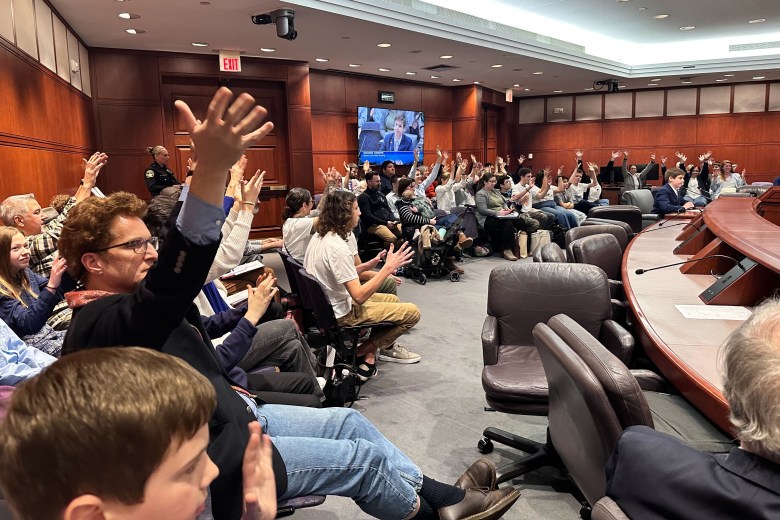
In a day of emotional testimony, parents of homeschooled children told lawmakers on the Education Committee that they oppose House Bill 5468, which would require families who seek to withdraw their children from the public school system to first receive the green light from the Department of Children and Families and then prove they are providing their child with “equivalent instruction” to children in public schools.
Though most voices in the room expressed opposition to the legislation, Child Advocate Christina Ghio spoke in favor, and Victor Torres, the father of Jacqueline “Mimi” Torres-García, whose mother allegedly pulled her out of public school for homeschooling just months before killing her, also appeared in support of the bill, though he did not speak before the committee.
During the hearing, Connecticut’s public education system and DCF were heavily criticized. Members of the homeschooling community recounted incidents of bullying and assault, as well as disillusionment and alienation with what they called cookie-cutter, insensitive models of education that ultimately result in low levels of school achievement.
While some parents were enthusiastic home-educators from early on, many said they were driven to homeschooling as a last resort after negative experiences in public school education.
According to written testimony from Education Commissioner Charlene M. Russell-Tucker, roughly 1,800 students left the public school system for homeschooling last fiscal year and around 3,700 students exited public school for private school.
At the hearing, homeschooled children, many stating they were performing work well above grade level and deeply engaged in extracurricular activities, also testified about the benefits of their bespoke education and urged legislators to vote against a bill they said would create unneeded bureaucratic hurdles for their parents.
“I just finished reading Oliver Twist. I’m starting to learn advanced algebra,” said Beatrix Tyson, a 10-year-old, who also said she is in a play, learning to sail, and has been learning French since age 3. To learn history, Tyson said she reads original sources and books by authors who care deeply about their subjects. “I’ve seen textbooks. I don’t want them.”
But advocates of the legislation said it is needed in a state that has no regulation of homeschooling at all, a situation which has allowed a smattering of families to use the system as a cover for chronic abuse and neglect.
That issue returned to the spotlight in 2025 when the remains of 11-year-old Torres-García were found in New Britain. Her mother is accused of covering up her death by telling school and DCF staff, which the family had previous involvement with, that she was being homeschooled.
Opponents said this, and the case of a Waterbury man who was allegedly locked away for decades, beginning in childhood, were outliers and should not serve as justification to change a system that benefits scores of families.
Under the bill, similar to Senate Bill 6, when a family decides to withdraw a child from public school, the Department and Children and Families would be notified by education officials and would then check as to whether the child’s parent or guardian has a history with the agency.
If they are the subject of an order for protective supervision or receiving protective services, that request to withdraw the child for a nonpublic school setting would be denied.
Opponents of H.B. 5468 also say that this casts undue suspicion on homeschooling families. They also oppose language that requires equivalent instruction, in some cases because children with medical needs, autism, and/or accelerated achievement say such benchmarks are the reason they withdrew their children in the first place. Parents of high achieving children also took issue with drawing comparisons to what they called a failing public education system.
“I’m not interested in reporting or filing on what goes on in our home, what curriculum we use,” Jannalyn Bailey, a homeschooling mother and artist, told lawmakers. She recalled a negative experience attending public school, and said that the new bill would created “unwarranted surveillance.” Bailey said that she had both attended public school and been homeschooled as a child, which led her to homeschool her own child. “I wish that all kids could be homeschooled.”
Bethany Miller said homeschooling was not her first plan. But as a parent of neurodivergent children, she said she reached the conclusion that her kids’ needs came first and they would be better served at home. “We have a mental health curriculum above everything in our household,” Miller said, adding that regulation on homeschooling would not have saved the abused children in the news from their fate. “I know everyone here cares about protecting children, but many of us choose homeschooling precisely because we are protecting our children.”
Nearly 300 people signed up to testify on the legislation. During the afternoon hours of the hearing, one father repeatedly spoke loudly at lawmakers and speakers, and was eventually asked to leave by Sen. Doug McCrory, co-chair of the committee.
Torres, who sat silently next to Mayor Bobby Sanchez of New Britain, attended the public hearing just hours after one of the people accused of killing his daughter, her mother’s then-boyfriend Jonatan Nanita, pleaded not guilty to numerous charges including murder. The child’s mother and aunt have also been charged in her death, which an autopsy showed was caused by starvation and child abuse.
Outside the hearing, Torres said he had come to honor his daughter and to protect other children from gaps that allow for abuse to go unseen.
“I feel there should be more regulation on homeschooling. There are absolutely no regulations at all, which is a problem,” Torres said. “This situation could have been prevented many ways. There was failures from all parts of the system, not the homeschool system. I’m not blaming the homeschool system. It’s what allowed her (Torres-García’s mother) to get away with it for so long, to use the system — it wasn’t the system — but she used the system to her advantage. I’m trying to do everything I can to prevent this from happening to other children.”
In Sanchez’s testimony, he echoed this sentiment, and concerns about how a vulnerable child can become invisible to the system intended to protect children like Torres-García.
“We know that there had been prior involvement with the Department of Children and Families. The fact that this tragedy still occurred should compel all of us to look closely at where gaps may exist and how we can close them.”
Kasey Nash, who said she had been homeschooled as a child and made to testify in opposition of regulation by her parents, said that abuse, neglect and a lack of education defined her childhood. She said a lack of regulation makes such treatment easy to hide. Growing up, Nash said that she lived in a state with no regulation on homeschooling and her education improved markedly when the family moved to California, a state with regulation.
“Without any regulation, my parents were free to abuse and neglect us without any witnesses,” Nash said. “Parents who are not abusing or neglecting should not oppose any measure that would discover those who are.”