


Connecticut lawmakers held public hearings on Friday on several major election-related bills that seek to prevent “harassment” and “intimidation” at polling places and would implement no-excuse absentee voting throughout the state for the first time.
Democratic lawmakers, who hold supermajorities in both chambers of the General Assembly, said the bill focused on voter intimidation was a response to President Donald Trump’s threats to nationalize state and local elections, as well as threats from his allies that Immigration and Customs Enforcement agents could be used to police polling sites in blue states.
That bill — SB 463 — would, among other things, ban federal agents from arresting or detaining people near a polling location and prevent those federal officials from standing outside election sites to check the voting eligibility.
The bill also makes it a crime for someone to possess a weapon within 250 feet of election sites in certain circumstances and requires local election officials to notify the Connecticut Attorney General’s office if they receive a subpoena for ballots and other records, as recently happened in Arizona and Georgia.
Rep. Matt Blumenthal, D-Stamford, who is a co-chair of the legislature’s Government Administration and Elections Committee, said setting up new laws to prevent voter intimidation was necessary ahead of this year’s midterm elections given the remarks made by the president and some of his former advisors, including Steve Bannon.
“It’s vital we pass this bill this year, for this election,” said Blumenthal.
Sen. Rob Sampson, R-Wolcott, said he has not heard of any examples of voter intimidation taking place in Connecticut, and he called the bill seeking to ban federal agents from arresting people near polling locations “propaganda and hyperbole” on the part of Democrats.
As for the concerns about ICE agents standing outside polling locations on election day, Sampson noted that it shouldn’t be an issue since noncitizens are not eligible to vote in federal or state elections in Connecticut.
The voter intimidation bill was also met with some opposition during the public hearing from gun rights advocates who raised concerns about gun owners who have a pistol permit from the state being arrested near polling sites.
Holly Sullivan, president of Connecticut Citizens Defense League, said she understood the concern for safety around polling places, but she was worried about permitted gun owners being arrested for unwittingly going too close to a polling location or ballot drop box.
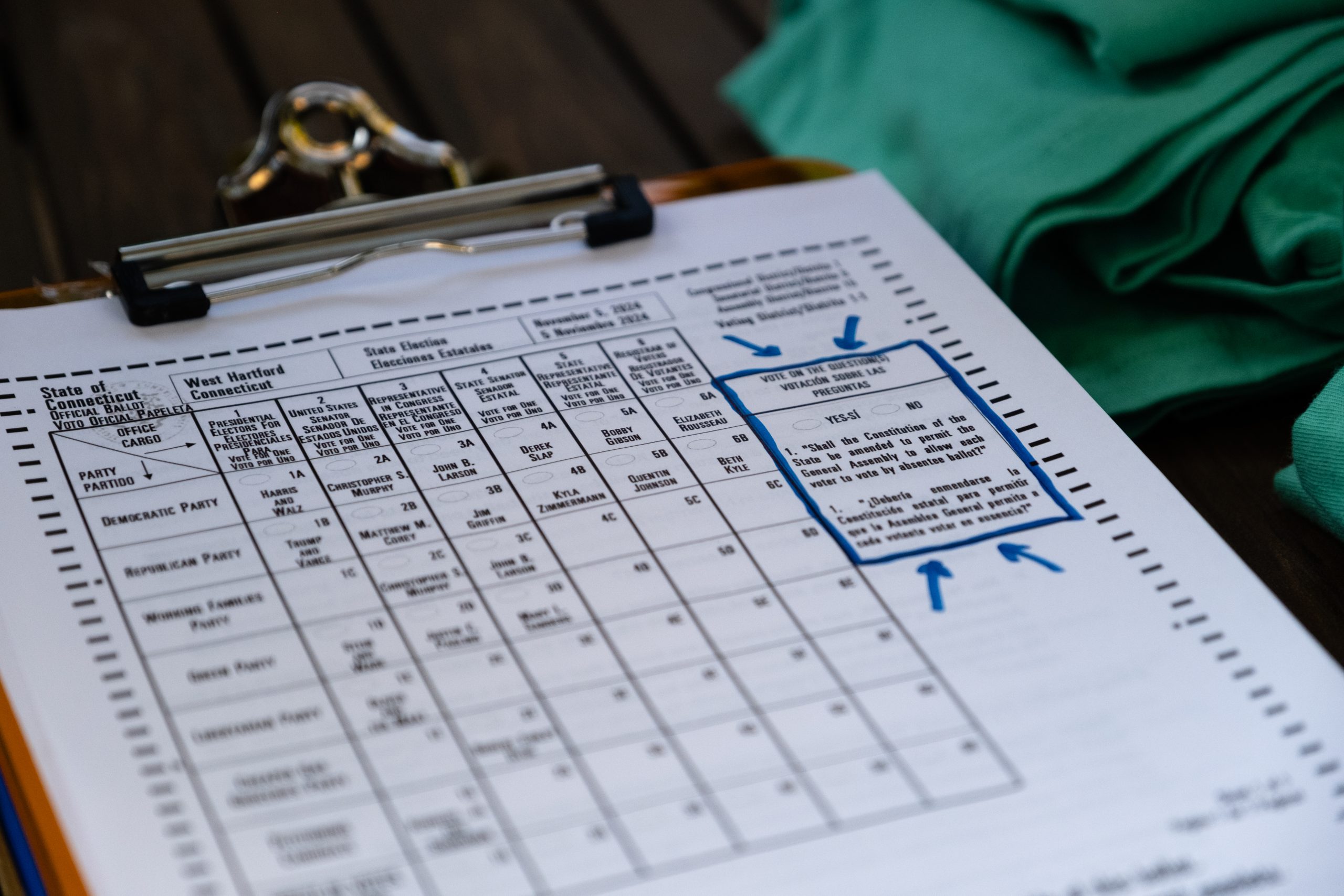
The other major piece of legislation that the GAE committee took up on Friday was a bill to officially authorize no-excuse absentee voting — an initiative that voting rights advocates have been pushing for years.
Connecticut voters widely approved a constitutional amendment in late 2024 authorizing state lawmakers to do away with the longstanding restrictions around absentee voting, which allowed someone to vote by mail only if they were sick, disabled, out of town or working at the polls on election day.
The Democratic leadership on the GAE committee is now seeking to implement those changes in a wide-ranging bill — HB 5001 — which deals with multiple aspects of election administration.
If that bill passes this year, Connecticut would join 28 other states that already have no-excuse absentee voting.
Advocates of mail-in voting, including officials from the ACLU, asked lawmakers to implement no-excuse absentee voting statewide this year.
“This session it is imperative for the General Assembly to implement no-excuse absentee voting and fulfill the clear mandate issued by voters in the 2024 election when over 60% of voters supported removing restrictions on absentee voting,” Jess Zaccagnino, the policy counsel for the ACLU, told lawmakers.
The potential expansion of absentee voting in Connecticut comes at a time when an election scandal is still playing out in Bridgeport, the state’s largest city.
Eleven people, including several sitting members of Bridgeport city council and the former vice chair of the city’s Democratic Party, are facing hundreds of state criminal charges for violating Connecticut’s absentee ballot laws during back-to-back mayoral elections in 2019 and 2023.
Many of those people are charged with illegally collecting people’s absentee ballots, which is not allowed in Connecticut, or filling out the absentee ballots for the voters.
The long list of criminal charges, which three of the defendants have already pleaded guilty to, has prompted Connecticut Republicans to call for tighter rules surrounding absentee voting and mandatory minimum sentences for people who are convicted of election-related crimes.
To this point, Democrats have rejected those types of Republican proposals.
But during the public hearing Friday, the GAE committee did take up a bill — SB 459 — that would ban anyone who is convicted of election crimes from circulating applications for absentee ballots for up to 12 years.
That bill, which was requested by Connecticut Secretary of the State Stephanie Thomas for the second year in a row, is meant to prevent political operatives from repeatedly committing absentee ballot fraud, as has been alleged in Bridgeport.
The criminal complaints filed in Bridgeport alleged that operatives have routinely signed up elderly and disabled voters for absentee ballots and then returned to those voters to harvest their ballots.
Sen. Mae Flexer, the other co-chair of the GAE committee, acknowledged the mountain of criminal charges filed against candidates and campaign operatives in Bridgeport over the past two years, and she said the committee was seriously considering the bill offered by the Secretary of the State.
At the same time, Flexer said she was hopeful that passing the bill to allow for no-excuse absentee voting would lessen the influence that campaign operatives have over the mail-in voting process.
By allowing everyone to vote absentee, Flexer said, voters should not be as reliant on campaigns and political operatives to obtain those mail-in ballots.
Callie Heilmann, a founder of Bridgeport Generation Now, told Flexer and the other lawmakers on GAE, however, that implementing no-excuse absentee voting is not enough.
Like past years, Heilmann asked lawmakers to ban candidates, campaigns and political operatives from circulating absentee ballot applications entirely. And she argued that allowing political operatives to pass out absentee ballot applications was the “gateway drug” for the absentee ballot fraud that has been seen in Bridgeport.
Heilmann pointed out that last year Alfredo Castillo, a sitting city councilman in Bridgeport, was arrested for the fourth time and accused of absentee ballot fraud in three separate election cycles.
“This committee has a moral obligation to design a system for mail-in voting that strictly between the voters and election officials,” Heilmann said. “Our votes are sacred. We are supposed to be able to cast them in secret, free from partisan intimidation or influence.”
