



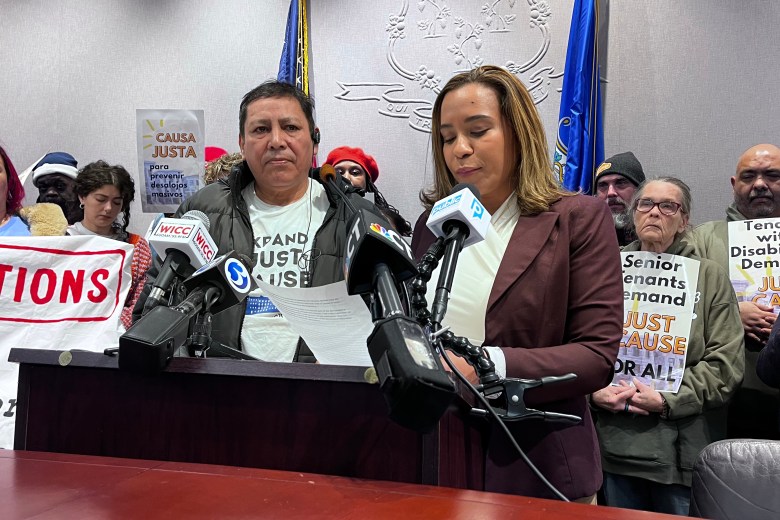
Amid Connecticut’s ongoing housing and homelessness crises, predatory landlords are using no-fault evictions as an excuse to replace lower-income renters with more affluent ones, retaliate against tenants for asserting their rights, and engage in housing discrimination.
In response, the Connecticut General Assembly must pass S.B. 257 and expand Just Cause eviction protections, which seniors (62 or older) and people with disabilities have had for over 40 years, to prevent tenants in apartment complexes of five or more units from being evicted without cause (e.g., nonpayment of rent or other lease violations).
Without expanded Just Cause, landlords will continue to profit from uprooting entire buildings’ worth of tenants in good standing, inflicting trauma on those being displaced and their community alike.
Mass evictions and constant resident turnover dismantle the social cohesion that develops from neighbors coming together in service for the common good. Living in fear of being arbitrarily forced from their home leaves people with limited capacity to join social groups, volunteer in the community, run for office, or even vote. People of color, women, families with children, and people with disabilities are disproportionately susceptible to eviction, and therefore to underrepresentation in the associations and activities that constitute the bedrock of civic life.
And for landlords who view housing as an investment instead of a human right, eroding this foundation of mutual trust and connection among neighbors is not simply a by-product of the system through which they profit off of revolving door tenancies.
Rather, intentionally keeping tenants divided, intimidated, and uninvolved in democratic processes is exactly how these investor-landlords maximize the power they wield over —and the wealth they extract from— whole communities, often ones to which they do not belong.
Through the neighborhood destabilization that no-fault evictions cause, profit-driven landlords undermine residents’ first line of defense against the commodification of their homes: the power to organize for collective action.
“A population that cannot afford to stay in one place cannot build civic associations, and a society without civic associations cannot resist concentrated power,” political writer Evelyn Quartz argues. Community fragmentation leaves the average citizen isolated and therefore powerless against an increasingly consolidated class of property owners, creating a direct threat to democracy.
To counter this threat, a broad and diverse coalition of tenants, community advocates, legal experts, homeowners, and small landlords supports expanding Just Cause to protect communities from the debilitating effects of no-fault evictions.
“We all benefit from this kind of neighborhood and community stability, which means tenants can build long-term ties to their neighborhood and town, know their children can continue to attend the same schools, and get involved in their community,” Connecticut Fair Housing Center attorney Sarah White attested.
A small landlord echoed this sentiment: “When people are uprooted without cause, the ripple effects extend to schools, employers, and social services.”
As Beth Sabilia, Director of the Center for Housing Opportunity Eastern Connecticut, wrote: “Stable housing allows residents to build relationships, support local businesses, participate in civic life, and contribute to the places they call home… Strong communities are built when neighbors can stay neighbors.”
Chief among the civic associations that help preserve strong communities and protect residents from no-fault evictions are tenant unions. Crucially, these unions’ power depends upon their members’ ability to remain in their homes.
Seeking to further entrench their already outsized influence, investor-landlords will regurgitate debunked claims that Just Cause reduces housing supply or quality. Professing concern that stronger tenant protections hurt neighborhoods, these same landlords will continue chipping away at our communities’ collective strength, one no-fault eviction (or, more often, many) at a time.
They will write off this hollowing out of neighborhoods as the “cost of doing business,” when it actually serves as yet another asset in their portfolio.
It is up to the rest of us to see through their deceptions and recognize that what they fear most —and what they take from us with every no-fault eviction— is our unity.
Jared Cavagnuolo is a social worker and member of Connecticut Tenants Union.