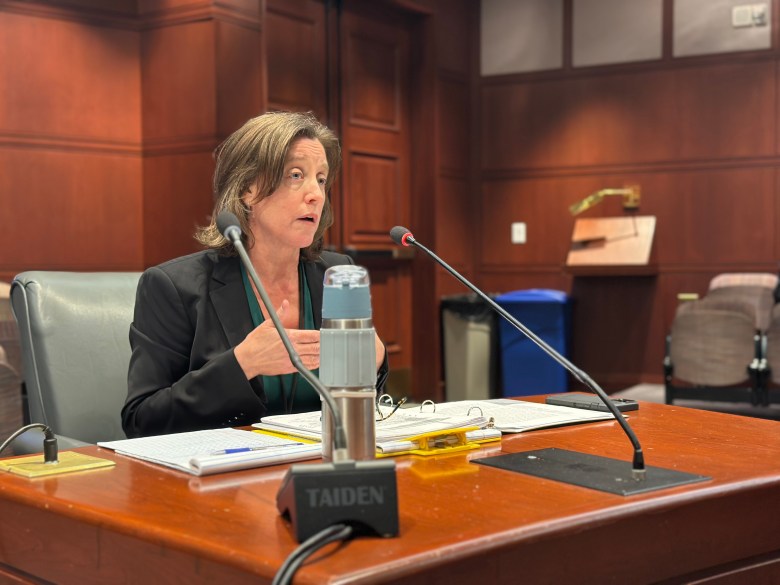
A legislative panel voted on Tuesday to advance the nominations of the interim leaders of two state offices focused on the well-being of Connecticut’s children.
Members of the Executive and Legislative Nominations Committee unanimously approved the appointment of Elena Trueworthy for commissioner of the Office of Early Childhood. She has served in that role since September, when her predecessor Beth Bye announced her retirement.
Lawmakers and child care advocates spoke highly of Trueworthy’s work in the role over the last few months.
Christina Ghio’s appointment to the role of child advocate, which she has held in an acting capacity since the fall of 2024, was also advanced, although a handful of lawmakers voted against her nomination.
Both of the nominations will now go to the House.
The votes come at a time when high profile abuse cases in the state have raised questions among lawmakers about the reforms that may be needed to ensure both the child welfare and homeschooling systems are serving Connecticut’s children well. They also come during a period of transformation for the state’s early childhood education system as an ambitious new plan to support low-income families clashes with economic realities.
Ghio has served as the acting child advocate since September 2024 when her predecessor, Sarah Eagan, resigned to take on the role of executive director of the Center for Children’s Advocacy. Eagan led the OCA through numerous investigations over the years, including high-profile child fatality investigations, into the use of restraint and seclusion, the treatment of foster children, and the quality of the state’s mental health care system for kids and services for children with disabilities.
About a year after Eagan’s departure, Gov. Ned Lamont announced that he was nominating Ghio to officially take over the role.
As an attorney, Ghio has an extensive background in advocating for children and people with disabilities. She worked for New Hampshire’s public defender’s office early in her career, before directing Disability Rights Center of New Hampshire and then becoming director of the Child Abuse Project at the Center for Children’s Advocacy. She joined the OCA in 2022, where she worked as Eagan’s deputy.
Ghio told lawmakers that under her leadership the office has released eight reports and also plans to release a report on the death of Jacqueline ‘Mimi’ Torres-Garcia, an 11-year-old who died of malnourishment and abuse at the hands of family members.
“I went to law school because I wanted to represent children and provide holistic legal representation,” Ghio told the committee in an opening statement. “I didn’t call it that at the time. I just had a belief that children needed attorneys that can represent them.”
Ghio said when the child advocate office was created 30 years ago it was with the hope that it would be secure in its independence and the authority to gather otherwise confidential documents in order to investigate how well the state was protecting its children. She also took a moment to go over the agency’s principals: transparency, independence and objectivity, which together attempt to close gaps in policy that endanger children.
Senate Majority Leader Bob Duff, D-Norwalk, the committee’s co-chair, told Ghio that he wanted to make sure that she has her own vision for the position and doesn’t feel beholden to “ghosts of child advocates in the past.
“No matter who it is, I’m not naming names, but you chart your own path,” Duff said.
“Absolutely, I wouldn’t take this position if I didn’t have my own sense for myself of what the children of Connecticut need,” Ghio responded.
Duff also asked Ghio what she thought should be the vision for the Department of Children and Families.
“Right now, they’re a consolidated children’s agency, and I think their vision is very much focused,” Ghio said, adding that DCF staff spend many meetings working on ways to ensure that fewer children enter care. “I think that’s a good vision, but I also think that we can’t just count beans. We have to be asking every day whether or not the children are better off.”
To that end, DCF should be tracking the results of their interactions with families, with a broader mandate to ensure children are ultimate better off, including when it comes to mental health outcomes, Ghio said.
Ghio was also asked about concerns of the role of homeschooling in obscuring possible cases of child abuse and neglect, an issue that has been on lawmakers’ minds as they consider bills that would create new requirements for checking if families are educating their children and screening homeschooling families for involvement with DCF.
In the Torres-García case, the girl’s mother told the district that she was being homeschooled to cover up her abuse. And in a case in Waterbury, a man who was allegedly pulled out of the public school system to be homeschooled was found to have been locked away for decades.
While Ghio emphasized that many families are doing an excellent job of homeschooling their children, she told the committee that the total lack of regulation of homeschooling is a problem.
“We have a system where we have no accountability at all and there is no verification that children are actually receiving an education,” Ghio said. “There were other cases where children have been removed for the purpose of hiding abuse and once they are removed, for the most part, they are not coming to the attention of DCF until something terrible happens.”
Drew Michael McWeeney, an assistant professor of early childhood education at CT State’s Norwalk campus, testified against Ghio’s appointment, arguing that she does not represent a fresh start in taking DCF to account.
“When the oversight body itself becomes passive or overly cooperative with the agency it is supposed to scrutinize, the result is institutional self protection rather than reform,” he said.
Like Ghio, Trueworthy had also previously worked under her predecessor.
She served as Bye’s deputy, and has worked for the OEC since 2019. Trueworthy worked in Head Start before working for the Hartford Foundation for Public Giving where she managed a portfolio of grants that included child health, parent education and leadership, community engagement, family child care, bilingual career pathways, and program capacity building. She was also director of their Hartford Area Child Care Collaborative.
Lawmakers and advocates praised the work Trueworthy had done to this point.
“I hear inside (the agency), people like you, think you’re doing a good job,” Senate Majority Leader Bob Duff, D-Norwalk, told Trueworthy.
Speaking in favor of the appointment, Merrill Gay, of the CT Early Childhood Alliance, called Trueworthy uniquely qualified to lead the effort to implement the new early childhood endowment, a considerably complex project in which she has been involved in the long term.
Eva Bermúdez Zimmerman, executive director of Child Care 4 CT, enthusiastically endorsed Trueworthy as well: “She has been an ally, she has been a friend, she is a trusted messenger. I feel like the title is now a formality that’s easy to give her because she’s really earned it.”
Senate President Pro Tem Martin Looney asked Trueworthy to describe the benchmarks she would like to see in two or three years as the investment in a historic endowment for early childhood education is expected to grow.
“The endowment really gives us the opportunity to correct and transform what our system looks like,” Trueworthy said, citing the workforce as the number one concern for investment. To that end, she said the money will be used in part to improve payment rates for providers.
Looney responded by describing a trajectory of so-called ‘disconnected youth.’
“We know that so many children who are not well prepared for kindergarten struggle from the very beginning,” Looney said that they start out struggling to attain literacy. “By grade three, it makes it harder for them to catch up. After that, they become aware of their own academic deficiencies, they start to become discipline problems in school. They start to become truant when they’re a little older, then they may wind up in trouble with the juvenile court.”
Asked by Sen. Eric Berthel, R-Watertown, what else lawmakers should be considering before the end of the session, Trueworthy indicated concerns about the health of an endowment that was conceived at a time when the state was flush with funds. She told lawmakers that such a model, which relies on the state having a robust surplus for annual investment in the endowment, may be in danger as federal cuts require Connecticut to spend more on safety net programs.
“The future of the endowment and the growth depends upon the surplus,” said Trueworthy. “I don’t think anybody knew the situation we were going to be in today.”