


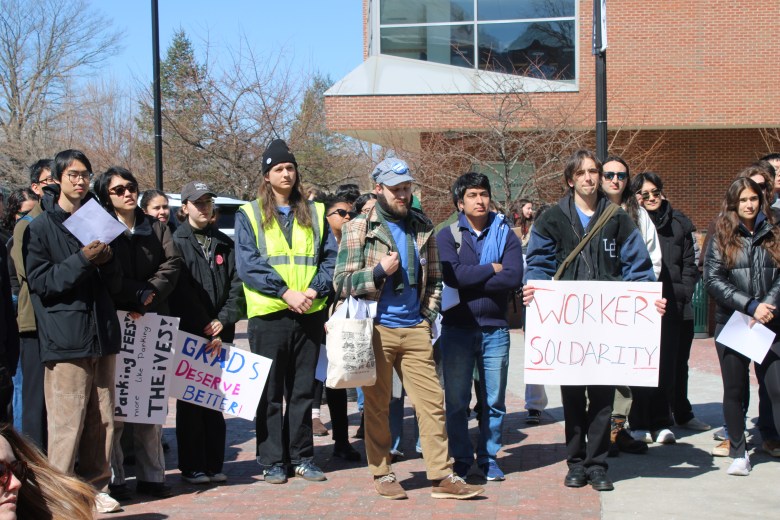
Graduate students at the University of Connecticut are calling on university administrators to freeze mandatory fees, increase wages and provide more support for international students.
Amid bargaining talks, members of the local Graduate Employees Union gathered outside the student union in Storrs Tuesday and marched across campus to the office of President Radenka Maric, where they dropped off a petition including signatures from nearly 400 individuals and 43 labor groups and other organizations.
The petition made reference to a series of concessions the graduate assistants are asking for in their latest contract. Their first request is that university fees be frozen at 2026-27 levels, and that certain fees be waived.
“In general, we’re simply asking that [graduate assistants] shouldn’t have to worry about paying rent or suffer from suddenly increasing fees that take back 6.56% of our paycheck,” Grace Easterly, the union president, said in a written statement to the Connecticut Mirror.
Stephanie Reitz, spokesperson for UConn, said the university would not comment on negotiations while collective bargaining was ongoing.
According to the union, the administration’s most recent proposal has graduate assistants paying at least $1,946 in fees, an increase of $70 over the current year. Graduate assistants at the Storrs campus pay an annual $570 “general university fee,” and additional fees for student health and wellness, technology, transit and grad activities.
The union said fees have increased at three times the rate stipends have increased over the last four years. The union estimates fees account for between 5.6% and 6.5% of graduate assistants’ stipends. Stipends range from $28,500 to $33,500 per academic year.
Anika Agrawal, a member of the union’s bargaining team and a PhD student studying natural resources and the environment, said that the rise in fees would negate any increase in stipends the students had received over the last few years.
“ A raise that disappears into new fees is not a raise,” Agrawal told union members on Tuesday.
The union is also looking for more protections for international graduate assistants, including a fund for legal support and 60 days of guaranteed job security in the event of an emergency. Its members are also asking that the university notify the union if it receives requests about immigration and that the university not share any immigration information about a graduate assistant unless compelled to by law.
“The people who work at a taxpayer-funded public institution to provide Connecticut’s students with an education should not have to worry about safety in the workplace, regardless of immigration status. Workers at UConn should not have to worry about access to healthcare, housing, or food. They should be able to affordably and safely access their workplaces, without undue costs for transportation or parking. We believe these are rights that extend to all workers, anywhere in the world,” the petition stated.
Alyssa Catlin, a PhD student in archaeology, said health care was a big concern for her. According to the union, the university proposed an increase in health insurance premiums of 67% over four years, raising the annual cost for a graduate assistant from $280 to $468, and for a graduate assistant with a family from $1,822 to just over $3,000.
“ If our payments go up, we won’t be able to afford to go to the doctor,” she said. “We really need vision insurance. Most of us have glasses.”
The cost of parking was also a top concern. Graduate students currently pay only half the cost of an “Area 2” permit, which allows parking in certain areas. But Easterly said there often aren’t enough Area 2 spaces, and they get little notice when a lot is closed.
According to the union, graduate students also pay more than other employees to park in parking garages. Employees pay about $647 annually, while graduate students pay $927 annually. The union said UConn proposed a larger discount for garage permits for graduate assistants, which would leave them paying $180 more than other employees but $270 less than other students.
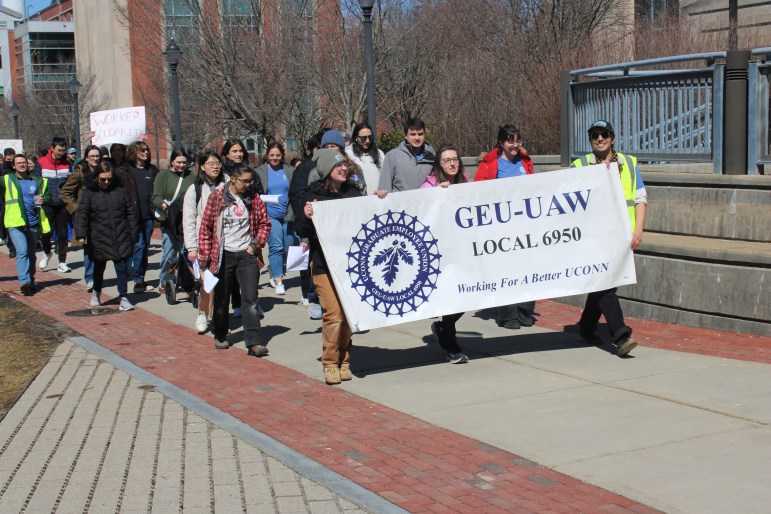
Jimmy Palmer, a PhD student in applied economics, told CT Mirror that it was the prospect of being part of a union that helped him convince his wife to move from the New York-New Jersey area to Connecticut. He said his involvement with the union became even more pressing after his daughter was born in late 2024.
“I tend to think of it as our affordability is everyone’s stability. If we can work here and afford to live here, students could learn better. We can facilitate learning better. We have a more stable Connecticut overall,” he said.
Some graduate students said their concerns were less about a particular issue and more about being recognized and respected for their work.
“We do a lot for this campus, and we care a lot for it,” said Joshua Newbend, who is in a Masters of Fine Arts program for art history.
Rep. Gregg Haddad, D-Mansfield, attended the march on Tuesday, where he called on the UConn board of trustees and Gov. Ned Lamont to listen to the graduate students’ “reasonable demands.”
Addressing the students, he said, “I’m here to tell you, you have supporters in the legislature. We will stand by you and we will demand that you have a fair contract as soon as possible.”
Haddad co-chairs the Higher Education Subcommittee of the legislature’s Appropriations Committee. He said the subcommittee has recommended a 4.5% increase for all higher education contracts and wants the state to cover the full amount — significantly more than what Lamont suggested in his proposed budget earlier this year.
That recommendation still needs to get past the Appropriations Committee and the governor before it can become law.
As to whether that will happen, Haddad acknowledged that the Appropriations Committee is “dealing with some very tight budget constraints” but said, “I think there’s broad consensus that we should increase the support [from the state] … by the same percentage as whatever is negotiated.”
Haddad said more state support might help higher education institutions keep from raising the fees already burdening graduate students. And he noted that international student enrollment has dropped precipitously under the Trump administration, with consequences for higher ed budgets.

