



This story was originally published by Chalkbeat. Sign up for Chalkbeat’s free weekly newsletter to keep up with how education is changing across the U.S.
The Trump administration loves red meat, and could soon change what students eat in schools. But an unlikely collection of groups that includes key constituents for the president agree on one message: Don’t put kids on the carnivore diet.
U.S. Health and Human Services Secretary Robert F. Kennedy Jr. is a big, vocal believer in the power of beef, lamb, pork, and similar foods. And red meat has a starring role in a new food pyramid unveiled by the federal government in January that says Americans should prioritize foods rich in protein.
The U.S. Department of Agriculture is expected to eventually align school meal nutrition standards to that new food pyramid. The agency’s proposal isn’t out yet. But those who believe fiber and not protein is a bigger priority — for Americans in general and kids in particular — are already expressing anxiety about it.
In March, a group of over 900 school districts and school nutrition professionals signed a letter to Secretary of Agriculture Brooke Rollins urging her department to maintain existing meat requirements. They warned that increasing that requirement might crowd out fiber-rich foods, which the group wrote is “under-consumed” by students.
That argument from the nutrition professionals has backing from groups supportive of the Make America Healthy Again — or MAHA — movement. These groups generally believe that better nutrition will help fight chronic illness and have backed aspects of the president’s agenda. A coalition of these organizations, including Moms Across America, also urged the USDA to maintain the previous meat requirement, with fiber the “more urgent public health priority.”
The National School Lunch Program is a consistent source of nutrition for children from low-income families. And the federally subsidized program operates on a large scale: It serves about 4.8 billion meals annually, according to a School Nutrition Association analysis of recent federal data. But it’s also run by the Agriculture Department, an agency whose primary stakeholders are food producers. That means over the decades, school lunch nutrition standards have been in constant flux and reflected contemporary health trends.
Standards have been tweaked, overhauled and recalibrated over many administrations, from the infamous “pizza as a vegetable” controversy that pitted Congress against the Obama administration’s quest for healthier lunches to a more recent decree from the Biden administration for schools to gradually scale back added sugar. A week after his administration unveiled the new food pyramid, President Donald Trump signed a law reversing an Obama-era rule that outlawed whole milk in school lunches.
The current scramble for supremacy between fiber and protein is on display on grocery shelves, which feature fiber-rich probiotic sodas and Pop Tarts touting added protein. Nutrition experts say most kids are getting adequate levels of protein. Fiber is “the nutrient that tends to get neglected,” said Annette Schille, a clinical nutrition specialist at Boston Children’s Hospital.
“Kids having access to school meals, it can be really one of the most powerful tools that we have to improve children’s nutrition,” Schille said.
Fiber in the spotlight in school lunch debate
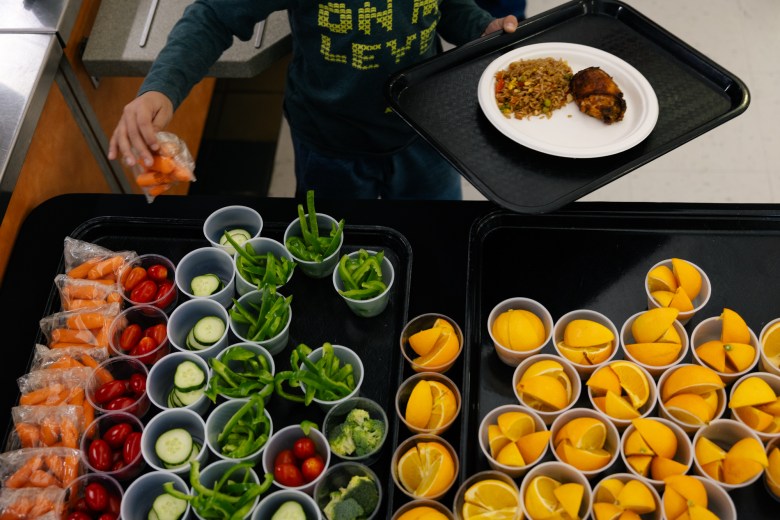
Current federal school meal standards regulate added sugar, fat, sodium and calories, but don’t set a specific fiber requirement. They do require lunches to include certain amounts of fruits and vegetables, including fiber-rich beans, peas and lentils. But generally, it can be difficult to get kids to go for those options, and upping a meat requirement could risk “crowding out” the fiber that does make it onto the plate, the group of school nutrition professionals argued.
Those who oversee school nutrition on a daily basis are under a lot of pressure, those experts say, to balance the requirements of making nutritionally balanced meals with the reality that students usually have a short window of time to eat lunch. And cafeterias are on a tight budget of roughly $4.60 a meal.
Liz Campbell, vice president of government affairs and media relations for the School Nutrition Association, said that economic realities look different from cafeteria to cafeteria. Some schools in North Dakota are running programs without adequate resources like functioning kitchens, while the Austin Independent School District in Texas — Kennedy Jr. recently visited to scope out school meals — has a dietitian on staff.
“We have to think about standards that are operationally feasible for everyone and so that folks can be financially solvent,” she said.
But food quality should be prioritized even under economic pressure, said Carrie Balkcom, executive director of the American Grassfed Association, a farm and ranching advocacy organization and one of the organizations that signed the letter from the MAHA-aligned coalition.
The letter argues that while meat requirements don’t need to go up, existing protein sources used in schools are often highly processed.
There’s not enough incentive for local, grassfed meat products to make it to a student’s lunch tray, Balkcom said. The administration last year cut several grant programs supporting local farm-to-school efforts. But Balkcom would like to see more collaboration.
“There are producers out there who are ready, willing and able to work with the school lunch program,” she said.
Michelle Saletan was a pastry chef in Charleston, South Carolina, before she moved over to managing school cafeterias. Meeting USDA requirements felt like a real challenge after working in the private sector for so long.
School kitchens have to be creative to include adequate nutrient levels in lunches that will appeal to children. For example, lunch periods tend to be short, so while oranges could be a source of fiber, students probably aren’t going to spend lunch peeling one.
Saletan now works as institutional support manager with Balanced.org, a nonprofit based in Kansas City that works with schools to help improve nutrition content — and especially fiber content — in their meals.
It’s disappointing to her that existing federal school lunch standards don’t include a fiber requirement. And the process for the USDA to finalize new standards, which includes taking public comment on proposed new federal rules, will likely take several months.
But schools don’t have to wait for them to incorporate more fiber, Saletan said. They also don’t have to wait for a budget increase, she said: It’s a misconception that plant proteins like black-bean burgers or plant-based nuggets are more expensive.
“It’s about how to serve them,” she said. “Take your existing spaghetti sauce and just put lentils in. Even if you’re doing 50% beef and 50% lentils, you’re increasing the fiber naturally, increasing the protein, and you’re cutting your cost.”
Lily Altavena is a national reporter at Chalkbeat. Contact Lily at laltavena@chalkbeat.org.
Chalkbeat is a nonprofit news site covering educational change in public schools.